
Benford’s law
In 1881 the American astronomer Simon Newcomb noticed something odd about tables of logarithms. The first pages, which hold the numbers starting with 1, were much more thumbed than the later ones. But why would people look up numbers starting with 1 more often than numbers starting with 8 or 9? Newcomb wrote a short paper about it. Nobody noticed.
Fifty-seven years went by. In 1938 the physicist Frank Benford of General Electric independently noticed the same thing. And he did not let it drop. He collected more than 20,000 numbers from 20 different fields: the areas of river basins, physical constants, death rates, numbers from newspaper articles, baseball statistics… Numbers that have nothing at all in common.
Nine different digits can stand at the start of a number, from 1 to 9 (a number does not usually begin with 0). So we would expect each of them to come first equally often, in about 11% of cases. But they did not. When Benford added it all up, 1 came first in about 30% of the numbers. The higher the digit, the less often it came first, and only just under 5% of the numbers started with 9. Today this phenomenon is called Benford’s law, sometimes also the Newcomb–Benford law.
Why 1 in particular
Imagine a village of 100 inhabitants whose population grows by 10% every year. After each whole year the village will have, rounded, 100, 110, 121, 133, 146, 161, 177, 195, 214… inhabitants. To get from 100 to 200, the population has to grow by 100%, and that takes 8 years. After seven years the village has 195 inhabitants, and in the eighth year it passes 200.
To get from 200 to 300 a rise of 50% is enough, and from 800 to 900 only 12.5%. The higher the first digit, the faster the village skips past it. On the whole journey from 100 to 1,000 inhabitants, which takes 25 years, the population starts with 1 for 8 years, with 2 for 4 years, with 3 for 3 years, and with each of the other digits for only a year or two. It starts with 9 for just one year, when the village has 985 inhabitants, and the very next year it has over a thousand. Eight years out of 25 is 32%, close to that 30%. Numbers that grow by the same percentage spend the most time with 1 at the start.
What is interesting is that the units do not matter. If you convert the lengths of rivers from kilometres to miles, all the numbers change. But if the lengths of rivers obey Benford’s law, they obey it in miles too. The share of numbers starting with 1 will stay roughly the same.
How often each digit comes first
According to Benford’s law, the probability that a number starts with the digit d is
where log10 is the logarithm to base 10. Let’s try it first for 1, that is, substitute d = 1:
We add up the terms in the brackets:
So 1 starts about 30.1% of numbers. The other digits turn out like this:
| digit d | P(d) |
|---|---|
| 1 | 30.1% |
| 2 | 17.6% |
| 3 | 12.5% |
| 4 | 9.7% |
| 5 | 7.9% |
| 6 | 6.7% |
| 7 | 5.8% |
| 8 | 5.1% |
| 9 | 4.6% |
Altogether that makes exactly 100%, as it should. The dashed line in the graph marks
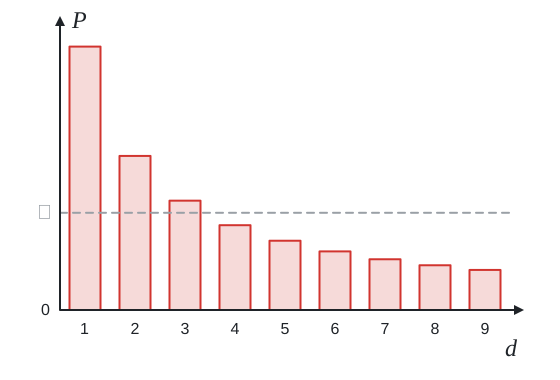
Now that we have the formula, we can go a step further. The law also holds for the first two digits. We just substitute the two-digit numbers from 10 to 99 for d in the same formula. So the pairs 10 and 11 come at the start far more often than 98 and 99:
A number starts with 10 in about 4.1% of cases and with 11 in 3.8%, whereas it starts with 98 or 99 in only about 0.44%. And the same holds, for example, for the lengths of the world’s rivers.
When the law holds and when it does not
Benford’s law usually holds for data that cover several orders of magnitude, from tens up to millions, and that arise from natural growth or measurement. Even a wide range does not guarantee it, which is why we say “usually”.
It does not hold for data with a limited range. The height of adults lies between 150 and 200 cm, so it almost always starts with 1. It does not hold for data with artificial limits either, for example the amounts of cash machine withdrawals, which are multiples of hundreds and have an upper limit. And it does not apply at all to identifiers and codes, such as telephone numbers or National Insurance numbers. Those are neither counts nor measurements, just names written in digits.
How fraudsters get caught
Anyone who makes up numbers tends to give all the digits a similar chance. In invented invoices or accounts we then find too few leading 1s and too many higher digits. Auditors and tax authorities therefore use the law as a pointer to where to look. In forensic accounting it is a common tool.
It is not proof of fraud, though. A company that sells one product for £790 will have a lot of invoices starting with 7 when customers buy one item at a time, and yet nobody has forged anything. A deviation only says that it is worth taking a closer look.
A 2011 study by Bernhard Rauch and colleagues tested the macroeconomic data that the member states of the European Union reported to Eurostat in 1999–2009 under the deficit rules against Benford’s law. Of the eurozone countries, the data from Greece deviated most from the law, and Greece was the country that, as it turned out at the time, had misrepresented its deficit figures.
After the 2009 Iranian presidential election, won by Mahmoud Ahmadinejad, statisticians analysed the vote counts. In elections, however, the first digit is not suitable, because polling districts are of similar size and so the vote counts do not cover enough orders of magnitude. Walter Mebane therefore used Benford’s law to test the second digit of the results from individual ballot boxes, and found deviations for three of the four candidates. Bernd Beber and Alexandra Scacco examined the last digits of the results in the provinces. These should be spread evenly, each in about 10% of cases, but there were 17% sevens and only 4% fives. Mebane himself stressed that his analysis does not prove manipulation, only supports it. In neither case was it proof of fraud.
Try it yourself on your own data, for example a bank statement or the prices on a receipt. And if you have no data to hand, take the powers of 2. Of the first thousand powers, that is, 21 to 21000, 301 start with 1, and Benford’s law also predicts 301. It could hardly fit better.
See also
Chapters: Monty Hall problem, Birthday paradox, Benford’s law, Probabilistic liar paradox, Necktie paradox, Simpson’s paradox, Medical test paradox, St Petersburg paradox, Non-transitive dice
