
Binomial theorem
The binomial theorem generalises the familiar formulae for (a + b)2 and similar expressions, using combinatorial techniques.
Motivation
You probably know the formulae for (a + b)2 and (a + b)3:
The natural question is whether these formulae can be generalised to any positive integer n. In other words, can we work out (a + b)n?
Derivation
We can, and that is exactly what the binomial theorem is for. Let’s see how the expansion continues for n = 4 and n = 5.
You should already be able to see a pattern. For the expression (a + b)n, the right-hand side always starts with the term an. The second term also contains a, but with the index one lower. For example, in the expansion of (a + b)4 the first term on the right is a4 and the second is a3. Each further term contains a with an index one lower than the previous term. The power of b, on the other hand, grows. At the start there is no b – or rather there is, but with index zero: b0 = 1. In the second term b has index one, then two, and so on.
Throughout, there is a simple rule: the indices always add up to n. In the last expansion, (a + b)5, the third term is 10a3 · b2, and the indices of a and b add up to 5.
The last thing to find out is the coefficients (the numbers in front of the variables) of each term. You will notice that the coefficients are symmetrical: for (a + b)4 they are 1, 4, 6, 4, 1, and for (a + b)5 they are 1, 5, 10, 10, 5, 1. Remember that a4 = 1 · a4, which is why I list the 1 even though it is not written explicitly in the formulae. We will see another relationship in Pascal’s triangle.
Pascal’s triangle
Pascal’s triangle is a handy tool for working out expansions with the binomial theorem. It is built from numbers, and each number is the sum of the two numbers directly above it. That sounds clumsy, but it is clear from the triangle itself:
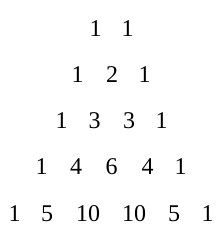
Look, for example, at the number 4. Directly above it are the numbers 1 and 3, and the sum 1 + 3 is exactly 4. The same holds for all the other numbers.
How do we use Pascal’s triangle? If you look at the numbers in each row, you will find that they closely resemble the coefficients in the binomial expansion. For example, (a + b)2 has coefficients 1, 2, 1, which is exactly the second row. For (a + b)4 the coefficients are 1, 4, 6, 4, 1, which is exactly the fourth row. To expand (a + b)n, it is enough to look at the nth row of Pascal’s triangle.
Statement of the binomial theorem
Formally, the binomial theorem says:
We sum from zero to n inclusive, so the number of terms is n + 1. The expression in brackets is a binomial coefficient (read “n choose k”), which comes from combinatorics and gives the number of different combinations that produce a given term of the expansion. The rest is just the variables with the appropriate indices. Notice that the indices really do add up to n: n − k + k = n.
Examples
A simple example: use the binomial theorem to expand (a + 2b)4. First we look at the fourth row of Pascal’s triangle. It tells us that the coefficients will be 1, 4, 6, 4, 1. Now we just fill in the indices step by step. The first term is just a4:
In the second term the indices are 3, 1, so we get a3(2b)1. Raising to the power 1 changes nothing, so we can write a32b. The coefficient of the second term is 4:
The third term has indices 2, 2. Watch out here: we raise the whole of 2b to the power, like this: (2b)2, which is equal to (2b)2 = 4b2. We add it to the expansion with coefficient 6:
The fourth term has the form a(2b)3. After raising to the power we get a8b3. We add it with coefficient 4:
The last term is just (2b)4 = 16b4:
Now we only need to tidy up a little. In the term 4a32b we can move the 2 to the front and multiply 2 · 4 = 8, which gives 8a3b. If we do the same with the rest, we get the result:
Notice that the coefficients no longer match the numbers in Pascal’s triangle.
