
Pascal’s triangle
Pascal’s triangle is made up of numbers, and the rule is that each number is the sum of the two numbers directly above it. Let’s build one and then see what it is good for.
How to build Pascal’s triangle
Down both sides of the triangle we write 1s, and for now we fill the inside with question marks:
Now let’s work out the first question mark. We add the two numbers above it, which gives 1 + 1 = 2:
We fill in the question marks in the next row in the same way. First we get 1 + 2 = 3:
And then we get 2 + 1 = 3:
We carry on like this, and each new row gives us another part of Pascal’s triangle:
Pascal’s triangle is, of course, infinite, and we can keep adding more and more rows. But there are always 1s down the edges, and each number inside the triangle is the sum of the two numbers above it. For example, the number 15 in the last row is the sum of the 5 and the 10 above it.
Basic properties of Pascal’s triangle
We have already seen the first basic property: there are always 1s down the sides of the triangle:
The “second diagonal” always contains all the positive integers:
Did you notice, by the way, that Pascal’s triangle is symmetrical? Each row is the same whether you read it from left to right or from right to left.
Triangular numbers
The third diagonal contains the numbers 1, 3, 6, 10, 15, …
What is interesting about them? These numbers are called triangular numbers. Imagine you had a number of circles and wanted to arrange them into a triangle. How many circles would you need? Have a look at the following picture:
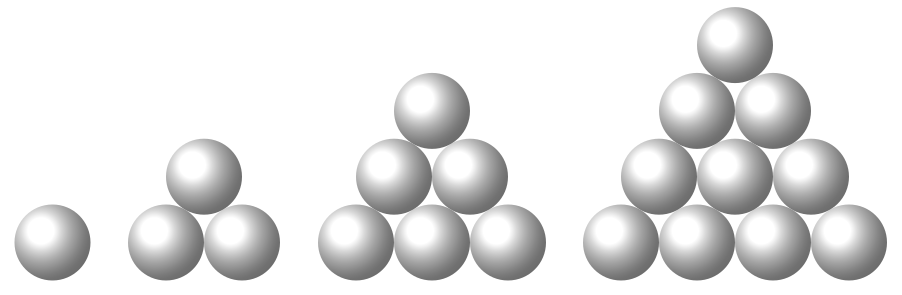
We can see that for a triangle with side 1 we need exactly one circle. For side length 2 we need three circles, for length 3 we need six circles and for length 4 we need ten circles. The number of circles we need is always a triangular number, and you can find these in Pascal’s triangle.
Sum of the rows
What if we tried adding up each row of Pascal’s triangle?
We can see that the sum of each row is twice the sum of the previous row. So all the sums are powers of two. If we call the top row row zero, we can write that the sum of the nth row of Pascal’s triangle is 2n.
Prime numbers
Again, call the top row of the triangle row zero. Then if we pick the nth row, where n is a prime number, every number in that row (apart from the 1s at the edges) is divisible by n.
For example, take n = 5. The number five is a prime number. The fifth row looks like this:
Each of the highlighted numbers is divisible by five.
The binomial theorem
You will certainly know the formulae for (a + b)2 and (a + b)3:
Notice that the coefficients of the individual terms match the numbers in Pascal’s triangle. Let’s look at the expression
First, let’s write in multiplication by 1 next to a3 and b3 to make this clearer:
Now we can see that the coefficients multiplying the terms are the same as the third row of Pascal’s triangle (if we count the top row as row zero):
This phenomenon has an article of its own, on the binomial theorem.
