Collatz conjecture
Take a pencil and any positive integer. If it is even, divide it by two. If it is odd, multiply it by three and add one. Do the same with the result, and then again and again. Let’s try 6: it is even, so 6 ÷ 2 = 3. Three is odd, so 3 × 3 + 1 = 10. Then 5, 16, 8, 4, 2 and 1.
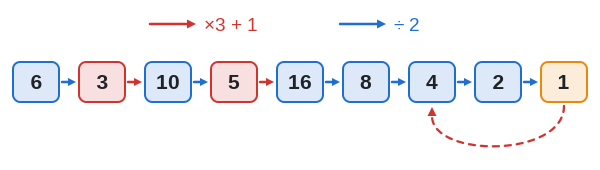
In fact the game does not end at one: one is odd, 1 × 3 + 1 = 4, then 2 and 1 again. The numbers 4, 2, 1 keep repeating in a loop. So when we say that a number “ends at one”, we mean that it falls into this loop.
So the question is: does every number get to one? That is the Collatz problem. Mathematicians suspect that it does, and they call this claim the Collatz conjecture. But nobody knows for sure. Computers have checked it for all numbers less than 271, which is about 2.4 sextillion, a number with 22 digits. The record is held by a Czech, David Bařina, from Brno University of Technology. But a proof is missing. The famous mathematician Paul Erdős said of the problem: “Mathematics may not be ready for such problems.”
The problem was stated in 1937 by the German mathematician Lothar Collatz, two years after his doctorate. But it goes by many other names: the 3n + 1 problem, the Ulam conjecture, the Syracuse problem and others. Behind all of them is the same game.
Twenty-seven
The number 6 got to one after eight steps. By a step we mean one use of the rule, that is, one division by two or one “times three plus one”. The number 26 manages it in ten steps: 26, 13, 40, 20, 10, 5, 16, 8, 4, 2, 1. Let’s try its neighbour, 27. We would expect something similar. Not so fast:
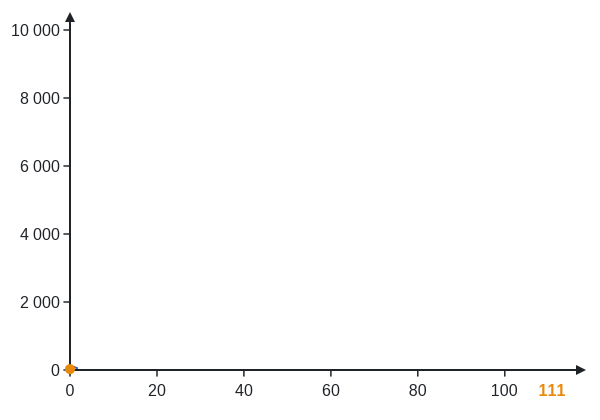
Horizontally we have the step number, vertically the number we are on at that step. Twenty-seven wanders around below two thousand for a long time, then climbs all the way to 9,232 (at step 77), and only then comes crashing down. It does not reach one until after 111 steps. So the neighbouring numbers 26 and 27 behave completely differently, and that is the trickiest thing about the whole game: you cannot tell from the number itself how long and how high it will fly.
Because of this rising and falling, these sequences are called hailstone numbers. A hailstone in a storm cloud also rises and falls before it finally drops to the ground.
The tree of all paths
Let’s turn the game around and go backwards from one. Where can you come to the number n from? The first option always exists: from 2n, because that is even and gets divided by two. The second option is the number (n − 1)/3, but only if it comes out as an odd integer, because only odd numbers get multiplied by three. So you can reach 16 from 32 and also from 5, because (16 − 1) ÷ 3 = 5, and indeed 5 × 3 + 1 = 16. You can reach 14 only from 28, because (14 − 1) ÷ 3 = 13 ÷ 3 is not an integer. You can reach 13 only from 26: (13 − 1) ÷ 3 = 4 is an integer, but it is even, and an even number gets divided by two, not multiplied by three. For 4 the number 1 would be an option, but that is the loop, so we leave it out.
If we carry on like this, a tree grows:
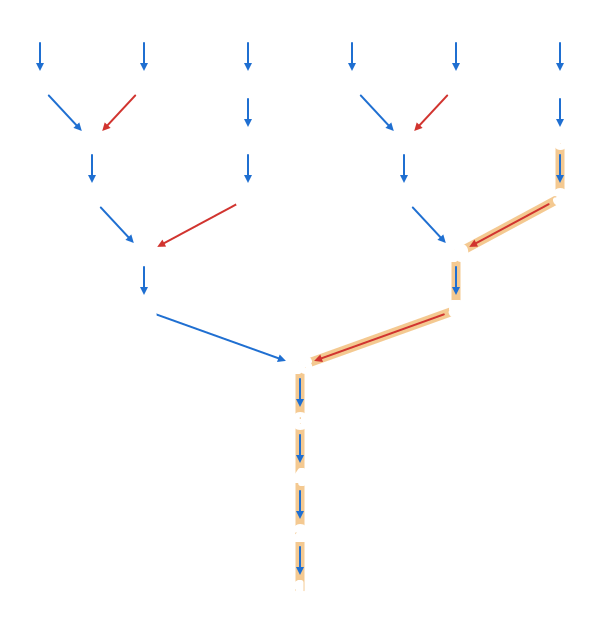
The arrows always point down, from a number to its successor. Each number has only one successor, so from every place there is only one path down. The tree only branches upwards, and it does so where a number has two predecessors, like 16, 64 or 10. In orange is the path of 6 from the picture above.
The Collatz problem can now be put differently: does every number appear in this tree? The picture only shows 10 levels, but the tree grows upwards for ever. Twenty-seven is in it, just not until level 111.
Why it should be true
Almost all mathematicians believe the answer is yes. Why? Let’s divide the path into rounds. One round is one “times three plus one” step followed by all the divisions by two until the number is odd again. So in the first round 7 goes 7 → 22 → 11, in the second 11 → 34 → 17 and in the third 17 → 52 → 26 → 13. In the first two rounds it was divided once, in the third twice.
After “times three plus one” an odd number always becomes even (odd times three is odd, and odd plus one is even), so at least one division by two is certain to come. How many will there be? We went through all 500 odd numbers less than a thousand:
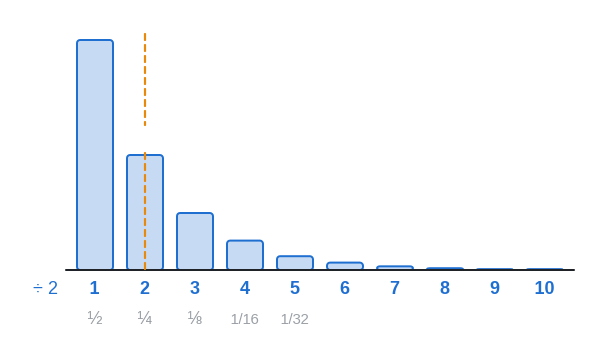
Half of the odd numbers are divided by two only once, a quarter twice, an eighth three times and so on; each bar is roughly half as tall as the one before. We get the mean by multiplying each number of divisions by the fraction of numbers that have it and adding everything up:
For our 500 numbers it comes out exactly: there are 1,000 divisions altogether, so on average two.
Dividing by two twice is the same as dividing by four. So on average one round multiplies the number by three and divides it by four, which shrinks it to roughly three quarters. Round by round the number shrinks on average, and so sooner or later it should get down to one.
The catch is in the words “on average”. The average score when you roll a die is 3.5, and yet you can roll a one three times in a row. In the same way a particular number can be unlucky and get several rounds in a row with only one division. That is exactly what happened to 27: up to its peak at step 77 it made 33 steps up and only 44 down, on average only 1.33 divisions per round, and that makes the number grow. That is why it flew so high.
The argument about the average sounds convincing, but it is not a proof. In a casino players lose on average, and yet someone can keep winning for a very long time. Nothing guarantees that there is no enormous number that keeps getting rounds with only one division.
Now let’s look at all the numbers up to ten thousand. For each one we count how many steps it needs to reach one, and plot a dot:
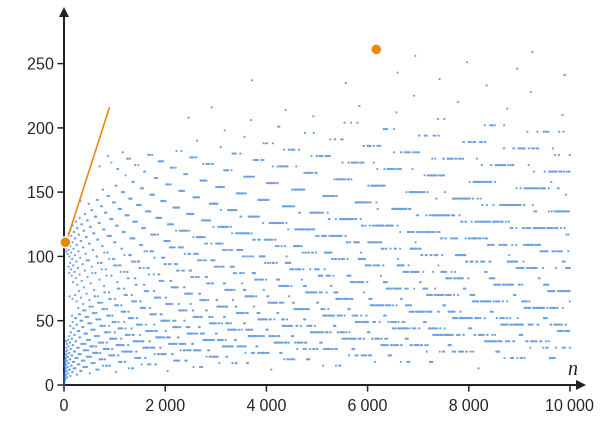
No dot flies far above the others. The longest path of all the numbers up to ten thousand belongs to 6,171: it needs 261 steps and on the way climbs as high as 975,400. The cloud rises only slowly as the numbers grow. Notice also that the dots form short horizontal dashes. Neighbouring numbers often have the same number of steps, because their paths soon meet.
What would a counter-example look like?
If the conjecture were false, one of two things would have to happen. Either there is a number whose path climbs higher and higher and never comes down, or there is a loop other than 4, 2, 1, in which the numbers would go round and round and never reach one. So a proof of the conjecture would have to show both: that no path grows for ever and that no other loop exists. Nobody has found anything like that so far. We even know that any other loop would have to have more than 355 billion steps. Mathematicians worked this out by combining computer checks with theory about what such a loop would have to look like.
Small changes to the rules show that none of this is obvious. If we play the same game with negative numbers, loops turn up straight away. Even and odd work just as for positive numbers: −14 is even and −7 is odd:
We are back at the start. Another loop starts, for example, at −17 and has 18 steps. The game with negative numbers is really the same as the game with the rule 3n − 1 on positive numbers, just without the minus signs: 5 → 14 → 7 → 20 → 10 → 5. And the rule 4n + 1 would turn an odd number into another odd number, a division by two would never come and the numbers would just keep growing. And what if we multiply by five instead of three, that is, replace an odd number n by 5n + 1? Then 13 goes round in a loop:
And in this game 7 apparently keeps growing and growing: after two thousand steps the number has 70 digits. That fits the argument about rounds: times five and divided by four makes the number grow on average. Three is the only odd number greater than one with which the numbers fall on average. But nobody can prove that absolutely all of them fall.
Checked by computer up to 271
The current record is held by David Bařina from the Faculty of Information Technology at Brno University of Technology. In January 2025 he finished checking all numbers less than 271, that is, less than 2,361,183,241,434,822,606,848, and his computation is still running. Many popular sources still give the older bound 268, which Bařina reached in 2020.
The program does not have to follow each number all the way to one. It is enough to follow the path until it drops below the starting number, because all the smaller numbers have already been checked. From them we also get to one.
Even that is not enough. There are infinitely many numbers, and as we saw with 27, a small number can have an unexpectedly wild path. Goldbach’s conjecture is in the same position: checked a long way, but not proved.
Why is it so hard?
The rule is simple, but the behaviour is chaotic. Whether the next step goes up or down depends only on whether the number is even, and every “times three plus one” shuffles this again. No known method can tame this shuffling. The Collatz problem has no direct use. It attracts mathematicians precisely because it shows how little we know about what happens when multiplication and addition are mixed together.
In 1972 John Conway proved that for more general games of this type no procedure can always decide whether a number reaches one. This suggests that there may be no clever trick for 3n + 1 either.
A big step forward came in 2019 from Terence Tao. He proved that if you pick a huge number at random, its path almost certainly falls far below it, for example from a number with a million digits to a number with just a few digits. But almost certainly is not certainly, and a few digits is not one.
There is money on offer for a solution, too. Paul Erdős offered 500 dollars, and in 2021 the Japanese company Bakuage offered 120 million yen, at the time about a million dollars, for a proof or a disproof.
Try it yourself
Follow the paths of the numbers 7, 9 and 97. How many steps do they need to reach one, and how high do they climb? A hint: one of them meets an old friend. You will find the solution at the very end of the article. For comparison, here are the numbers from the article:
| number | number of steps | highest value |
|---|---|---|
| 6 | 8 | 16 |
| 26 | 10 | 40 |
| 27 | 111 | 9,232 |
| 6,171 | 261 | 975,400 |
News
We are writing this section on 23 November 2026. In July 2026 a “proof” appeared that the Collatz conjecture is false. It was created with the help of artificial intelligence in Lean. Lean is a program into which a proof is entered step by step, and it strictly checks every step. But it turned out that the proof exploited a bug in Lean itself. The bug made it possible to “prove” a contradiction, that is, a statement and its opposite at the same time, and in logic absolutely anything can be derived from a contradiction. The authors of Lean fixed the bug within a few days, and the problem remains open. It is a good warning: a computer check is only as reliable as the program that does it.
Solution
Seven needs 16 steps and gets as high as 52: 7, 22, 11, 34, 17, 52, 26, 13, 40, 20, 10, 5, 16, 8, 4, 2, 1. Nine goes 9, 28, 14, 7 and then on in the same way as seven, so it has 19 steps and a maximum of 52 as well. The number 97 needs 118 steps, the most of all numbers up to a hundred. After fourteen steps it gets to 47, and that is a number from the path of 27. From there it goes the same way as 27, via 9,232 all the way down to one.
See also
- Goldbach’s conjecture, another unsolved problem that anyone can understand
- Are there more even or odd numbers?
- Mathematical induction
- The Millennium Prize Problems
- Famous problems