The cosmological constant
The universe is almost empty. The matter in it has only a low density, and its gravity ought to be slowly braking the expansion. Yet the universe is expanding faster and faster. What is driving it? The simplest answer is a single Greek letter,
The whole article is built on powers of ten. 10120 is a one followed by 120 zeros, and 10−27 is one divided by a one followed by 27 zeros.
How big is 10120? The number of atoms in the observable universe is of the order of 1080. So the error in the estimate is 1040 times larger even than the number of all the atoms. If the theory were right, the universe would have flown apart so fast that not a single galaxy would have formed in it. Yet here we are, so somewhere in our physics there is a hole.
Einstein’s “blunder”
According to Einstein’s general theory of relativity, gravity is a curvature of space and time, and matter attracts other matter. So a universe full of stars ought to start collapsing in on itself. But Einstein believed, as almost everyone did at the time, that the universe is unchanging. That is why he added
That the universe can expand had already been deduced from Einstein’s equations by Georges Lemaître. Then in 1929 Edwin Hubble measured that distant galaxies are moving away from us, and the further away they are, the faster they move. The universe is expanding, and no
The universe is accelerating
In 1998 two teams of astronomers set out to measure how fast the expansion is slowing down, and they were in for a surprise. They used type Ia supernovae, explosions of white dwarfs, that is, burnt-out cores of stars. They shine with almost the same brightness, and their luminosity can be pinned down even more precisely from how quickly they fade after the explosion. From how faint they look to us, we can tell how far away they are, much as with a light bulb of known power. And from how far their light is shifted towards red, we can tell how much the universe has stretched since the explosion. The distant supernovae were fainter, and so further away, than would fit a slowing expansion. The universe is expanding faster and faster. For this discovery three astronomers from the two teams received the 2011 Nobel Prize in Physics.
What is driving the universe, we do not know. We call it dark energy: “dark” because it does not shine and we cannot see it, only its effect on the expansion. The simplest explanation is exactly Einstein’s
The expansion only applies to the space between galaxies. Your watch, the Earth and the Solar System are not expanding; they are held together by much stronger forces.
When the measured values are put into the equation for the expansion (the Friedmann equation), this is how it comes out:
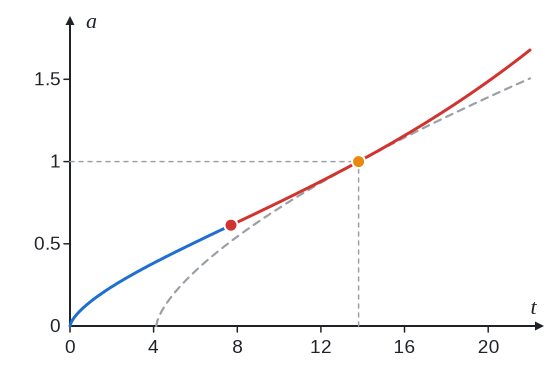
The blue part of the curve bends downwards: the expansion was slowing down. At the red dot the curve straightens out and then bends upwards. The universe started to accelerate about 7.7 billion years after the Big Bang, that is, 6.1 billion years ago, when it was 61% of its present size. The number z ≈ 0.63 next to the dot is the so-called redshift. You will work out where it comes from in exercise 3. A universe without
How much emptiness weighs
If dark energy is Einstein’s
But why does this energy make space expand instead of pulling it together? In general relativity it is not only density that gravitates but pressure too. The vacuum has negative pressure, so it “pulls” rather than pushes, and gravitationally this outweighs the density. The result is repulsion.
What is more, energy “weighs” something: by the formula E = m · c2 we can convert it into mass, and so into density too. From the Planck satellite’s measurements the density of dark energy comes out as
That is about as much as if there were three and a half hydrogen atoms in every cubic metre. Water, with a density of 1000 kg/m3, is 1029 times denser. A room with a volume of 50 m3 contains about 60 kg of air, but the dark energy in it “weighs” only as much as 175 hydrogen atoms. No scales could measure it.
So how can something so thin make up 68% of the universe? Because the universe is almost empty. If we spread all the matter out evenly, on average it comes to a mass of about 1.6 hydrogen atoms per cubic metre. Of that, ordinary atoms account for only about a quarter of an atom; the rest is dark matter. Matter thins out as the universe expands; dark energy does not. So once upon a time matter ruled and gravity braked the expansion. As matter thinned out, dark energy took over and the universe started to accelerate.
Empty space is not at rest
This is where the problem begins. Quantum physics says that even perfectly empty space cannot have zero energy.
Space is filled with fields, for example the electromagnetic field, whose waves are light. We can imagine each field as a huge collection of waves of all possible wavelengths, a bit like strings of all possible lengths. In quantum physics none of these waves can come to a complete stop. Even in the calmest state, when there is not a single particle in space, each one trembles a little and keeps a small lowest energy, which is called the zero-point energy. For most of physics it is harmless, but gravity feels all energy, this kind too.
It can be worked out roughly like this:
- A shorter string plays a higher note, and a higher note carries more energy. A wave with a ten times shorter wavelength has ten times more zero-point energy, and 103 times more of them fit into a cubic metre, ten times more in each of the three directions. So when we make the shortest wavelength we count ten times shorter, the total energy grows 10 · 103 = 104 times.
- If we added up absolutely all the waves, we would get infinity. So we have to stop somewhere. This is called a cutoff: we say that our theory can no longer describe shorter waves.
- The shortest length that physicists dare go down to is the Planck length, about 1.6 × 10⁻³⁵ m. Below it, quantum physics would have to be combined with gravity, and so far nobody knows how to do that.
The result corresponds, in order of magnitude, to having the so-called Planck mass, about 22 micrograms, in every little cube whose edge is the Planck length. This is the Planck density:
A more careful calculation gives only roughly a hundred-and-fiftieth of it, but that changes nothing about the gulf: the theory gives roughly 10120 times more than the Planck satellite measured. That is why it has been nicknamed “the worst theoretical prediction in the history of physics”.
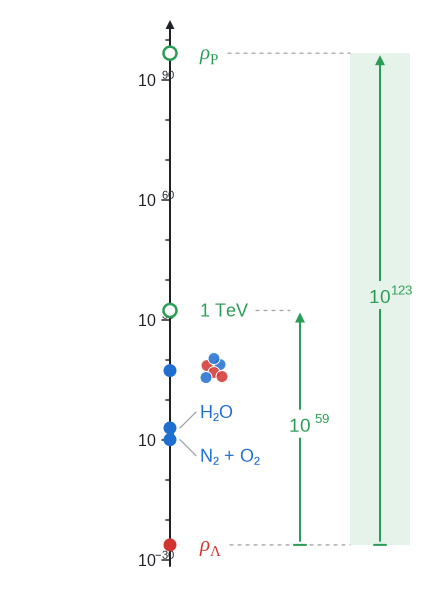
But the nickname is exaggerated. It is not a real prediction but a rough estimate, and the result depends on where we cut off. If we stopped at energies of around 1 TeV (the teraelectronvolt is a unit of energy), the kind studied by today’s largest particle accelerators, the gulf would shrink to roughly half the number of orders of magnitude. More careful calculations give around 55 orders of magnitude. But nobody can explain even those. The problem does not go away; it just gets smaller.
How could it be explained?
The three best-known proposed solutions:
- Supersymmetry. Particles of matter (fermions) contribute to the zero-point energy with a negative sign, particles of forces (bosons) with a positive one. If every particle had a “mirror” partner from the other group, their zero-point energies would cancel exactly. But the partners have not been found, so if they exist they are heavier and the cancellation is only partial. More than 50 orders of magnitude would still be left.
- The anthropic principle. In 1987 Steven Weinberg noticed that if
- Changing dark energy. Perhaps dark energy is not a constant at all, but a field that changes slowly. It is called quintessence. We could then catch its change by measurement.
Is dark energy changing?
That is exactly what the DESI instrument is investigating; it has measured the positions of more than 40 million galaxies and quasars. Its results from 2024 and 2025, from the first part of the data, suggested that dark energy may be slowly weakening, with a deviation of up to around 4σ (read “four sigma”). Sigma is the standard deviation, the typical size of a random measurement error. A deviation of at least 3σ in one direction or the other is produced by chance roughly once in 370 tries, like eight or nine heads in a row when tossing a coin. That is why only 5σ, less than once in a million, counts as a discovery.
Then astronomers corrected hidden errors in the calibration of the supernovae, and the hint has now weakened to roughly 3σ. What is more, according to DESI dark energy would first have grown stronger and only then weakened, which does not fit even the simplest quintessence. Results from the whole survey are due in 2027. It is not certain yet.
If
Try it yourself
- (easy) The theory gives roughly 10120 times more than we measure, and there are about 1080 atoms in the observable universe. How many times larger is the error than the number of atoms?
- (easy) The density of dark energy is 5.8 × 10⁻²⁷ kg/m3 and a hydrogen atom has a mass of 1.67 × 10⁻²⁷ kg. How many hydrogen atoms per cubic metre does that make?
- (for the brave) When did the universe start to accelerate? Going back into the past, the density of matter grows with the cube of how many times smaller the universe was, while the density of dark energy stays the same. Today the ratio of the densities of matter and dark energy is 0.315:0.685. The acceleration began when matter was exactly twice as dense as dark energy. How many times smaller was the universe then?
Solutions:
- We divide powers with the same base by subtracting the exponents:
The error is 1040 times larger than the number of atoms.
- We divide the density by the mass of an atom. The powers of ten cancel:
It comes to three and a half hydrogen atoms per cubic metre.
- Where does the two come from? The acceleration depends on the density plus three times the pressure. For the vacuum the pressure is negative and the same size as the density, so dark energy acts like 1 − 3 = −2 times its density. Braking by matter and repulsion balance when matter is twice as dense.
Let k be how many times smaller the universe was than today. The density of matter was k3 times greater, so we are looking for the k for which
We divide by 0.315:
And we take the cube root:
So the universe was 1.63 times smaller then, which means it was about
You will find more famous problems in the category Famous problems.