Goldbach's conjecture
Try it yourself: 4 = 2 + 2, 6 = 3 + 3, 8 = 3 + 5, 10 = 3 + 7. A hundred is 3 + 97. It looks as if every even number greater than 2 can be written as the sum of two prime numbers, that is, numbers that can only be divided by one and by themselves. Does it always work? That is Goldbach’s conjecture, and nobody knows the answer. It has been troubling mathematicians since 1742, and computers have checked it for every even number up to four quintillion (a 4 followed by 18 zeros), but it has not been proved. It is one of the most famous unsolved problems in mathematics, and yet anyone who can add can understand it.
First, the rules of the game. The same prime may be used twice, which is why 4 = 2 + 2 counts. One is not a prime, so 4 = 1 + 3 does not count. And why “greater than 2”? The smallest prime is 2, so the smallest sum of two primes is 2 + 2 = 4. The number 2 itself cannot be split, and the conjecture allows for that. Here are all the even numbers up to twenty:
| number | ways of writing it as a sum of two primes |
|---|---|
| 4 | 2 + 2 |
| 6 | 3 + 3 |
| 8 | 3 + 5 |
| 10 | 3 + 7, 5 + 5 |
| 12 | 5 + 7 |
| 14 | 3 + 11, 7 + 7 |
| 16 | 3 + 13, 5 + 11 |
| 18 | 5 + 13, 7 + 11 |
| 20 | 3 + 17, 7 + 13 |
The order of the two numbers does not matter: 3 + 7 and 7 + 3 are the same way of splitting 10.
A letter from 1742
On 7 June 1742 the mathematician Christian Goldbach sent a letter to his more famous colleague Leonhard Euler. He stated the claim in a slightly different form, partly because at the time 1 was still counted as a prime. Euler wrote back that he regarded the even version as “a completely certain theorem”, although he could not prove it. Nobody can prove it to this day.
The bigger the number, the more possibilities
A hundred can be split into two primes not just in one way but in six. On a number line we show each partition as an arc that joins the two primes:
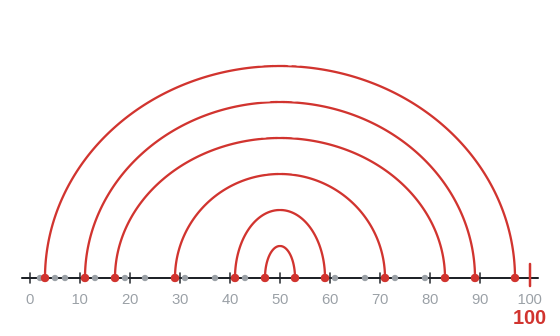
Notice the grey dots. They are primes whose partner, the number that makes them up to a hundred, is not a prime: for example, 7 would need 93, and that is 3 × 31. So not every prime gets a partner, but for a hundred we still get six pairs.
The bigger the number, the more partitions it usually has. A thousand has 28 and ten thousand already has 127. If we count the partitions of every even number up to ten thousand and plot each one as a dot, we get a picture that mathematicians call Goldbach’s comet:
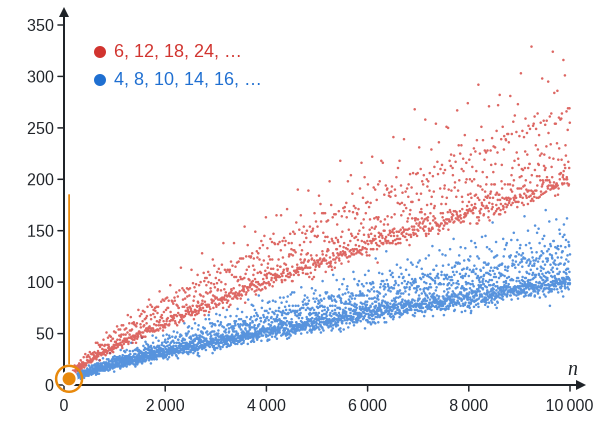
Horizontally we have the even number and vertically the number of ways it can be split. The orange dot in the circle at the bottom left is our hundred with its six partitions. What matters is what the picture is missing: no dot lies on zero. And the lower edge of the cloud rises as the numbers grow. If the conjecture failed somewhere, one dot would drop all the way to zero, far below all its neighbours.
Why does the comet have two tails? The red dots belong to numbers divisible by three, and these have roughly twice as many partitions as the others. For a hundred, about half of the primes drop out straight away: 100 − 7 = 93, 100 − 13 = 87, 100 − 19 = 81, and these are all multiples of three, not primes. That cannot happen with 102, because a multiple of three minus a number that is not divisible by three is never divisible by three. That is why 102 has eight partitions and 100 only six.
There are infinitely many primes, and as the numbers grow there are more and more partitions. That is why mathematicians are almost convinced that the conjecture is true. But being almost convinced is not a proof.
Why isn’t checking lots of numbers enough?
Computers have checked four quintillion numbers and the conjecture held for every one of them. Why isn’t that enough for mathematicians? There are infinitely many even numbers, and a computer can only ever check finitely many of them. A single counter-example, one even number that cannot be split, would be enough to disprove the conjecture. If one existed, it would have to be bigger than four quintillion. We know nothing more about it, not even whether it exists at all.
Could a counter-example be hiding beyond four quintillion? It could. Mathematics knows conjectures that held for an unbelievably long time and then failed. One of them claimed that for every n from 2 upwards, among the numbers from 1 to n there are at least as many numbers with an odd number of prime factors as numbers with an even number. Prime factors are the primes that a number is made of by multiplication: 8 = 2 × 2 × 2 has three of them, 6 = 2 × 3 has two. The conjecture held for every n up to 906,150,256 and failed for the first time at 906,150,257. Goldbach’s conjecture has been checked roughly four billion times further, and still nothing is guaranteed.
Why only even numbers?
An odd number usually cannot be written as the sum of two primes. Two odd numbers always add up to an even number, so one of the two primes would have to be even, and the only even prime is 2. An odd number could only be split as 2 + something, and for example 11 = 2 + 9 does not work, because 9 = 3 × 3.
For odd numbers there is therefore the weak Goldbach conjecture: every odd number greater than 5 is the sum of three primes. If we could prove the strong conjecture, the weak one would follow without any effort. You just subtract 3:
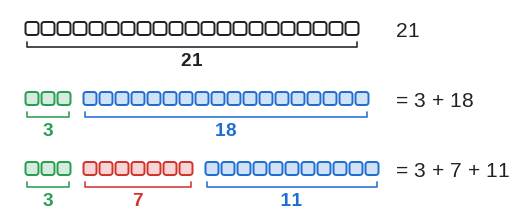
An odd number minus 3 is even, and by the strong conjecture an even number (if it is at least 4) could be split into two primes. We add the 3 to them and we have three. But it does not work the other way round. And the weak version is easier, because with three numbers there are far more possibilities: 101 can be written as the sum of three primes in 38 ways, while a hundred can be written as the sum of two in only six ways. The more possibilities there are, the easier it is to show that at least one of them works. That is why the weak conjecture was proved first, as we will see later.
How do computers check it?
The furthest anyone has got is the team of Tomás Oliveira e Silva. Their program went through every even number up to 4 · 1018, the result was published in 2014 in the journal Mathematics of Computation, and nobody has beaten the record since.
The program goes number by number, but cleverly. It does not look for all the partitions, one is enough. It tries the smallest primes 3, 5, 7, 11… and asks whether what is left up to the given number is a prime. It almost always succeeds very quickly. In the whole computation the worst case was the number 3,325,581,707,333,960,528, and even there it was enough to get as far as the prime 9,781.
Even so, it was hard work. The program ran in the spare time of many computers. A single computer with a single processor core would have needed about 782 years, and a thousand such computers more than nine months. Today it can be done faster: according to a paper from 2026, a single gaming graphics card can check every even number up to ten trillion (1013) in under an hour. But that is still a long way from the record, as 4 · 1018 is 400,000 times more.
Why is it so hard?
A prime is defined by multiplication: it is a number greater than 1 that cannot be written as a product of two smaller numbers. But Goldbach asks about addition. And these two worlds do not talk to each other well. Knowing that 97 is a prime tells us nothing about whether 100 − 97 is also a prime. We have to find that out separately.
The popular approach “it works for 4, and if it works for one number, it works for the next one too” does not help either, because the partitions of neighbouring numbers have nothing to do with each other. The number 98 is made of the primes 19, 31, 37, 61, 67 and 79, a hundred of completely different ones, and they do not share a single one. So the partitions of 98 tell us nothing about a hundred.
What has been proved
The weak conjecture, the one about three primes, was largely proved in 1937 by the mathematician Ivan Vinogradov. He showed that it holds for all sufficiently large odd numbers, that is, from some threshold onwards. The catch was that the threshold was enormous. Even after later improvements it was a number with more than a thousand digits, and no computer will ever get that far.
In 2013 Harald Helfgott finished the job. He brought the threshold down so low that all the odd numbers below it had already been checked by computer. With that the weak conjecture is proved, and mathematicians treat it as a proved theorem. Only the final book version of the proof has not come out yet; according to the latest reports Helfgott is still rewriting it.
For the strong conjecture, the one about two primes, we are not that far. As early as the late 1930s it was proved that almost all even numbers are the sum of two primes. This means that if you pick a large even number at random, the chance that it cannot be split is tiny, and it gets closer and closer to zero as the numbers grow. But that does not rule out a few exceptions, and those are exactly what the question is about.
Why does it matter?
To be honest: it has no direct use. No bridge will fall down and no cipher will be broken, whether the conjecture is true or not. It is more a test of how little we understand about what happens to primes when we add them.
Nobody has yet won any money for a proof. In March 2000 the publishers Faber and Faber and Bloomsbury offered a million dollars as an advertisement for Apostolos Doxiadis’s novel Uncle Petros and Goldbach’s Conjecture. The deadline was two years, and by spring 2002 nobody had won the prize.
News
We are writing this section on 23 November 2026. “Proofs” of Goldbach’s conjecture regularly appear on the internet, and mathematicians have not accepted any of them. In September 2026 the media reported that artificial intelligence had proved “Goldbach’s conjecture”. In reality it was a much looser problem in which, instead of primes, it is enough to use numbers with an odd number of prime factors, such as 8 = 2 × 2 × 2 or 12 = 2 × 2 × 3. The proof has been converted into a form that a computer can check, but mathematicians have not assessed it yet. And it has not moved the real Goldbach’s conjecture forward.
Try it yourself
Write the numbers 50 and 98 as the sum of two primes. How many partitions can you find? The prime number checker will tell you whether a number is prime.
Solution: 50 has four partitions, 3 + 47, 7 + 43, 13 + 37 and 19 + 31. The number 98 has only three, 19 + 79, 31 + 67 and 37 + 61, and they only start at 19. Try 3 with 98: 98 − 3 = 95 = 5 · 19. Then 5: 98 − 5 = 93 = 3 · 31. Then 7: 98 − 7 = 91 = 7 · 13. All the primes smaller than 19 go the same way. This close to zero the conjecture still sometimes breaks a sweat, but in the end it always works out.
You will find more famous problems in the category Famous problems.
See also
- Prime numbers
- Prime number checker
- The Riemann hypothesis, which is about how densely the primes are spread
- The Millennium Prize Problems
- Proof by contradiction, with the proof that there are infinitely many primes