The abc conjecture
Add one and eight: 1 + 8 = 9. Nothing special? Yet eight is all twos, 8 = 2 · 2 · 2, and nine is all threes, 9 = 3 · 3. We added two numbers built from small primes and got another number built from small primes. This happens surprisingly rarely.
The abc conjecture says that when we add two numbers made up of high powers of small primes, the result will almost never be like that as well. Addition and multiplication simply “don’t get on”. The Japanese mathematician Shinichi Mochizuki claims that he proved it in 2012, in more than five hundred pages. His proof has even been published in a journal. But most mathematicians do not accept it and still regard the conjecture as unsolved. First we will show what it is about, and then why mathematicians are arguing.
The prime skeleton of a number
A prime number is a number greater than 1 that can only be divided by one and by itself, such as 2, 3, 5, 7 or 11. Every other number can be broken down into a product of primes, and in only one way, apart from the order. For example
Now let’s do something unusual. The rule is: cross out repeated primes and multiply the ones that are left. From the factorisation of 24 a two and a three are left, and their product is 2 · 3 = 6. We will call this number the prime skeleton:
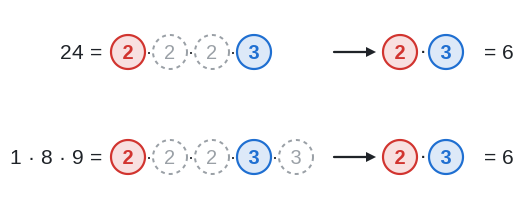
Mathematicians call the skeleton the radical and write rad(24) = 6. It has nothing to do with the square root, which is sometimes also called a radical. More examples: rad(8) = 2, rad(9) = 3 and rad(10) = 10, because ten, 2 · 5, does not repeat anything. The prime factorisation calculator will work out the factorisation of any number for you.
The skeleton is at most as large as the number itself. It is much smaller when the number is made up of high powers, like 1024 = 210 with skeleton 2.
Add and compare
We take two numbers a and b, add them, call the result c, and work out the skeleton of all three together, that is, the skeleton of the product a · b · c. Why the product? That skeleton contains every prime that appears anywhere in the equation a + b = c, and each one only once. So it measures how many “building blocks” the whole equation is built from.
The numbers a and b must not have any prime factor in common; they must be coprime. Otherwise it would be possible to cheat. Take 1 + 2 = 3 and multiply the whole equation by 1024:
The numbers have grown, but the skeleton is still only 2 · 3 = 6, because we have only added more twos. In this way c could be made larger and larger for ever without any effort.
The usual case: 5 + 16 = 21. We factorise: 5, 16 = 24, 21 = 3 · 7. The skeleton of the product is
that is, ten times more than c = 21. That is how it turns out almost every time.
The rare case: 1 + 8 = 9. Here the skeleton of the product is only 2 · 3 = 6, and that is less than c = 9. This is the second row of the picture above.
How rare is it? Let’s go through all the sums a + b = c with c at most 50 (with a less than b and the two coprime). There are 386 of them, and the skeleton comes out smaller than c for only three:
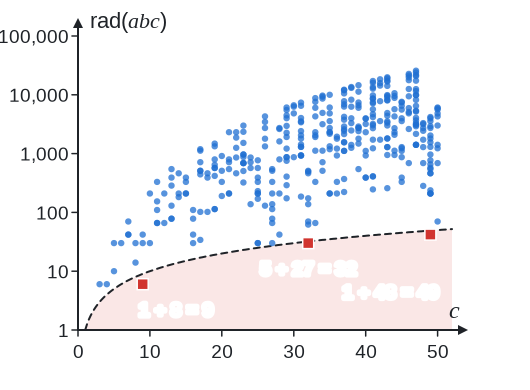
The vertical axis is logarithmic: each step on it means ten times more. Otherwise the blue dots with skeletons of over twenty thousand would not fit. Up to ten thousand it is even rarer: out of 15,198,742 triples only 121 have a skeleton smaller than c, roughly eight in a million.
What the conjecture says
But there are infinitely many such triples. It is enough to take c equal to three raised to the power 2, 4, 8, 16, …:
The skeletons are 6, 30 and 1,230, because 80 = 24 · 5 and 6,560 = 25 · 5 · 41. The middle number contains a higher and higher power of two, and in the skeleton it shrinks to an ordinary two. This can go on for ever.
To be able to say by how much c has outgrown the skeleton, we need a yardstick. We ask: to what power do we have to raise the skeleton to get c? For the triple 1 + 8 = 9 the skeleton is 6 and
This exponent is called the quality of the triple and is written q. A quality below 1 is the usual case; a quality above 1 means that c has beaten the skeleton. (For those interested: it is worked out with a logarithm, q = log c/lograd(abc).)
The conjecture then says:
There are infinitely many triples with quality above 1. But whatever bound above 1 we choose, say 1.01, there are only finitely many triples with quality above it.
So the skeleton can be beaten by a little, but only exceptionally by a lot, finitely many times. This is how Joseph Oesterlé and David Masser stated the conjecture in 1985. Our family with threes does not contradict it: according to all the calculations, its quality approaches one as the numbers grow, so it eventually gets under every bound above 1.
The conjecture does not say how many exceptions there are or how large they can be, only that there are finitely many of them. A version with specific bounds would be even stronger; we will come back to it with Fermat’s Last Theorem.
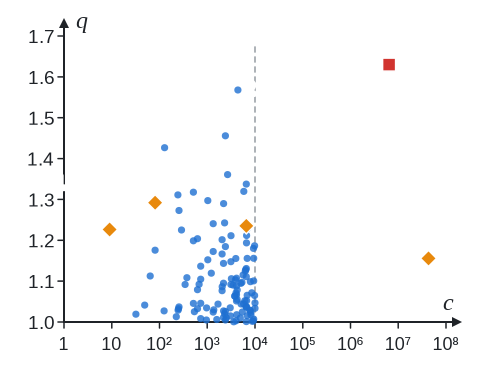
The blue dots are all 121 triples up to ten thousand. Most have a quality only a little above one; only three get above 1.4. The orange diamonds are our family with threes: first it rises, then it falls back towards one. Beyond the vertical line we did not calculate; there is only the fourth member of the family, 316, and the red square at the top right. That is the record.
The record: 2 + 3¹⁰ · 109 = 23⁵
The highest known quality belongs to the triple found in 1987 by Éric Reyssat:
Check on a calculator that it works:
Now the skeleton. Two is a prime; from 310 · 109 we are left with 3 and 109, and from 235 only 23:
The number c is over six million, and its skeleton only fifteen thousand. To get c from the skeleton, we have to raise it to roughly the power 1.63.
Such triples cannot be found by trying all the sums; there are far too many. So computers put numbers together from small primes and look for when two of them add up to a third. The ABC@Home project at Leiden University, to which volunteers contributed their computers, had found in this way by 2011 all the triples with c up to 1018, more than 14 million of them. None of them is better than Reyssat’s.
What would it be good for?
The conjecture links addition with multiplication, and we know surprisingly little about the two together. That is why a whole range of other theorems would follow from it. This is easiest to see with Fermat’s Last Theorem: the equation
has no solutions in positive integers for n from 3 upwards. If a solution existed, we would have a triple in which all three numbers are high powers. The skeleton leaves only x · y · z of them, and that is less than z3, whereas c = zn. For large n, c would outgrow the skeleton by a crushing margin.
For those interested: The powers disappear in the skeleton, and x and y are both smaller than z, so
We have to raise the skeleton to a power greater than n/3 to get zn, so the quality is above n/3. For n = 30 it would be over 10.
The conjecture allows only finitely many such triples. So Fermat’s Last Theorem follows from it for all large enough n, only we do not know from which one. A version with specific numbers would be enough for everything: if the quality never exceeded 2, we would get n/3<2, that is, n<6. Mathematicians had already dealt with the exponents 3, 4 and 5 between the 17th and 19th centuries.
Fermat’s Last Theorem was in fact proved by Andrew Wiles with the help of Richard Taylor; the proof came out in 1995 and is notoriously long and difficult. From the abc conjecture it could be derived in a few lines. In the same way, it would imply for example Faltings’s theorem (proved by other means in 1983) that equations of a certain kind have only finitely many solutions in fractions, or the Fermat–Catalan conjecture about the equations xp + yq = zr.
The dispute over the proof
In August 2012 Shinichi Mochizuki of the RIMS institute in Kyoto, Japan, published four papers with a new theory that he had built himself, and claimed that they proved the abc conjecture. Hardly anyone understood them.
In March 2018 Peter Scholze and Jakob Stix came to visit him, and they spent a week going through the proof together. Afterwards they wrote that there is a serious gap in one step which, in their view, cannot be fixed. In it Mochizuki works with several copies of the same world of numbers, which he deliberately keeps separate, and compares sizes between them. Scholze and Stix claim that when you honestly identify the copies with each other, the estimate that comes out is too weak for the conjecture to follow from it. Mochizuki replied that this identification is exactly an inadmissible simplification of his theory.
In 2021 his papers were published in the journal PRIMS, which is published by his own institute and whose editor-in-chief is Mochizuki himself. He did not take part in the review; the papers were checked by a committee of his colleagues from the institute. This did not convince the critics. To put it a little simply: in Kyoto it is a theorem, elsewhere a conjecture.
In other cases, such disputes have been settled. In 1993 Wiles announced a proof of Fermat’s Last Theorem, the reviewers found a mistake in it, and a year later he fixed it together with Taylor. Here, though, the two sides cannot even agree on whether there is a mistake at all. They do at least agree which step is being talked about, even though Mochizuki claims that the criticism is aimed at a simplified version that he did not write. It cannot be settled by a vote. A proof has to convince the experts step by step, and most experts outside the circle of Mochizuki’s collaborators do not consider this step valid.
In 2023 the Japanese businessman Nobuo Kawakami offered a prize of a million dollars, not for a proof of the conjecture, but for finding a fundamental mistake in Mochizuki’s theory. Nobody has won it yet.
Another attempt to settle the matter is the LANA project led by Fumiharu Kato of the ZEN Mathematics Center, which also administers Kawakami’s prize. The team includes Mochizuki’s collaborator Yuichiro Hoshi as well as independent mathematicians from Europe and America. They want to convert the proof into the Lean language, in which every step has to be written down so precisely that a computer can check it. While still preparing the conversion, at joint workshops, they came across a place that they cannot fill in. The interim report of 16 July 2026 puts it in the same step as Scholze and Stix did, although it describes it differently in several respects. The authors write that they cannot yet reconstruct the necessary link, but they do not give a verdict on whether the proof is valid.
So as of 23 November 2026 the whole dispute revolves around a single step. But nothing has been decided.
Try it yourself
Exercise: Find all the triples a + b = c with c at most 100 (a less than b, coprime) for which the skeleton rad(abc) is smaller than c. Which of them has the highest quality?
One of them is worked out right in the article: 1 + 8 = 9, skeleton 6. Hint: look for c and b among powers of small primes, like 27, 32, 49, 64 or 81. If you can program, you can write the search in a few lines.
Solution: There are exactly six such triples:
- 1 + 8 = 9, skeleton 2 · 3 = 6,
- 5 + 27 = 32, skeleton 5 · 3 · 2 = 30,
- 1 + 48 = 49, skeleton 2 · 3 · 7 = 42, because 48 = 24 · 3,
- 1 + 63 = 64, skeleton 3 · 7 · 2 = 42, because 63 = 32 · 7,
- 1 + 80 = 81, skeleton 2 · 5 · 3 = 30,
- 32 + 49 = 81, skeleton 2 · 7 · 3 = 42.
The highest quality belongs to 1 + 80 = 81: we have to raise the skeleton 30 to roughly the power 1.29 to get 81. Second is 1 + 8 = 9 with a quality of about 1.23. The others are lower, the closest being 5 + 27 = 32 with a quality of 1.02.
You will find more famous problems in the category Famous problems.
See also
- Prime numbers
- Prime factorisation calculator
- Logarithms
- Goldbach’s conjecture, another problem about what primes do when you add them