Erdős–Straus conjecture
The ancient Egyptians wrote fractions differently from us. Instead of two fifths they would write
Out of this old game grew a question that the mathematicians Paul Erdős and Ernst Straus asked around 1948: can every fraction with 4 in the numerator be written as the sum of three unit fractions? It is called the Erdős–Straus conjecture, and nobody knows the answer yet. Computers have checked it for all denominators up to 1018, that is, up to a quintillion (a 1 followed by 18 zeros), and a solution was found every time. This bound is given in a paper from 2025 that has not yet been peer-reviewed; an older paper from 2014 got as far as 1017. But it has not been proved.
The rules of the game: n is an integer from 2 upwards, and we are looking for positive integers x, y, z for which
The denominators may repeat, so
Two loaves for five people
The most famous Egyptian mathematical text, the Rhind Mathematical Papyrus, was copied by the scribe Ahmes around 1550 BC. Today most of it is kept in the British Museum in London. Its very first six problems share a few loaves of bread among ten men and write each man’s share in unit fractions. The papyrus also has a table of fractions with 2 in the numerator, split into unit fractions, and in it we find exactly
Bread helps to show where this comes from. Two loaves are to be shared among five people, so each gets two fifths of a loaf. The Egyptian way: we cut the first loaf into thirds for three people, and the remaining two each get a third of the second loaf. One third is left over, and we cut it into five equal pieces. If we cut all three thirds of a loaf like this, the loaf would have 3 · 5 = 15 pieces. So each piece is a fifteenth of a loaf, and each person gets one third and one fifteenth:
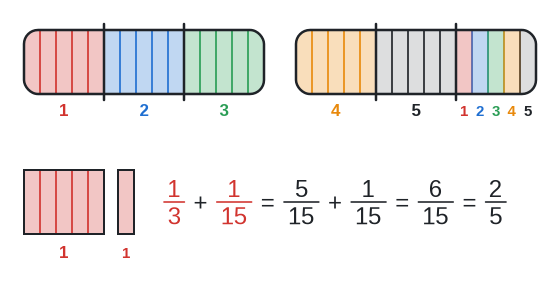
We check that it works by adding the fractions with the common denominator 15:
So everyone gets the same: one bigger piece and one smaller piece.
A game with fours
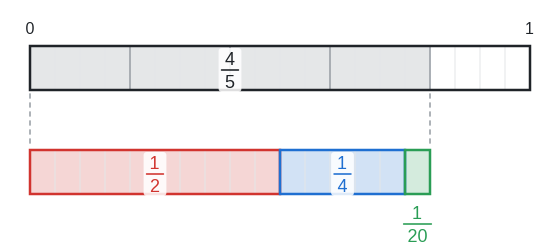
Let’s go back to 4 in the numerator. For n = 5 it is easy:
You can see it in the picture if we divide a strip into twentieths. Four fifths are 16 twentieths, a half is 10 of them, a quarter 5, and one is left:
For the denominator 7 the decomposition is less obvious:
We check it with the common denominator 210:
The last piece is a tiny crumb. If the whole were a metre long, one two-hundred-and-tenth would be just under five millimetres. And there is usually more than one solution. Four fifths can also be written as
The greedy method
How do you find such decompositions? The simplest way is the greedy method: take the largest unit fraction that still fits into the number, subtract it, and repeat with what is left. Fibonacci already described it in 1202. Let’s try it on
The largest unit fraction that fits into
What is left is already a unit fraction, and so we are done:
Notice the numerators of what is left: 4, then 3, then 2, which simplified to 1. Why does the numerator go down? In the first step the new numerator came out as 4 · 4 − 13 = 3. If it were at least 4, we would have 4 · 3 ≥ 13, and a third would already have fitted. The same argument works at every step, so the numerator of what is left is always smaller than before. That is why, starting from 4, the greedy method gives at most four unit fractions. So four fractions are always enough; the conjecture asks whether three are enough. The greedy method is not enough for that: for
And yet it can be done with three, just differently:
Why four?
A 2 in the numerator causes no trouble. For even n,
Let’s check:
With 3 in the numerator, on the other hand, it can be proved that three unit fractions are always enough. So for 2 and 3 in the numerator the job is done; 4 is the first numerator for which we cannot prove it. And the question for 5 in the numerator, asked in 1956 by Wacław Sierpiński, is just as open.
Primes are enough
Take
This always works: from a decomposition for some n we immediately get a decomposition for its double, its triple and any other multiple of n. And every number greater than 1 is either a prime or a multiple of some prime. So it is enough to prove the conjecture for primes. Even all the even numbers are dealt with by a single decomposition,
Numbers with a formula
For many numbers we can write down a decomposition straight away. Let’s show one such formula using 7. It works for every n for which n + 1 is divisible by four. For 7 we have 7 + 1 = 8, and a quarter of eight is two. We take 2 as the first denominator and 7 · 2 = 14 as the second:
We convert to fourteenths:
We add and simplify by two:
We got exactly
But these are only two fractions, and we need three. A rule that splits any unit fraction into two helps here: add one to the denominator and add a fraction whose denominator is the product of the old and the new denominator. For a half it looks like this:
And indeed,
We put it into the decomposition of four sevenths, and we have the three fractions we saw above:
Mathematicians have discovered other similar formulae. Each one works for numbers that leave a certain remainder when divided by three, five, seven or eight. We don’t need to deal with division by four separately, because the remainder when dividing by four can be read off from the remainder when dividing by eight. All these remainders can be read off from the remainder when dividing by 840 = 3 · 5 · 7 · 8. The mathematician Louis Mordell put the formulae together and showed in 1969 that a ready-made formula exists for all numbers except those that leave one of six remainders when divided by 840: 1, 121, 169, 289, 361 or 529. And they happen to be squares: 12, 112, 132, 172, 192 and 232. It is not a coincidence, but we will skip the deeper reason here.
None of the primes up to a thousand is like that. The first stubborn prime is 1009 = 840 + 169:
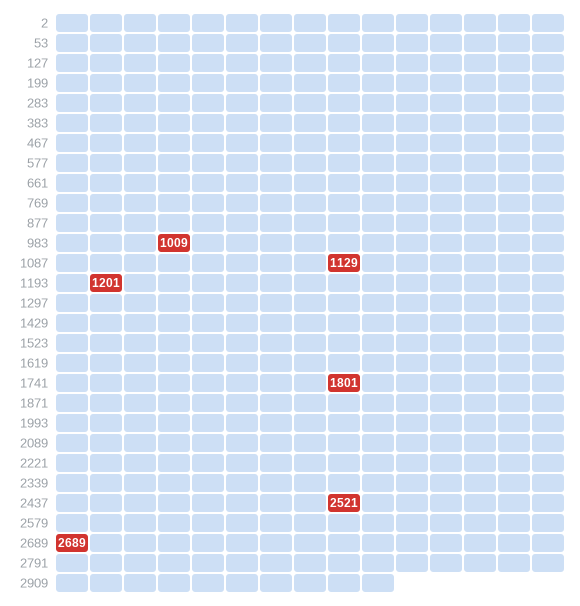
Of the 430 primes up to three thousand the formulae cover 424, and six are left. A decomposition can be found for those too; it just has to be searched for:
Couldn’t even cleverer formulae be found that would also cover these remainders? If we divide by a number larger than 840, there really are fewer stubborn numbers. But remainders that are squares can never be covered by formulae of this kind. One is always a square (1 = 12), so numbers with remainder 1 stay uncovered, whatever we divide by.
Doesn’t that contradict the fact that the number of stubborn numbers goes down? It doesn’t. At least one remainder always stays stubborn, but the larger the number we divide by, the smaller the share of all numbers that leave that remainder. When dividing by 840, six remainders out of 840 are stubborn, which is about 0.71% of all numbers. In 1971 Terzi refined this to division by 120,120, and 198 remainders were stubborn, about 0.16% of the numbers. So the stubborn numbers thin out like this, but they never disappear completely.
Why isn’t a computer enough?
A computer can limit its efforts to the stubborn primes; for the other numbers a formula gives the decomposition. Even so, it is an enormous amount of work. In 2025 all the numbers up to 1018 were checked this way. If you just wanted to list them, one per second, it would take you over 31 billion years.
Why isn’t that enough for mathematicians? There are infinitely many numbers, and a computer can only ever check finitely many of them. A single counter-example would be enough to disprove the conjecture: a number n for which it could be shown that no three unit fractions add up to
But how would we recognise a counter-example? After all, there are infinitely many triples of fractions. Fortunately, for a single number it can be done, because only finitely many candidates need to be tried. The largest of the three fractions has to be smaller than
We do have something proved, though. Exceptions, if there are any at all, are negligibly rare: in 1970 Robert Vaughan proved that their share among the numbers up to N gets closer and closer to zero as N grows. On top of that, as n grows, there are more solutions on average. But that does not rule out a few exceptions.
Why does it matter?
To be honest: practically not at all. It is a puzzle that anyone who can add fractions can understand, and yet it shows how little we understand about how fractions and divisibility are connected. If you read in autumn 2026 that artificial intelligence had proved Erdős’s conjecture on Egyptian fractions, that was a different conjecture: it does not ask about 4 in the numerator and three fractions, but about how few different unit fractions are enough to write any fraction. Nobody has cracked 4 in the numerator yet.
Try it yourself
Write
Solution: For 3 we have
For eleven, a quarter of 11 + 1 is three, so
If you got a different solution, it need not be wrong. Four ninths can be written in six ways (counted as above), for example
You will find more famous problems in the category Famous problems.