Is π + e irrational?
The number π ≈ 3.14159 and Euler’s number e ≈ 2.71828 are both irrational, which means they cannot be written as a fraction. Mathematicians have known this for more than 200 years. Add them together and you get π + e ≈ 5.85987. Is this number irrational too? Nobody knows. The question is open, and nobody can rule out that π + e is some fraction, perhaps with an enormous denominator.
Yet almost all mathematicians believe that it is not a fraction, and even that π + e is transcendental, meaning that it does not satisfy any equation with integers. We will show exactly what that means below. Why do they believe it? A number chosen at random between 0 and 1 is a fraction with probability zero, and almost all numbers are transcendental. What is more, it would follow from one big conjecture that has not been proved yet, known as Schanuel’s conjecture.
It sounds absurd. Addition is the simplest arithmetic operation, we know a lot about π and e separately, and almost nothing about their sum. The trouble is that π and e are not obviously related in any way. One came from the circle, the other from compound interest. Euler’s famous identity eiπ = −1 does connect them, but it goes through complex numbers and says nothing about the sum. Nobody has found an equation with integers that ties π and e together, nor proved that there is none.
A fraction or not?
A rational number is a fraction whose numerator and denominator are both integers. Its decimal expansion either ends, like
The block of six digits 142857 is the repetend, and it repeats over and over. An irrational number, such as
So why not work out a few billion digits of π + e and look to see whether they repeat? Because the repetend can be very long. Try working out
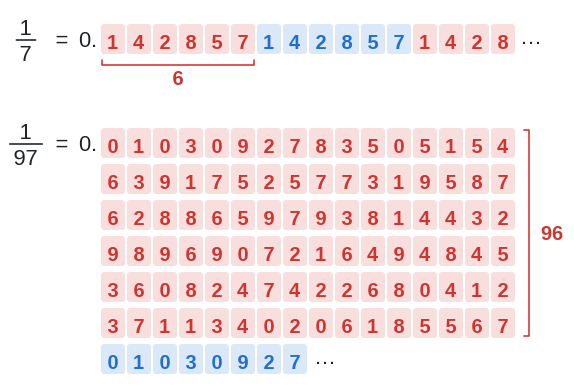
A fraction with a hundred-digit denominator could have a repetend longer than the number of digits of π + e that anyone will ever work out. So no number of digits can prove irrationality.
But the computer has at least ruled out small fractions and simple equations. By that we mean equations like 3x2 + 5x − 7 = 0. The numbers 3, 5 and −7 are its coefficients, and the highest power of x, here two, is its degree. In 1988 David Bailey showed that π + e is not a root of any equation of degree at most 8 with integer coefficients, unless those coefficients are on average larger than roughly a billion. In plain terms: if π + e satisfied some not very large equation, the computer would have found it. It did not. But this is not a proof; there are still infinitely many equations with larger coefficients and higher powers.
The sum of two irrational numbers can be anything
Why does nothing follow from π and e being irrational? Because two irrational numbers can easily add up to an integer:
The number
But that does not always happen. For example,
We square both sides using the formula (a + b)2 = a2 + 2ab + b2. The middle term is
On the right there is a fraction, so
Numbers that satisfy no equation
The ancient Greeks were troubled by squaring the circle: constructing, with a straightedge and compasses, a square with the same area as a given circle. For a circle of radius 1 the square would need to have side
What does that mean? The number
Lengths that can be constructed with a straightedge and compasses are always algebraic. If
So transcendental is a stronger property than irrational. Fractions are only part of the algebraic numbers, and those in turn are only part of all numbers. Every transcendental number is irrational, but not the other way round:
The trick: at least one of the pair is strange
Let’s sum up what we know so far. π and e are both transcendental; about π + e we know almost nothing. Now comes a neat trick which shows that the sum π + e and the product π · e cannot both be fractions at the same time. All we will need is a quadratic equation and the definition from above: an algebraic number is a root of an equation with integers.
A root of an equation is a number that satisfies the equation when substituted for x. Let’s take the expression
For x = π the first bracket is zero, and so the whole product is too. For x = e the second bracket is zero. So π and e are both roots of the equation (x − π) · (x − e) = 0. Now we multiply out the brackets, each term by each term:
And look, exactly our sum π + e has appeared in the equation, and with it the product π · e:
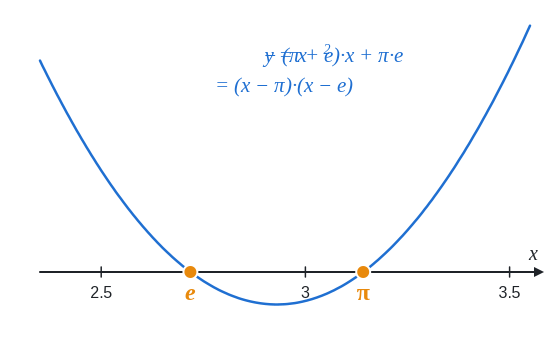
Now let’s assume that π + e and π · e are both fractions, say
We multiply it by the common denominator 10:
With the real fractions it would turn out the same, only the common denominator would be different: we get an equation with integers. And its root is π, so π would be algebraic. But Lindemann proved that π is not algebraic. A contradiction.
It follows that at least one of the numbers π + e and π · e is not a fraction. Even more can be shown. The roots of an equation whose coefficients are algebraic numbers are algebraic too. So if π + e and π · e were both algebraic, π would be algebraic as well. That is why at least one of them is in fact transcendental.
And now the catch. We do not know which one. It could be the sum, it could be the product, it could be both. For neither of them on its own can we even prove that it is not a fraction. For the difference the trick works the same way:
so at least one of the numbers π − e and π · e is transcendental.
Why we know about e to the power π, but not π to the power e
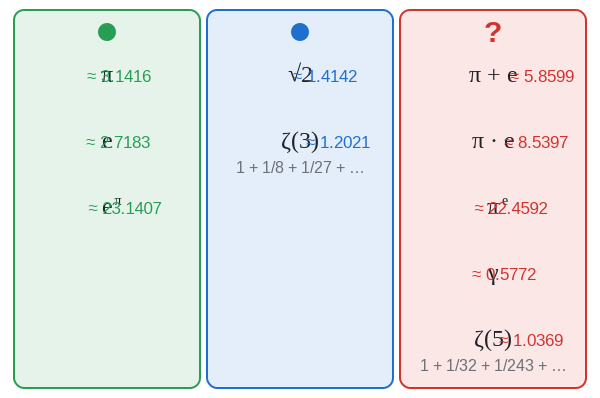
It is just as strange with powers. The number eπ ≈ 23.1407 is proved to be transcendental, but for πe ≈ 22.4592 we do not even know whether it is irrational. Why the difference?
The Soviet mathematician Alexander Gelfond proved that eπ is transcendental in 1929. Then in 1934 he and, independently of him, Theodor Schneider proved a general theorem about powers ab, where a and b are both algebraic numbers and b is not a fraction. Such powers, for example
Now one more number for the collection. The letter
This is what the map of our knowledge looks like. In green are the numbers we know to be transcendental, in blue those we only know to be irrational, and in red with a question mark those we do not even know that about:
A constant we know nothing at all about
There is one more famous number in the red column, the Euler–Mascheroni constant γ (gamma). Add up
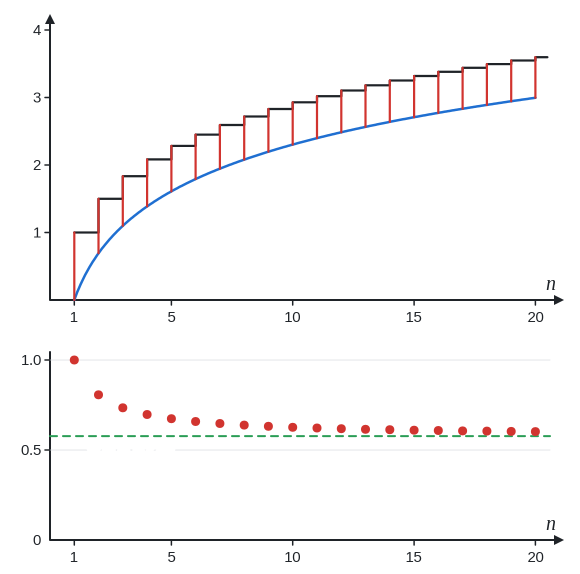
The difference approaches the number γ ≈ 0.5772. We know more than 1.3 trillion of its digits; Andrew Sun’s record is from 2023. Whether it is a fraction, we do not know. But in 1997 Thomas Papanikolaou calculated that if it were a fraction, its denominator would have more than 244,000 digits. If you printed it with 2,000 digits per page, you would get a book of 123 pages. And that would be the denominator of a single fraction.
Where progress is being made
Sometimes it does work out. In 1978 Roger Apéry announced a proof that
Apéry found a special sequence of fractions that approach
Nobody has found such fractions for π + e or for γ. For γ we do know formulas that can be used to calculate it very quickly, but none of them gives fractions with such unexpectedly small denominators.
We are writing this paragraph on 23 November 2026. In September 2026 Aabir Fauzan published a preprint, that is, a paper that has not yet been peer-reviewed, in which he claims to have proved that
Try it yourself
- Find two irrational numbers whose sum and product are both integers. Hint: solve the equation x2 − 2x − 1 = 0 using the discriminant.
- Can the product of two irrational numbers be a fraction?
- Find the fraction with a denominator of at most 100 that is closest to the number π + e ≈ 5.859874. Why does this prove nothing?
Solutions:
- The roots of the equation x2 − 2x − 1 = 0 are
- It can:
- The closest is
You will find more famous problems in the category Famous problems.
See also
- Irrational numbers
- Where Euler’s number comes from
- We calculated a hundred trillion digits of pi
- Why 0.999… equals 1, another story about recurring decimals
- The Riemann hypothesis