Twin primes
3 and 5. 5 and 7. 11 and 13. 17 and 19. 29 and 31. These are all pairs of prime numbers, that is, numbers divisible only by one and by themselves, that differ by exactly two. They are called twin primes. Are there infinitely many of them, or will a last pair come one day? Nobody knows the answer. The claim that there are infinitely many of them is called the twin prime conjecture, and it has not been proved.
Even so, in recent years a real race has started around it. In 2013 a little-known mathematician, Yitang Zhang, proved a result nobody had expected: infinitely many pairs of primes lie less than 70 million apart. By 2014 mathematicians had brought this bound down to 246, and in August and September 2026 claims appeared that it can go even lower. The goal is 2.
The primes thin out, and yet they huddle together
The further we go along the number line, the fewer primes we meet. Between 1 and 100 there are 25 of them, between 101 and 200 only 21, and up to a million there is roughly one prime for every thirteen numbers. Let’s draw the numbers up to two hundred as a barcode: every prime is a line, and twin primes are red and joined by a small arc.
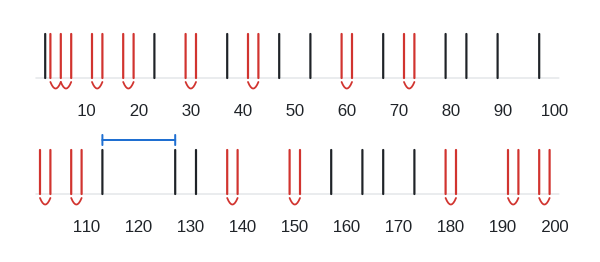
The gaps between the lines slowly grow. There is not a single prime between 113 and 127; these two neighbours are 14 apart. But the red pairs do not disappear. There are eight of them up to a hundred and seven between 100 and 200. Even if we set off towards the millions and billions, the twins do not die out.
Why are we interested in a difference of exactly 2? A difference of 1 is not interesting: of two neighbouring numbers one is always even, and the only even prime is 2. The only such pair is 2 and 3.
Notice also which number lies between the twins. Between 5 and 7 there is 6, between 11 and 13 there is 12, between 17 and 19 there is 18, between 29 and 31 there is 30. It is always a multiple of six. This holds for all twin primes except 3 and 5, and the explanation is simple. The number in the middle is even, because its neighbours are odd primes. And of three consecutive numbers one is always divisible by three. It cannot be one of the outer numbers, as they are primes greater than 3, so it has to be the middle one. Even and divisible by three means divisible by six. So twin primes always sit around a multiple of six: they have the form 6n − 1 and 6n + 1.
Why should there be infinitely many?
Let’s compare how many primes and how many twin primes there are below a given limit. The next picture shows, in blue, the number of primes and, in red, the number of twin prime pairs up to x, for x up to a million.
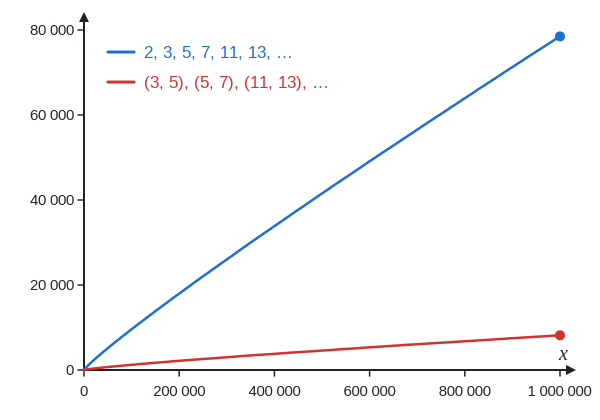
The red curve counts pairs, not individual primes. So 5 is counted twice, in the pair (3, 5) and in the pair (5, 7). No other prime is in two pairs: of three consecutive odd numbers one is divisible by three, so the only three primes with a difference of 2 are 3, 5 and 7.
Up to a million there are 78,498 primes and 8,169 pairs of twin primes. So twin primes are much rarer, but the red curve keeps rising and does not look as if it wants to stop.
Mathematicians also have an argument for it. Take any number n around a million, even or odd, and ask what the chance is that n and n + 2 are both prime. Around a million roughly every fourteenth number is prime. If the primes were scattered like rolls of a die, each number independently of the others, the chance would be
that is, about one in two hundred. But the primes are not random. If n is prime, it is odd, and then n + 2 is odd too. Among odd numbers every seventh one is prime, not every fourteenth, so the chance doubles to roughly one in a hundred. Divisibility by three, five, seven and other primes can be taken into account in a similar way. That lowers the chance again a little, by about a third altogether, and we get roughly one in 150. The reality around a million is one in 140.
The English mathematicians G. H. Hardy and John Littlewood turned this argument into a formula that predicts how many twin primes there will be below a given limit. Up to a million it predicts 8,248 pairs; the actual number is 8,169. Up to ten million it predicts 58,754 against an actual 58,980. So the prediction differs from reality by about one per cent, even though the dice argument knows nothing about where the primes really lie. That is how well the model fits, and according to it there are infinitely many twin primes.
As the numbers grow, the probability of finding a twin falls, but very slowly. In the first million numbers there are 8,169 pairs, in the tenth million only 5,113. According to the formula, each further million contains on average slightly fewer twins, but they never drop to zero. Even in a million numbers around a googol, that is, a one followed by a hundred zeros, the formula predicts about 25 of them. And there are infinitely many millions. For these reasons almost all mathematicians believe that there are infinitely many twin primes. But an argument based on chance is not a proof.
Why isn’t a computer enough?
The largest known twin primes were found in September 2016 by Tom Greer in the PrimeGrid project, in which volunteers lend their computers’ processing power:
Each of the two numbers has 388,342 digits. If we printed one of them on pages of 1,800 characters each, we would get a book of just over two hundred pages.
But not even such a huge find proves anything. If there were only finitely many twin primes, there would have to be a last pair. If somebody happened to find it, they would not know: without a proof nobody knows whether nothing comes after it. And a computer only ever searches a finite piece of the infinite number line.
If it really turned out that there are only finitely many twin primes, it would mean that the primes have some as yet unknown property that keeps them apart from a certain point onwards. And the dice model, which fits to within one per cent up to ten million, would stop working from that point.
Why Euclid’s trick doesn’t help
That there are infinitely many primes has been known since Euclid. His proof by contradiction goes roughly like this: we multiply together all the primes we know and add one. The result is a number that none of them divides, so there must be a prime we did not know yet.
Let’s try the same trick on twin primes. We take 2 · 3 · 5 · 7 = 210 and look at the numbers 209 and 211. None of the primes 2, 3, 5, 7 divides them. But 211 is prime and 209 is 11 · 19. Euclid’s trick guarantees some new prime, but it cannot guarantee that both numbers are prime at once. And for twin primes that is exactly the point.
Zhang’s breakthrough
Yitang Zhang got his doctorate in 1991 at Purdue University in the United States. But for several years after that he worked as an accountant and even at a Subway fast-food restaurant. In 2013 he was teaching as a lecturer at the University of New Hampshire and was over fifty when, on 17 April, he sent a paper to the prestigious journal Annals of Mathematics that astonished mathematicians.
Zhang proved that there are infinitely many pairs of primes that are less than 70 million apart. It does not say exactly how far apart they are, only that the gap is less than 70 million. At first sight this looks almost ridiculous. Seventy million, when we want two? But before that, nobody knew even this much. It had not been ruled out that neighbouring primes eventually drift apart for ever, and that every gap, however large, never comes back after a certain point. Zhang showed that this is not the case: even very far along the number line you keep finding two primes less than 70 million apart.
And something stronger follows from this. Which differences smaller than 70 million are possible at all? The difference of two odd primes is even, so only 2, 4, 6 and so on up to 69,999,998. That is roughly 35 million possibilities.
Now imagine 35 million drawers, each labelled with one of these differences. We put each pair from Zhang’s theorem into the drawer for its difference, for example 11 and 13 into drawer 2 and 23 and 29 into drawer 6. There are infinitely many pairs and only finitely many drawers. If each drawer ended up with only finitely many pairs, there would only be finitely many pairs altogether. So at least one drawer fills up with infinitely many pairs, and at least one particular difference occurs infinitely often. We don’t know which one. The twin prime conjecture says it is the difference 2.
The race to close the gap
Zhang’s paper set off an avalanche. Terence Tao, one of the best-known mathematicians of today, launched an open online project, Polymath, in June 2013, in which dozens of mathematicians refined Zhang’s method together on a blog. By the end of July they had brought the bound down to 4,680. In November 2013 James Maynard came up with a new, simpler method and a bound of 600. Tao hit on the same idea independently at almost the same time. Combining the two approaches brought the bound down to 246 in 2014.
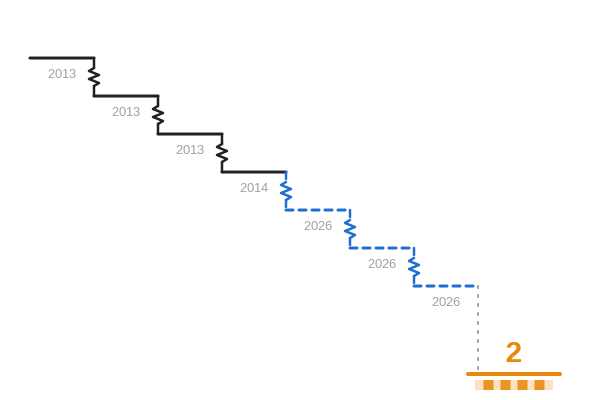
The steps are not to scale. Each one is the same height, which is why their vertical lines are broken. To scale, the first jump from 70 million to 4,680 would take up the whole picture and the rest would merge into a line at the bottom. The solid line shows verified results, the dashed line with a question mark the claims from 2026, which we will come to shortly.
The same drawer argument works for the bound 246. Infinitely many pairs differ by at most 246, the possible differences are 2, 4, …, 246, and that is only 123 drawers. One of them keeps filling up for ever. But at 246 the race stalled for twelve years. Why? The method that achieved it has a built-in limit. The authors of the project themselves showed that even if further unproved conjectures about primes were true, it would not get below 6. So even in the best case this method will not get further than six, and getting to two will need a completely new idea.
The year 2026
We are writing this section on 23 November 2026. At the turn of August and September 2026, within a few days, several preprints appeared, that is, papers published on the internet before peer review, when nobody independent has checked them yet:
- The mathematician Julia Stadlmann claims a bound of 240. She took the classical route, without artificial intelligence.
- Nine mathematicians, among them the well-known American mathematician Ken Ono, claim a bound of 212. The conversion of the proof into a form that a computer can check was produced for them by the program AxiomProver from the company Axiom Math.
- The company OpenAI claims a bound of 186, and in the abstract of its paper it writes that the proof is the work of its model GPT 6 Astra. In doing so it builds on earlier results of the Polymath project and of Stadlmann.
All three improve the same method from 2013 and 2014. So they are steps down the same staircase, and they will not get below six this way.
In both results with artificial intelligence, the proof has been converted into the program Lean. It is a program that checks every step of a proof and lets nothing through that does not follow from the previous steps. But here only conditionally. The authors gave it some ready-made results from other papers as assumptions, and Lean did not verify those, it simply accepted them. For OpenAI these are estimates taken from earlier work and numerically computed bounds on integrals; for the team with Ono, similar inputs from earlier work. Other similar claims have also appeared. According to the encyclopedia MathWorld, as of 7 September 2026 nobody had yet reported an independent verification of the new bounds, and we have not found any newer report of a verification by 23 November 2026. Until then, 246 is the last certain bound, and everything below it is promising but unconfirmed progress. The conjecture itself is unchanged; it is still a long way from 186 to 2.
What is it good for?
To be honest: it has no direct use. Twin primes are more a test of how well we understand the way the primes are scattered along the number line. And so far it is clear that we don’t understand it as well as we would like.
Twin primes have left one practical trace, though. In 1919 Brun proved that if we add up the reciprocals of all twin primes, that is
Try it yourself
Find all the twin primes between 100 and 150. The prime number checker will tell you whether a number is prime. For a harder task: check for each pair you find that the number between them is divisible by six. And then find the largest gap between two neighbouring primes up to 200.
Solution: between 100 and 150 there are three pairs, 101 and 103, 107 and 109, 137 and 139. In the middle are the numbers 102 = 6 · 17, 108 = 6 · 18 and 138 = 6 · 23. The pair 149 and 151 already goes past 150. The largest gap up to 200 is between 113 and 127, a difference of 14. It is the blue one in the first picture.
See also
- Prime numbers
- Goldbach’s conjecture, another unsolved problem about primes
- Collatz conjecture
- Proof by contradiction, with Euclid’s proof that there are infinitely many primes
- The Riemann hypothesis, which is about how densely the primes are spread
- Famous problems