Colouring the plane
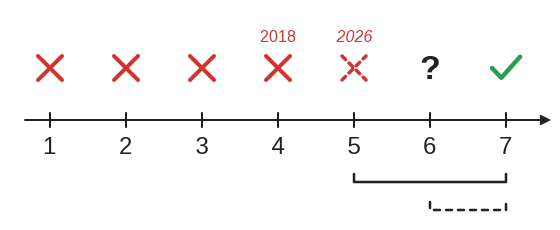
Take an infinitely large sheet of paper and colour absolutely every point on it. There is just one rule: no two points that are exactly 1 centimetre apart may have the same colour. Imagine a pair of compasses opened to 1 cm. Wherever you stick it in, the other leg must land on a different colour from the one under the needle. What is the smallest number of colours you need for this? This is the Hadwiger–Nelson problem, and nobody knows how it turns out. Since the 1950s we have known that seven colours are enough, and since 2018 that four are not. So there are three possibilities left: 5, 6 or 7. On top of that, in 2026 the company OpenAI announced a proof that five are not enough either, but nobody has checked it independently yet.
What exactly does “colour every point” mean? A colouring is a rule that assigns one colour to each point of the plane. To picture it, we colour regions, like in the tiling we will see below, but a colouring may also be much wilder. It does not matter whether the distance is 1 centimetre or 1 kilometre. When we enlarge or shrink the picture, everything still holds. That is why people only talk about the distance 1.
It has only the colours in common with the famous four-colour problem for maps: there, neighbouring countries of the same colour must not touch; here, two points must not “see” each other at a distance of exactly 1, even if they lie in the middle of completely different regions.
What is it good for? To be honest, practically nothing. It attracts mathematicians because anyone can understand the question, and yet they have been racking their brains over it for more than seventy years. It is also a test of how far computer-assisted proofs can reach, as we will see with five and with six.
Why two colours are not enough
Draw an equilateral triangle with side 1. Any two of its vertices are exactly 1 apart, so all three must have different colours. With two colours it cannot be done; two of the vertices would always come out the same.
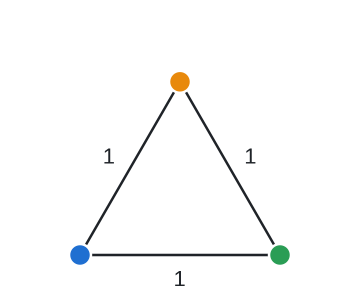
Notice how the proof works. We did not have to examine the whole infinite plane; three points were enough. If a piece of the plane cannot be coloured, the whole plane cannot be coloured either, because that piece is part of it. All the lower bounds we will see here are built on this idea.
Such pieces are called graphs: a few points and edges between those that are exactly 1 apart. You may have come across graphs in the seven bridges of Königsberg. For a graph the task is the same as for the plane: points joined by an edge must have different colours.
Why three colours are not enough
For three colours not to be enough either, we have to come up with a cleverer graph than a triangle. In 1961 the brothers Leo and William Moser found one, and because of its shape it is called the Moser spindle. It has seven points and eleven edges, each exactly 1 long.
Let’s build it. We put two equilateral triangles ABC and BCD with side 1 together along the side BC and get a rhombus ABCD. Watch the order of the letters: the opposite vertices are A and D, and going round the perimeter the vertices come in the order A, B, D, C. The long diagonal AD is twice the height of one of the two triangles. We work out the height using Pythagoras’ theorem:
So the diagonal is this long:
We attach a second identical rhombus AEFG, this time with opposite vertices A and G, at the same vertex A. Then we rotate it so that the far vertices D and G are exactly 1 apart. This adds the eleventh edge DG, and that is where the whole trick lies.
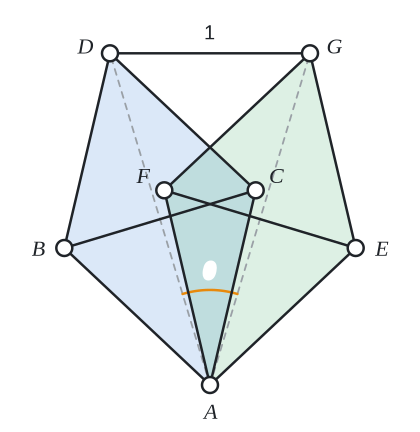
For the curious: through what angle θ should the rhombus be rotated? Without it we could not draw the spindle exactly. If you do not know the cosine rule yet, you can skip the calculation. Triangle ADG has sides
We make the cosine the subject:
And we work out the angle:
Now try it yourself. Copy the spindle and colour its points with three colours so that no edge joins two of the same colour. Hint: start with one rhombus. The solution is just below the next heading, so don’t look yet.
Why it cannot be done with the spindle
We start with the rhombus ABCD. The points A, B and C form an equilateral triangle, so they have three different colours, say orange, blue and green. The point D is joined to both B and C, so it must not be blue or green. The only choice left is orange. So the opposite vertices of the rhombus must have the same colour.
Exactly the same happens with the second rhombus: the point G must also have the colour of the point A. But D and G are exactly 1 apart and both are orange. A contradiction.
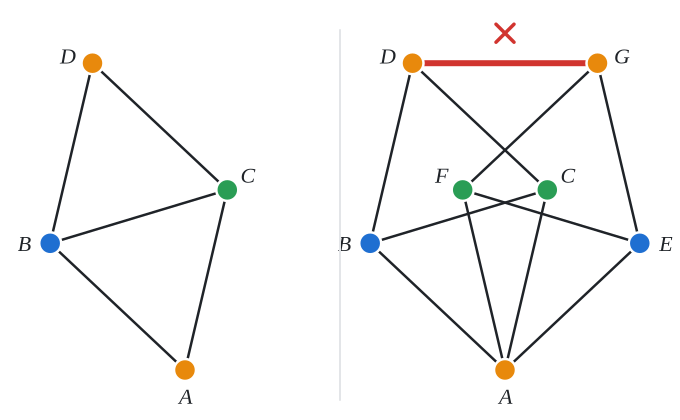
It does not matter which three colours we choose; it turns out the same every time. So the spindle cannot be coloured with three colours, and therefore neither can the plane. The plane needs at least four colours.
Why seven are enough
We prove the upper bound the other way round. Here a piece is not enough; we have to show a colouring of the whole plane that keeps to the rule. John Isbell described such a colouring as early as 1950, and nobody has found a better one to this day. We put the plane together from regular hexagons like a honeycomb and colour them with seven colours:
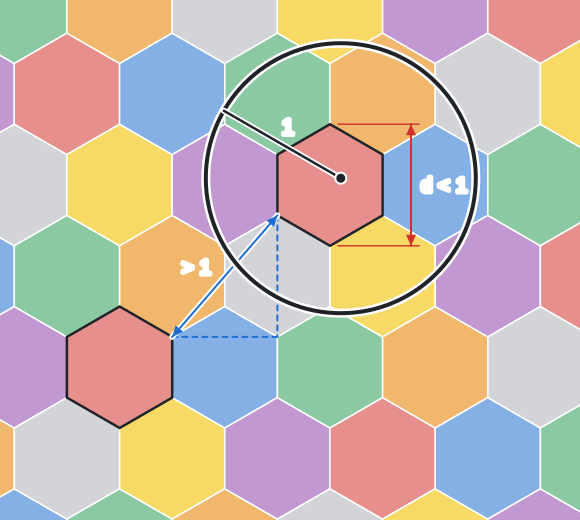
Why seven exactly? Take one hexagon and its six neighbours. Any two of these seven have points that are closer together than 1 and also points that are further apart than 1. So somewhere in between we can also find two points exactly 1 apart, and this is true even for two neighbours that do not touch each other. That is why all seven hexagons need different colours. What is more, the pattern is arranged so that each colour only repeats at a decent distance.
And how big should the hexagons be? We choose hexagons with side 0.45. The longest distance inside one of them, its diameter, is twice the side:
That is less than 1, so two points in the same hexagon cannot be 1 apart. And the two nearest hexagons of the same colour? The closest points they have are two vertices. Horizontally they are apart by the width of a hexagon, that is, two heights of an equilateral triangle with side 0.45, and vertically by the diameter 0.9. In the picture these are the dashed shorter sides. By Pythagoras’ theorem the gap is:
That is more than 1. So two points of the same colour are either in the same hexagon and closer than 1, or in different ones and further than 1. Exactly 1 never comes out. A circle of radius 1 around any point therefore only lands on other colours, as in the picture. Another side length would work too, as long as it is between
One small detail is left: points exactly on the boundary between two hexagons. We give each side to just one of them, and with a gap of 1.19 there is plenty of room for this to work.
Five: an amateur and a computer
Between four and seven nothing then moved for more than fifty years. Only in April 2018 did Aubrey de Grey come up with a breakthrough. He is not a mathematician; he is a biologist known for research into ageing, and he does maths in his spare time. He put together a graph with 1,581 points that cannot be coloured with four colours. So the plane needs at least five colours. His graph is made up of many Moser spindles and similar pieces, on which equal colours are laboriously forced.
But how do you find out that 1,581 points cannot be coloured with four colours? There are 41581 possibilities in all, a number with 952 digits, and no computer can try that many. So the program tries cleverly: as soon as two joined points have the same colour, there is no point colouring the rest. It goes straight back one step and tries another colour, so it never goes through the vast majority of the possibilities at all. Other mathematicians soon confirmed the result independently.
How are such networks made? We take a piece of a triangular grid and add a copy of it rotated by the angle θ from the spindle:
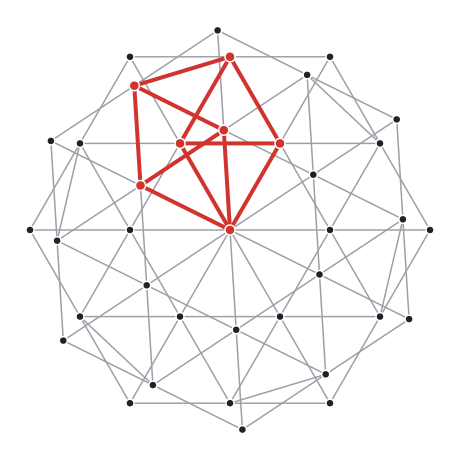
It is only 37 points and they already have 90 edges of length 1. One whole spindle is hidden in them in red. De Grey’s graph is made of similar pieces, only it is more than forty times larger and there are lots of spindles in it. A graph that big cannot be checked by hand, so after de Grey’s discovery a public online collaboration of mathematicians (the Polymath16 project) set about looking for smaller graphs. The smaller the graph, the easier it is to verify and the better it can be understood. In 2020 they got down to 509 points, and that is still the smallest known graph that cannot be coloured with four colours. Jaan Parts, who found it, then also wrote up a proof that four colours are not enough which can be checked without a computer.
It is nice that such an old problem was moved forward by an amateur. Mathematics is open to anyone with a good idea, patience and a computer.
Why is it so hard?
The two bounds are proved in completely different ways. For the upper bound, one clever colouring is enough, such as the hexagon tiling. For the lower bound you need to find a network of points that cannot be coloured, and it may be huge. For three colours seven points were enough; for four it already took hundreds. For five colours nobody knows any such network.
2026: six?
We are writing this section on 23 November 2026. In October 2026 OpenAI, a company that develops artificial intelligence, published hundreds of mathematical manuscripts. One of them, dated 23 September 2026, claims that the plane cannot be coloured with five colours either. If that holds, the answer is 6 or 7.
The proof does not use any big graph. The authors converted it into the Lean language, in which a computer could check every step; but this check is still waiting too. Lean is a programming language for proofs: a proof is written in it in so much detail that the program goes through every step and lets no gap through. But it has not yet passed peer review in a journal, and we have not found any statements from experts who have worked on the problem for a long time either. Some mathematicians already count on the bound of 6, while surveys by others still give 5, 6 or 7. Until people have checked the proof, it is a claim, not a certainty. That is why the five on the opening number line is only dashed.
However it turns out, a question mark will remain between six and seven. Anyone who wants to prove seven must find a graph that cannot be coloured with six colours. And anyone who wants six must come up with a colouring of the plane with six colours, better than Isbell’s tiling. Nobody has managed either yet.
You will find more famous problems in the category Famous problems.
See also
- The seven bridges of Königsberg, where graph theory began
- Proof by contradiction, which is exactly what we did with the spindle
- Goldbach’s conjecture
- The Millennium Prize Problems