Inscribed square problem
Draw any closed line on a piece of paper that does not cross itself anywhere, for example the outline of an island on a map. Can you always find four points on it that are the vertices of a square? That is the question the German mathematician Otto Toeplitz asked in 1911. The answer is: for “nice” curves, yes, and that has been proved, not just tried out on a few pictures. But for absolutely every curve, nobody knows. This is the inscribed square problem. It looks like an exercise from a geometry lesson at school, and yet mathematicians have been stuck on it for more than a hundred years.
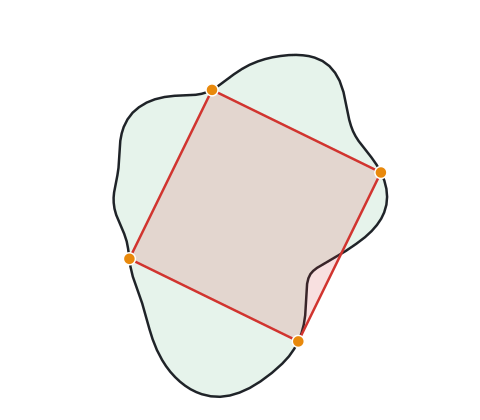
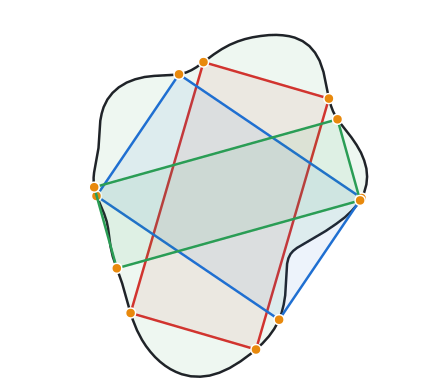
A square is inscribed in a curve when all four of its vertices lie on the curve. It can be large or small, turned at any angle, and its sides may even stick out beyond the island. In the picture it was found by a computer. It tried pairs of points on the coast as opposite vertices of a square, worked out the other two vertices and looked for a pair for which both of them land exactly on the coast. When the island changes a little, the square only moves a little.
Which curves count
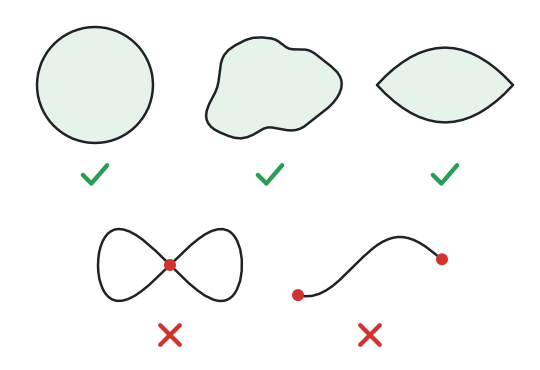
The curve must be closed and must not cross or touch itself anywhere. Corners are fine. Mathematicians call such a line a simple closed curve (or a Jordan curve).
Circle, ellipse and triangle
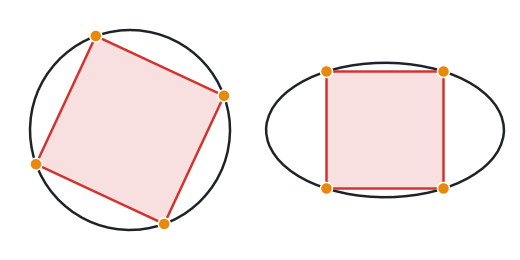
The simplest is the circle. You can inscribe a square in it turned at absolutely any angle, so it has infinitely many of them. Other curves are not so well off: an elongated ellipse has just one inscribed square.
A square always fits into a triangle: one of its sides lies on a side of the triangle and its top two vertices are on the other two sides. How many there are depends on the angles. An acute triangle has three inscribed squares, a right-angled triangle two and an obtuse triangle only one.
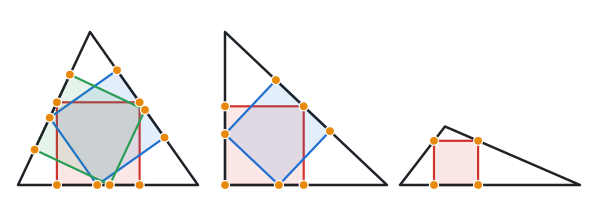
As early as 1916 Arnold Emch proved that every polygon has an inscribed square, however complicated it is. Anyone who thinks the other curves will be just as easy is in for a disappointment.
We can always find a rectangle
Before we get on to squares, let’s try something easier: a rectangle. One can be inscribed in every simple closed curve, and this has been proved, with no conditions at all. The proof was found by Herbert Vaughan in the late 1970s and made famous by a 3Blue1Brown video. Let’s go through it.
First let’s look at the diagonals of a rectangle. They are the same length and they bisect each other. It also works the other way round: when two line segments have the same length and the same midpoint, their ends are the vertices of a rectangle.
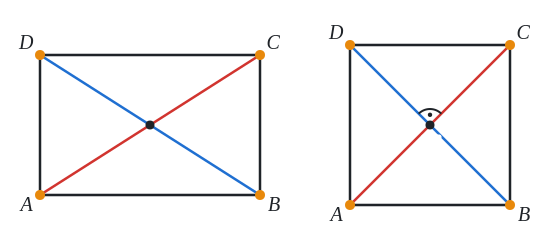
So all we need is to find on the curve two different pairs of points that have the same midpoint and the same distance. Each of them will be one diagonal of a rectangle. But there are infinitely many pairs of points on the curve, so how do we find two among them that match in both respects?
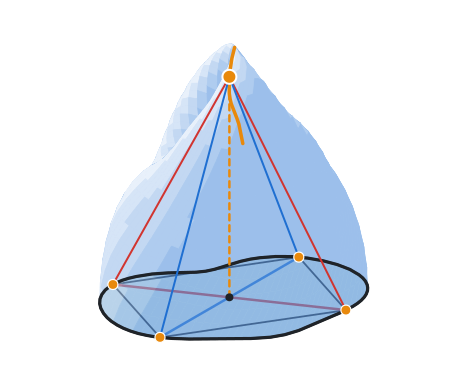
Vaughan’s trick is to record each pair as a single point in the space above the paper. We place it directly above the midpoint of the pair and raise it to a height equal to the distance between the two points of the pair. So the position above the paper tells us where the midpoint is, and the height tells us the distance. Why this way? Because two pairs with the same midpoint and the same distance then end up at one and the same point. Instead of a rectangle, we are looking for a place where two points meet.
When we record all the pairs like this, we get a surface. The closer together the two points of a pair are, the lower their point is. When the two points merge, the distance is zero and the point lies right on the curve. So the edge of the surface is the curve itself: the surface is stuck to the paper along the whole curve and rises above it everywhere else.
Why the surface has to intersect itself
This surface is a Möbius strip, that is, a strip of paper whose ends are glued together with a half-twist. We can imagine why. Put two points on the curve, a red one and a blue one, and move them both in the same direction until the red one reaches the place where the blue one started, and the blue one the place where the red one started. You have the same pair again, only the points have swapped sides.
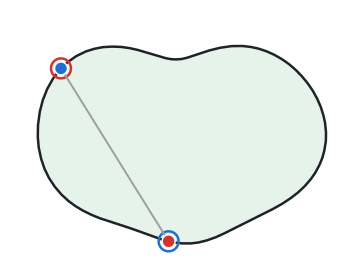
Meanwhile the point of the pair on the surface has gone round a closed path and come back to the same place, but flipped over: what was on the left is now on the right. That cannot happen on an ordinary ring; there, after going all the way round, you come back the same way you set out. The flip is caused by the half-twist. In the earlier picture of the surface you can hardly see the strip, it is crumpled into the shape of a tent, but the half-twist is there.
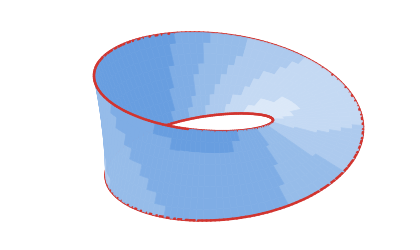
A Möbius strip has a single edge, which goes round it twice. For our surface, that edge is the whole curve on the paper. And now comes a step that we will not prove here; it is a deeper theorem from topology. But you can try it out: glue a strip of paper with a half-twist and try to stick its whole edge to the table so that the rest of the strip stays above the table. You will not manage it without the strip passing through itself somewhere. You would have to cut the paper.
At the place where the surface passes through itself, two different pairs of points with the same midpoint and the same distance meet, and we have a rectangle. In the picture of the surface this is the orange line; each of its points gives one rectangle.
Why does this trick not give a square? A square also needs the diagonals to be perpendicular to each other. But our surface only remembers the midpoint and the distance; the angle between the diagonals slips away from it. The rectangle it finds may be very elongated.
Why the square works for smooth curves
A curve is smooth when it has no sharp corners or teeth. You can tell with a magnifying glass: when you magnify a smooth curve enough, any piece of it looks like a straight line. For smooth curves the problem has been solved since the middle of the 20th century. The main idea is counting squares. A typical smooth curve has an odd number of inscribed squares. An ellipse has one. When we slowly reshape it into another smooth curve, a new square cannot appear on its own: one appears, immediately splits in two, and the two then move apart. They disappear in the same way: two merge into one, and that one vanishes. Why it has to be like this can be shown, it just takes more calculation. So squares appear and disappear in twos, an odd number stays odd, and zero is not odd, so there is always at least one square. This kind of gradual change is shown in the animation of the island at the start of the article. An inscribed square has also been proved for curves with corners (but not with cusps) that are smooth between the corners, like the square or the leaf in the picture above.
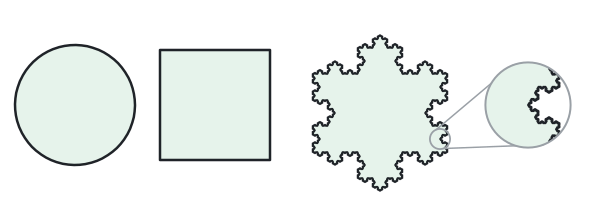
For a square, the magnifying glass shows a straight line everywhere except at the four corners. But a curve can be jagged absolutely everywhere, like the Koch snowflake. We get it from a triangle by replacing the middle third of each side with a smaller tooth and repeating this for ever. However much you magnify it, you will still see teeth. It is still a simple closed curve, it just is not smooth anywhere.
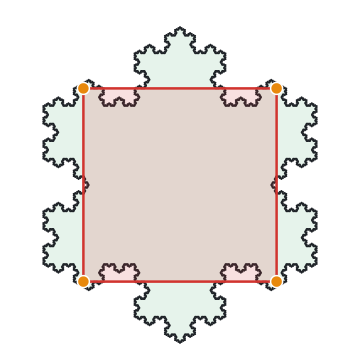
The Koch snowflake is not a counter-example, though. It is symmetrical, and for symmetrical curves, even ones as wild as this, an inscribed square has been proved.
The trap: squares that shrink
So why can’t the general problem be finished off? There is an obvious trick: we approximate the wild curve by smooth curves that are more and more jagged and more and more like it. Each of them has an inscribed square, we know that. From these squares we would then like to get a square on the wild curve.
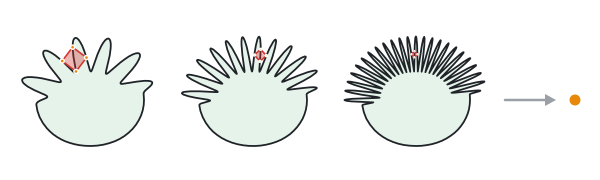
But nobody can guarantee that the squares will not vanish. They can hide in narrower and narrower teeth and shrink, and in the limit all that is left of them is a single point, not a square. Choosing the largest square on each curve does not help either. The trouble is that all the squares can shrink like this at once.
So a counter-example would be a curve on which no four points form a square. It would have to be jagged everywhere, rather like the Koch snowflake, but without its symmetry, and nobody has found one. But nobody can prove that it does not exist either. A computer will not help here: it can only try finitely many curves with finite precision, and the suspect curves have teeth at every scale, so they cannot even be drawn exactly.
In practice nothing depends on the answer; no bridge will fall down because of it. What attracts mathematicians is mainly that an idea that cracked it would probably move other areas of mathematics forward too.
What has been achieved
An interesting question is about rectangles of a given shape, for example twice as long as they are wide. The Möbius strip guarantees some rectangle, but not its shape. In 2020 Joshua Greene and Andrew Lobb proved that every smooth curve has an inscribed rectangle with any ratio of sides.
It is a strange situation. We can inscribe a rectangle in absolutely every curve, a rectangle of a prescribed shape so far mainly in smooth ones, and a square, the most ordinary rectangle of all, still not in every curve.
And there is one more oddity. A square is a rectangle with all its sides the same length, that is, a rectangle that is also a rhombus. We can inscribe a rectangle in every curve, and a rhombus too; Mark Nielsen proved that in 1995. But both at once, in one shape, nobody has managed yet.
In a paper from 2024, which a journal published this year, Greene and Lobb showed an inscribed square for many curves that are not smooth as well. It is enough for the curve to be made up of two pieces, an upper one and a lower one, neither of which anywhere rises or falls more steeply than at an angle of 67.5°, that is, by more than
Try it yourself
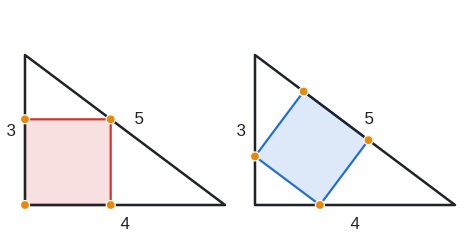
Take a right-angled triangle whose two shorter sides are 3 and 4 and whose hypotenuse is 5. Inscribe in it a square that has one vertex at the right angle, and work out its side. A right-angled triangle has a second inscribed square as well. Can you find it, and is it larger or smaller? You will find the solution at the end of the article.
Solution
Let the side of the square be s. The square divides the triangle into itself and two small right-angled triangles: one above the square with shorter sides s and 3 − s, the other to the right of it with shorter sides 4 − s and s. Their areas together give the area of the whole triangle, that is,
We multiply out and add the fractions:
The s2 terms cancel:
The second square has one side on the hypotenuse. The height to the hypotenuse is
So the square on the hypotenuse is a little smaller.
See also
- The Poincaré conjecture, another famous problem about shapes
- Collatz conjecture
- Goldbach’s conjecture
- Famous problems