Odd perfect numbers
Add up the divisors of the number 6, except 6 itself: 1 + 2 + 3 = 6. You get six again. The same happens with 28: 1 + 2 + 4 + 7 + 14 = 28. Such numbers are called perfect, and the ancient Greeks already admired them. Today we know 52 of them, and all of them are even. Is there also an odd perfect number? Nobody knows. It is one of the oldest unsolved questions in mathematics, and all we know about it is that if such a number existed, it would have more than 1,500 digits.
Divisors and proper divisors
A divisor of a number is a number that divides it without a remainder. Let’s show this with blocks. Six blocks can be arranged into a rectangle in two ways:
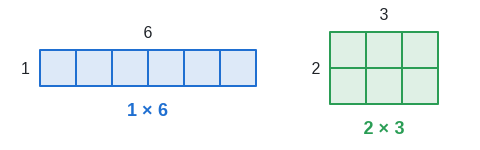
The sides of the rectangles are 1, 2, 3 and 6, and these are exactly all the divisors of 6. Six cannot be divided by five or by four, and we cannot make a rectangle with such a side out of six blocks.
If we leave out the number itself, we are left with the proper divisors: for 6 they are 1, 2 and 3. A number is perfect if it equals the sum of its proper divisors. In this article we add up the proper divisors; there is just one place where I will say explicitly that we are adding up all of them.
Let’s try other numbers. Twelve has the proper divisors 1, 2, 3, 4 and 6, and their sum is 16, which is more than 12. Such numbers are called abundant. Eight has the proper divisors 1, 2 and 4 with the sum 7, which is less than 8. That is a deficient number. An exact match is rare, as the picture shows. Horizontally it has the numbers 1 to 30, vertically the sum of their proper divisors:
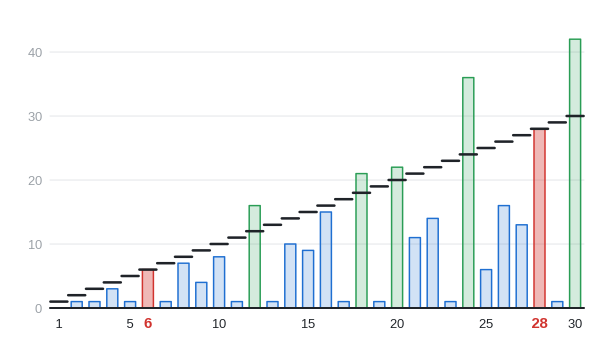
The black line at each bar is the height the bar would need for the number to be perfect. So for the number 12 the line is at height 12 and the bar at height 16. A blue bar below the line belongs to a deficient number, a green one above the line to an abundant number. Among the numbers up to thirty, only 6 and 28 hit the line exactly, in red. Of the others, 23 are below the line and five above it. The low bars of height 1 belong to prime numbers, which have only one proper divisor, the number one.
Euclid’s recipe
The next perfect numbers are 496 and 8,128, and then nothing for a long time: the fifth one is only 33,550,336. They all have the same structure. Let’s break them down into prime factors. Prime factors are the primes that a number is made of by multiplication, for example 28 = 2 × 2 × 7 and 496 = 2 × 2 × 2 × 2 × 31. Using powers we can write it more briefly:
It is always some power of two times a prime. And the prime is not just any prime: 3, 7, 31 and 127 are one less than the next power of two, that is, 4, 8, 32 and 128.
Euclid already wrote down the recipe in his Elements around 300 BC. Multiply k twos together, which gives 2k, and subtract one. So the number k tells us how many twos we multiply. If 2k − 1 is prime, then the number
is perfect. Let’s try the recipe for the first six values of k:
| k | 2k − 1 | prime? | 2k−1 × (2k − 1) | perfect? |
|---|---|---|---|---|
| 2 | 3 | yes | 2 × 3 = 6 | yes |
| 3 | 7 | yes | 4 × 7 = 28 | yes |
| 4 | 15 = 3 × 5 | no | 8 × 15 = 120 | no |
| 5 | 31 | yes | 16 × 31 = 496 | yes |
| 6 | 63 = 7 × 9 | no | 32 × 63 = 2,016 | no |
| 7 | 127 | yes | 64 × 127 = 8,128 | yes |
Primes of the form 2k − 1 are called Mersenne primes. But not every number of the form 2k − 1 is prime. For k = 11 we get 2,047, and that is 23 × 89. Mersenne primes are rare, and finding them is hard work.
Why the recipe works
Let’s look at 496 = 16 × 31. Because 31 is prime, every divisor of 496 has only two options: either it is a divisor of 16, or a divisor of 16 times 31. So the divisors line up in two rows:
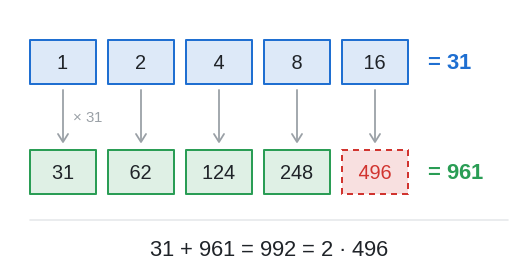
In the top row a doubling trick works. One plus two is three, one less than four. Add four and we have seven, one less than eight. Add eight and we have 15, one less than 16. Each further power of two again only tops the sum up to one less than the next power. That is why for every k we have 1 + 2 + 4 + … + 2k − 1 = 2k − 1, and so for 496 we get 1 + 2 + 4 + 8 + 16 = 32 − 1 = 31. And here is the clever part of the recipe: the sum of the top row is exactly the prime 31.
The bottom row is the top row times 31, so its sum is 31 × 31 = 961. This time we add up all the divisors, including 496 itself:
The sum of all the divisors is twice the number. If we subtract 496 itself (dashed in the picture), the sum of the proper divisors is left: 992 − 496 = 496. It equals the number itself, and so 496 is perfect. It works out the same way for every Mersenne prime.
By the way, 31 + 961 is the same as (1 + 2 + 4 + 8 + 16) · (1 + 31). We got the sum of the divisors of the whole number by multiplying the sums of the divisors of its two pieces. This always works when the pieces have no common divisor other than one. For example, 12 = 4 × 3 and (1 + 2 + 4) · (1 + 3) = 28, which really is 1 + 2 + 3 + 4 + 6 + 12.
Why does 2k − 1 have to be prime? If it were not, extra divisors would appear. For k = 4 we have 24 − 1 = 15 = 3 · 5, and the number 8 · 15 = 120 has proper divisors with the sum 240. Here the sum of the proper divisors is twice the number, when it should be equal to it. The number 120 is abundant, not perfect.
More than two hundred years ago Leonhard Euler also proved the converse: every even perfect number comes from Euclid’s recipe. So we know everything about even perfect numbers, except how many there are.
How many Mersenne primes are there?
Every Mersenne prime gives one even perfect number through the recipe, and every even perfect number comes from one Mersenne prime. There are as many of one as of the other. They are searched for by volunteers who lend their computers to the GIMPS project (Great Internet Mersenne Prime Search). So far they have found 52, and that is why we know 52 even perfect numbers. The largest known Mersenne prime, from October 2024, is 2136,279,841 − 1 and has 41,024,320 digits. Whether there are infinitely many of them, nobody knows.
What we know about an odd perfect number
Nobody has found an odd perfect number. Even so, mathematicians know a surprising amount about the number they are looking for, like a detective who knows the culprit’s height, shoe size and coat colour but has never seen them. If an odd perfect number existed:
- it would be greater than 101500, so it would have at least 1,501 digits (Pascal Ochem and Michaël Rao, 2012),
- its prime factorisation would contain at least 101 prime factors, counting repetitions (same source),
- of which at least 10 would be different (Pace Nielsen, 2015),
- its prime factorisation would have a special structure found by Euler: one prime would occur an odd number of times and all the others an even number of times.
Euler’s structure is important because it narrows down the search. We don’t have to examine all odd numbers, only those with such a factorisation. But on its own it is not enough. The number 45 = 3 × 3 × 5 satisfies it: 5 occurs once in the factorisation and 3 twice. But its proper divisors 1, 3, 5, 9 and 15 only add up to 33. All the conditions on the list would have to hold at once, and even then it would not be certain that such a number really exists.
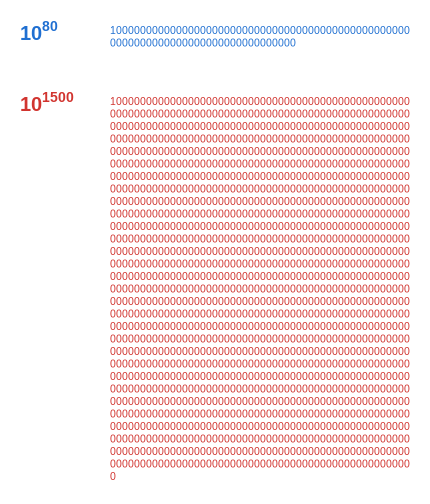
How big is 101500? According to estimates, there are around 1080 atoms in the observable universe, a number with 81 digits. An odd perfect number would have at least 1,501 digits, almost a whole standard page of 1,800 characters. In the picture, at the top in blue is the number of atoms in the universe, at the bottom in red the smallest possible size of an odd perfect number:
Descartes’s impostor
In 1638 the French philosopher and mathematician René Descartes wrote that he saw no reason why an odd perfect number could not exist. In the same year he found a fake: a number that looks like an odd perfect number because one piece of its factorisation, 22,021, looks like a prime, although it is not one.
If 22,021 were prime, the factorisation would have exactly Euler’s structure, and the sum of the divisors, calculated by multiplying the sums for the individual pieces, would come out as for a perfect number. But 22,021 = 19 × 19 × 61, so it has more divisors than were counted. The real sum of the proper divisors is 227,441,894,589, about 15% more than the number itself. Mathematicians call such numbers spoofs. Descartes’s number is still the only known odd spoof of this kind.
Why isn’t a computer enough?
With the help of computers it has been proved that there is no odd perfect number below 101500. The computer did not go through the numbers one by one; it would not have managed that even in billions of years. Mathematicians cleverly worked out what the factorisation of the number they are looking for could look like, and the computer then went through all the possible factorisations and showed for each one that it leads to a contradiction. But above the limit there are infinitely many odd numbers, and no computer will check them all. Pushing the limit a little higher will not decide anything.
Proving that no odd perfect number exists would mean finding a contradiction: showing that some of the conditions it would have to satisfy rule each other out. For example, that it would have to be divisible by some prime and at the same time could not be divisible by it. Mathematicians have found dozens of conditions, but nobody has yet discovered a contradiction between them. So we keep learning more and more about the number we are looking for, and yet we don’t know whether it exists at all.
Why does it matter?
To be honest: practically not at all. No technology depends on an odd perfect number. If one were found, it would disprove a centuries-old conjecture, but otherwise nothing would change. It would be easy to check: it would be enough to give its prime factorisation, and a computer would work out the sum of the divisors by the same multiplication as for the number 496. It is a puzzle that a school pupil can understand and nobody can solve, and yet it is about something as ordinary as divisors. It nicely shows how little we actually know about divisors.
Try it yourself
Among the numbers up to thirty we saw five abundant numbers in the picture: 12, 18, 20, 24 and 30. All of them are even. Is the number 945 abundant? It helps if you first break it down into prime factors.
Solution: 945 = 27 × 5 × 7. It has 16 divisors, from 1 to 945. We get their sum by multiplying the sums of the divisors of the individual pieces, which have no common divisor:
Without 945 itself, the sum of the proper divisors is 975. That is more than 945, so the number is abundant. And it is even the smallest odd abundant number. All the odd numbers below it have a sum of proper divisors smaller than the number itself.
You will find more famous problems in the category Famous problems.
See also
- Prime numbers
- Powers and roots
- Prime factorisation calculator
- Goldbach’s conjecture, another question about primes that anyone can understand
- Proof by contradiction