The three-body problem
Release two bodies into space, say a star and a planet, and Newton’s laws will tell you exactly what they will do: the planet will orbit along an ellipse, in a billion years’ time just as it does today. Add a third body and everything goes wrong. There is no general formula for the paths of three bodies, and the motion is often chaotic. That does not mean random, only sensitive to tiny details: a minute change at the start leads, after a while, to a completely different result. This is called the three-body problem.
And what about the Sun, the Earth and the Moon? There the Sun is much heavier than the other two, so the Earth orbits almost exactly along an ellipse. The Moon’s motion is more complicated – it is said to have given Newton a headache – but astronomers can calculate it very accurately by making successive corrections. The trouble starts with bodies of similar mass that come close to each other.
You may know Liu Cixin’s novel of the same name or the series based on it. In it, three suns shine on a planet and nobody can predict when the frost will come and when the heat. We will reveal how much truth there is in that at the end.
So is it unsolved? A computer can calculate the paths of three bodies to any accuracy you ask for; it just takes time. But with chaotic motion that is not enough if we want a prediction a very long way ahead, and some questions remain open. So in practice the problem is solved by computer, but in principle, that is, by a formula, it is not.
Two bodies: an ellipse for ever
Gravity pulls any two bodies towards each other, the more strongly the heavier they are and the closer together. From this and from Newton’s second law, Isaac Newton worked out in 1687 that two bodies that hold on to each other orbit along ellipses.
Careful: they both orbit around their common centre of mass, and that lies closer to the heavier body, just as on a seesaw a dad has to sit closer to the middle than his little daughter:
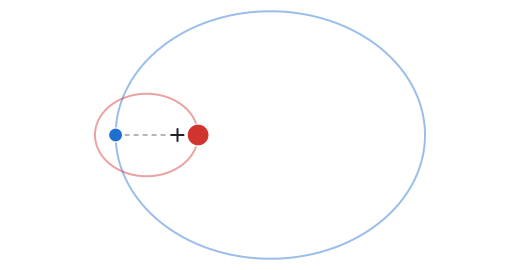
This is also how the Earth goes round the Sun, only the centre of mass of the Sun–Earth system lies deep inside the Sun, because the Sun is about three hundred and thirty thousand times heavier.
For two bodies, the formulas tell us which ellipse they travel along. Where they will be on it at any moment is given away by one simple equation, Kepler’s equation. For three bodies this cannot be done.
A prize from a king, a mistake costing a thousand kronor
In 1885 King Oscar II of Sweden offered a prize for solving the many-body problem, that is, for a description of the motion of the planets that would hold for ever. The prize, a gold medal and 2,500 Swedish kronor, went in January 1889 to the French mathematician Henri Poincaré. He did not bring a complete solution, but he discovered so much that was new in the three-body problem that he got it anyway.
Then came the blow. While the work was being prepared for printing, a serious mistake turned up in it: Poincaré had assumed that the paths that approach a certain repeating path and the paths that move away from it merge into a single smooth surface. In reality they cross again and again, infinitely many times. The journal had already been printed; the whole print run was destroyed and Poincaré paid for a new printing. It cost him more than 3,500 kronor, roughly a thousand more than he had won. But in the correction he described how wildly the paths tangle together. With that he laid the foundations of today’s chaos theory.
Why there is no formula
A solution exists; it just cannot be written down neatly. Why does it work for two bodies? Some quantities do not change during the motion, for example the total energy or the momentum. Physicists call them integrals of motion. For two bodies there are enough of them for both the ellipse and the motion along it to follow; for three there are not. In 1887 the German mathematician Heinrich Bruns proved that there is no further integral that would be an algebraic function of the positions, velocities and time.
It is a bit like equations. For a quadratic equation you know a formula; for the general equation of the fifth degree no formula using radicals exists, and yet a computer can solve it to as many decimal places as you like.
An untidy formula for three bodies does in fact exist. In 1912 the Finnish mathematician Karl Sundman found an infinite sum that describes the motion of three bodies for ever, provided the system as a whole is rotating. But it approaches the correct value incredibly slowly. According to an estimate from 1930, the accuracy astronomers work with would require adding up at least 108,000,000 terms, that is, a one followed by eight million zeros. Just writing this number down would take thousands of pages.
Chaos is not chance
The most famous example of chaos is the so-called Pythagorean problem. Three bodies with masses 3, 4 and 5 are at rest at the vertices of a right-angled triangle with sides 3, 4 and 5, each one opposite the side with the same number. The nice numbers are historical: this is how the Danish astronomer Carl Burrau worked the problem out by hand in 1913. Then we let the bodies go. We calculated it twice, the second time with the red body moved by a millionth of a unit. If the sides of the triangle measured 3, 4 and 5 metres, that would be a thousandth of a millimetre, much less than the thickness of a hair.
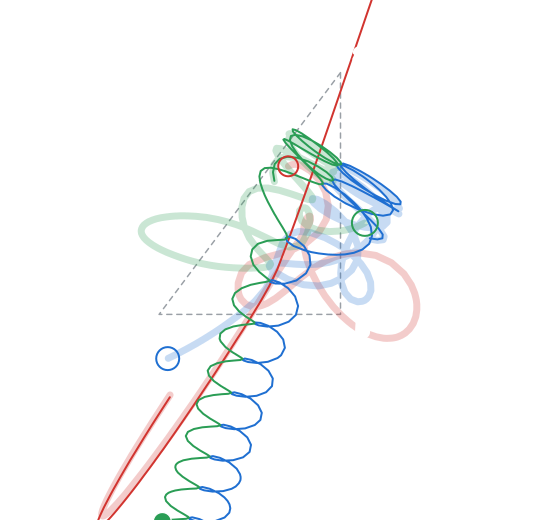
The solid dots and the rings coincide for a long time, then they separate and each calculation turns out differently. In the first, the blue and green bodies join up into a pair that flies off downwards, and the red one flies away in the opposite direction. In the second, all three are still together for now.
How fast the difference grew is shown by the graph. Vertically it shows how many times the distance between the two calculations has increased, horizontally the time. Each line upwards means a hundred times more:
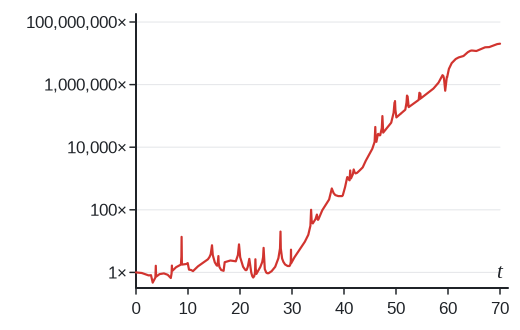
For a long time almost nothing happens; the difference just jumps about at every close encounter of two bodies. Then it takes off: at time 40 it is about four hundred times larger than at the start, at time 50 roughly a hundred thousand times, and at the end twenty million times. So the positions differ by tens of units, more than the whole picture measures.
This is what chaos looks like: the motion is exactly determined, but unpredictable in the long run. A ball on the ridge of a roof will fall either to the left or to the right, and a tiny nudge decides which. Chaotic motion is like a roof with ridges at every step.
That is why even the best computer is not enough. Every error in measurement or rounding grows just like our difference. Physicists have the Lyapunov time for this: the time it takes for a deviation to grow e times, that is, about 2.7 times (e is Euler’s number). This growth is exponential growth: after two Lyapunov times the error is about seven times larger, after ten already twenty thousand times. In our Pythagorean problem the Lyapunov time, judging by the slope of the graph, is about 2.3 units of time.
Where the Webb telescope is
There are also completely regular motions of three bodies. Two were found as early as the 18th century: the bodies can orbit lined up on a straight line, or at the vertices of an equilateral triangle. The first was found by Leonhard Euler, the second by Joseph-Louis Lagrange.
From them follow the places where a small body, such as a space probe, can orbit together with the Sun and a planet and always keep the same distance from them. The problem in which the third body is so light that it does not affect the others is called the restricted three-body problem. Those places are called Lagrange points, and there are five of them: three on a line with the Sun and the planet, and two that form an equilateral triangle with them.
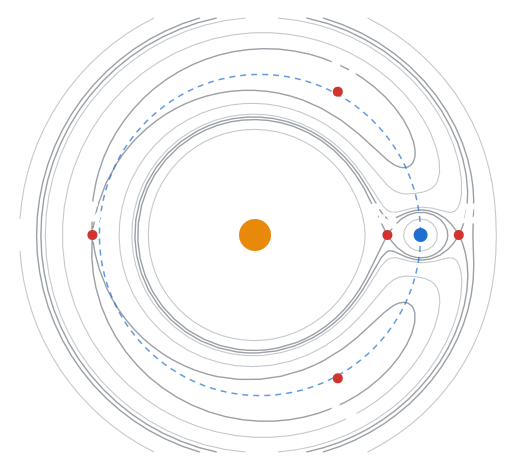
The picture shows the “landscape” felt by a small body when we look from a merry-go-round turning together with the planet. Besides the gravity of the Sun and the planet, centrifugal force also acts in it. At the five Lagrange points the landscape is flat; the forces cancel out there.
The James Webb Space Telescope arrived in January 2022 at the point L2 of the Sun–Earth system, about one and a half million kilometres from the Earth on the side facing away from the Sun, and it circles around that point. Why doesn’t it fall? It goes round the Sun once a year just like the Earth, even though it is further away, because the gravity of the Sun and the Earth together gives it exactly the centripetal force it needs for that. But L2 is a saddle: a small displacement is enough for the probe to start sliding away. That is why roughly every three weeks Webb briefly fires its thrusters and corrects its path.
The points L4 and L5 are on hilltops, and yet they are stable. A body that starts rolling down from the hilltop is turned sideways in the rotating frame by the Coriolis force, another of the fictitious forces, and instead of falling it circles around the hilltop. This only works if the Sun is at least roughly twenty-five times heavier than the planet. For Jupiter this holds with a large margin, which is why asteroids, the Trojans, have gathered at its points L4 and L5. Astronomers now know more than fifteen thousand of them, and since 2021 the Lucy probe has been on its way to them.
The figure of eight
For a long time only a few regular motions of three equally heavy bodies were known. But in 1993 the physicist Cris Moore discovered this on a computer:
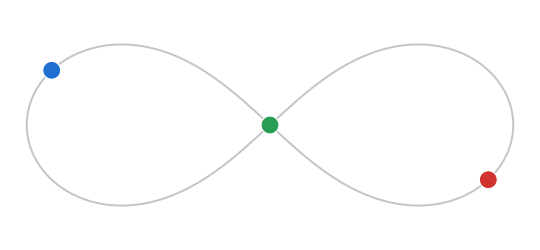
In a third of an orbit the bodies swap places, and after a full orbit everything is exactly as it was at the start. Such a path is called periodic. What is more, the figure of eight is stable: if you nudge the bodies just slightly, they do not fly apart, they only wobble around the figure of eight. But we will probably not find it in nature; the masses would have to be almost exactly equal. In 2000 mathematicians proved that the figure of eight really exists and is not just the result of rounding in the computer.
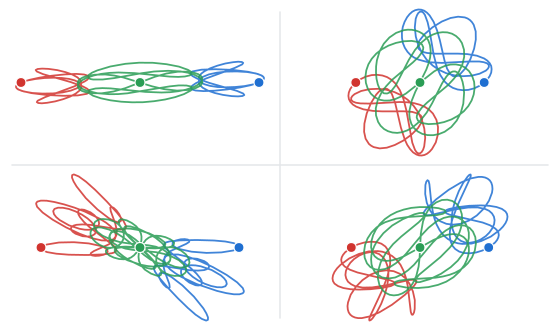
Nobody expected that three identical bodies could chase one another along a single shared path. The figure of eight showed that such paths are worth looking for. The computer tries different starts and fine-tunes them until the bodies come back to their places with the same velocities. Until 2013 only three families of periodic orbits with equally heavy bodies were known. Then computers found 13 new ones, in 2017 more than six hundred, and in 2024 another team found more than twelve thousand orbits just among those in which the bodies start from rest. That is only a small slice of all the possibilities: the search is for the shape of the starting triangle, but not for the velocities. We calculated four of those thirteen from 2013:
Is the Solar System stable?
As early as the end of the 18th century mathematicians concluded that the Solar System is stable and that the orbits of the planets only sway very slightly around fixed values. But they were calculating approximately.
In 1989 the French astronomer Jacques Laskar calculated that the motion of the planets is chaotic and that its Lyapunov time is about five million years. According to Laskar, the position of the Earth in its orbit therefore cannot be predicted more than roughly a hundred million years ahead.
In 2009 Laskar and a colleague checked this on a large scale. They ran 2,501 simulations of the whole Solar System five billion years ahead, and neighbouring simulations differed only in the size of Mercury’s orbit, and only by 0.38 mm. In about one in a hundred, Mercury’s orbit stretched so much that Mercury could collide with Venus or fall into the Sun. An independent calculation from 2015 gave a similar result, just under one per cent.
No need to worry. In five billion years the Sun will grow old and swell up anyway. And the Earth itself is surprisingly calm; it is mainly Mercury’s orbit that is uncertain.
So what is open
In general we cannot say which systems will last for ever and which will fall apart, nor how many periodic orbits there are. Mathematicians are also investigating whether, for more bodies with given masses, there are always only finitely many arrangements similar to Euler’s and Lagrange’s. Papers from October 2026 that claim to have solved this for five bodies in a plane are still waiting to be checked.
Space flight, in fact, depends on the three-body problem. Probes use the gravity of planets as a slingshot, the so-called gravity assist, and that is how the Voyagers got from Jupiter to Saturn, and Voyager 2 all the way to Uranus and Neptune. Orbits around Lagrange points or near-Earth asteroids are also problems for three or more bodies.
And what about the novel? At heart it is right: a planet near three stars of similar mass that weave around each other would move chaotically and its climate could not be predicted. But the author simplified the astronomy for the sake of the story. The real Alpha Centauri system, where the novel is set, is calm: two stars orbit close around each other and the third, Proxima, circles far away.
Try it yourself
a) Three equally heavy bodies lie at the vertices of an equilateral triangle. Each is acted on by the attractive forces of the other two, each of magnitude F. Where does their resultant point, and how large is it? The angle between the two forces is 60°.
b) The error in a planet’s position grows e times in one Lyapunov time. After how many Lyapunov times will an error of 1 m grow to 150 million kilometres, that is, to the whole distance from the Earth to the Sun?
Solution to a): Both forces make an angle of 30° with the line that runs from the vertex to the midpoint of the opposite side. We split them into a part along this line and a part perpendicular to it. The perpendicular parts are the same size and point in opposite directions, so they cancel out. Along the line each force has magnitude F · cos(30°), so the resultant has magnitude
That is roughly 1.73 · F.
It points along the median towards the centroid of the triangle. This holds for all three bodies, which is why the whole triangle can circle steadily around the centroid without falling apart. This is Lagrange’s solution.
Solution to b): A distance of 150 million kilometres is 1.5 × 10¹¹ metres. In n Lyapunov times the error grows en times, so we are looking for the n for which
We take the natural logarithm of the equation:
Roughly 26 Lyapunov times are enough. For the Solar System, where the Lyapunov time is five million years, that is about 130 million years.
You will find more famous problems in the category Famous problems.
See also
- Newton’s first law
- Newton’s second law
- Newton’s third law
- The Poincaré conjecture, another famous problem of Henri Poincaré’s
- Exponential growth