
Continuity of a function
Continuity of a function tells us, as intuition suggests, whether a function is continuous at a given point or whether it is somehow broken apart. We define and work out continuity using limits of functions, so if you are not comfortable with them, you will struggle to follow.
Definition of continuity
Continuity is surprisingly easy to define and easy to understand, provided you have fully grasped limits. So here is the definition of continuity of a function:
A function f(x) is called continuous at a point a in the domain of f if
We can also define continuity from the left and from the right, by using the left-hand or right-hand limit in place of the limit. Note:
- So far we have only defined continuity of a function f at a point. If f is continuous at all points of its domain, then we say that f is a continuous function on its whole domain.
- The point a in the definition of continuity must be an accumulation point.
- For a function to be continuous at a, f(a) must exist (the value a must be in the domain of the function), the limit
- A function that is continuous at a point is continuous there from both the left and the right. As with limits, a function can be continuous at a point from the left only or from the right only. If the left-hand and right-hand limits differ, the function is not continuous at that point.
What does the definition tell us? First, the function must be defined at the given point. If it is not defined there, it is certainly not continuous there. If it is defined, we look at the limits. If the function approaches the value at that point from both the right and the left, then it is continuous at that point. If the limits differ from the value of the function, then the function is discontinuous at that point.
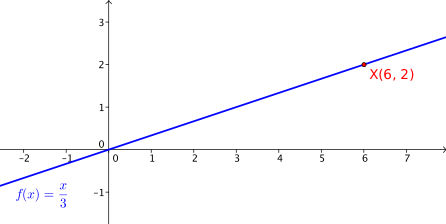
A simple example: in the article on the limit of a function we had the function
So f is continuous on its whole domain. For example, if we substitute 6 for a, we get:
Discontinuities
If a function is not continuous at a point a, it is discontinuous there. That is no big surprise. However, we distinguish several kinds of discontinuity, depending on how much we would have to “fix the graph of the function” to make it continuous.
There are three basic kinds of discontinuity:
Removable discontinuity
A removable discontinuity is a point where both one-sided limits exist and are equal, so the function has a limit there, but this limit differs from the value of the function or the function is not defined at the point. If a is a removable discontinuity of f(x), then:
As an example, let’s look at the absolute value of the sign function of x. We want to know whether the function is continuous at a = 0. Here is the graph:

We can see that the function is continuous almost everywhere – there is only a gap at zero, because the value of the function there is zero, not one. Meanwhile the limits from the left and from the right at this point are both equal to one. This discontinuity is called removable because simply redefining that single point gives us a continuous function. So this discontinuity is easy to remove.
Jump discontinuity
A jump discontinuity (a discontinuity of the first kind) is a point a at which both one-sided limits exist and are finite, but are not equal. Definition:
Let’s look at this kind of discontinuity for the simple function f(x) = sgn(x):

Again we can see that the function is discontinuous at a = 0. The limit from the left is −1 and the limit from the right is 1:
The left-hand and right-hand limits are not equal, but they are finite. So this is a jump discontinuity.
For this kind of discontinuity we also define the jump of a function at a point. It is the difference of these limits, so the jump s of a function f at a point a is:
Essential discontinuity
An essential discontinuity (a discontinuity of the second kind) is a point where at least one one-sided limit is infinite or at least one limit does not exist. As an example, let’s look at the function

The limit from the left at zero is minus infinity and the limit from the right at zero is plus infinity. Both limits are infinite, so this is an essential discontinuity (a discontinuity of the second kind). This discontinuity cannot be removed in any simple way.
Continuity on an interval
We have defined continuity at a point, but not yet continuity on an interval. So: a function is continuous on an interval I if it is continuous at every point of that interval. It is important to distinguish carefully between open and closed intervals. If an interval is open at both ends, the function need not be continuous at the endpoints – simply because an open interval does not contain its endpoints. If the interval is closed, however, the function must be continuous from the left or from the right at the endpoints.
It has been a while since we last had the sign function, so let’s take it again. On the open interval (0, ∞) the function is continuous. The sign function does have a discontinuity at zero, but because the interval is open, zero is excluded from the test. On the interval [0, ∞) the function is no longer continuous, because it is not continuous from the right at 0.
And why is it not continuous from the right? Because the limit from the right is equal to one, but the value of the function is equal to zero. The values are not equal, so the function is not continuous from the right at that point.
We call a function piecewise continuous if it has a finite number of jump discontinuities (or removable discontinuities). So if it has infinitely many discontinuities, it is not piecewise continuous – watch out for that.
In practice we find out about continuity using the derivative of a function. A function that is differentiable at a point is also continuous at that point.
