
Limit of a sequence
The limit of a sequence is the number that a given sequence approaches at infinity. The limit of a sequence is a kind of forerunner of the limit of a function, which is hugely important in mathematical analysis.
A short introduction to limits
The limit of a sequence is the number that a given sequence of numbers keeps getting closer to (and possibly even reaches in the end). It is best to start with a picture showing the sequence given by the formula

In the picture we can see that the terms of the sequence get closer and closer to zero. The larger n is, the smaller the value of an is, and the closer it gets to zero. The graph never touches the horizontal axis, because the equation 1/n = 0 never holds (where n is a positive integer). Still, it is worth finding out which number the whole sequence approaches. So the question can be: if we keep increasing n, which number will the value of the sequence approach? If we let n go to infinity, what value will the term of the sequence have? This is exactly what limits deal with. We write it using the symbol
We read it: “The limit of the sequence one over n as n tends to infinity is zero.” A few more trivial examples: what is the limit of the sequence an = n? This is a simple sequence where a1 = 1, a42 = 42, a58766 = 58766 and so on. Which number will the terms of the sequence approach at infinity? The larger n is, the larger an is, so the limit will be infinity.
You can probably guess that the limit of the sequence an = n2 will also be infinity. This sequence will grow even faster than the previous one. On the other hand, the sequence
Definition of a finite limit of a sequence
It is time to define the limit of a sequence properly.
A sequence
The notations in use are:
That is a nice definition, so now let's explain it. For that we need a picture of some sequence, so let's choose, for example, the following sequence:
And its graph:
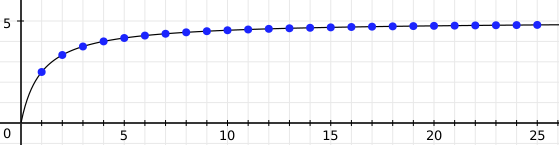
From the graph we can see nicely that the sequence converges to five, that is, that the limit of this sequence is five. Before I start demonstrating the definition of a limit on this sequence, I'll add a bit of colour to the graph:
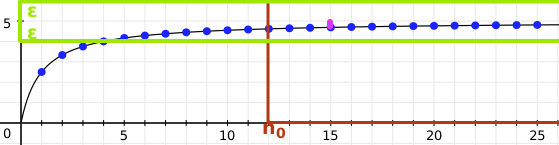
We already know that the limit of this sequence is five. The first part of the definition talks about ϵ>0, that is, some epsilon that is greater than zero. Epsilon here represents the neighbourhood of the limit, the neighbourhood of a point. It is greater than zero because a neighbourhood can be neither negative nor zero. In the picture this neighbourhood is shown by the horizontal green lines on the y-axis. The point here is the value five, and the neighbourhood of the point is those green lines on the y-axis. The neighbourhood itself is defined in both directions, up and down. We will now need this imaginary strip bounded by the green horizontal lines. In the picture ϵ = 1.
Our aim is to find a number n0 on the bottom horizontal axis that splits the axis into two parts, such that all the terms of the sequence to the right of n0 lie in this green strip. It doesn't matter where the terms to the left of n0 are, and we don't have to look for the smallest n0 for which the definition holds. In the picture n0 = 12.
What does it actually mean for a term of the sequence to be in the green strip? It means that its distance from the limit (in this case from the number five) is at most epsilon. And that is exactly what the definition says: |an − a|<ϵ. Remember that the value a stands for the limit, so in our case a = 5. Let's try working out the value of the fifteenth term:
Now we substitute into the relation |an − a|<ϵ:
We can see that the inequality holds. This point satisfies the definition. The number 0.3125 is the distance between the fifteenth term of the sequence and the limit of the sequence. In the picture this distance is highlighted by a short purple line segment. If we tested all the numbers greater than n0 in this way, we would find that the inequality still holds. So the number a = 5 satisfies the definition of the limit of this sequence.
There is one important thing in the definition, though. It says that for every ϵ>0 we are able to find that number n0. That is, for an arbitrarily large epsilon, but above all for an arbitrarily small epsilon. However small (but still positive) we make epsilon, we must still be able to find n0.
So let's try making epsilon smaller. What happens? The green strip that we have to fit into gets narrower. That doesn't bother us at all – we simply increase the value of n0, moving it to the right. The shrinking and the shift are illustrated in the following picture:
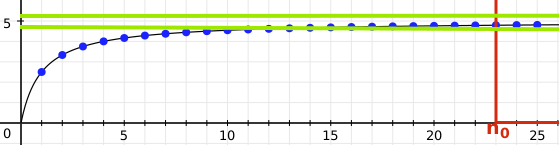
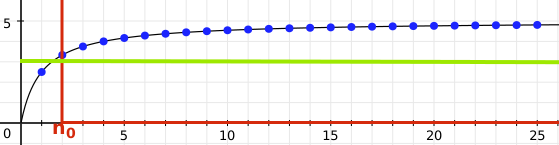
This shift nicely illustrates the behaviour of a limit. We expect the terms of the sequence to get gradually closer to the limit, and their distance from the limit to keep decreasing. (The distance from the limit is what we worked out a moment ago, the purple line in the picture.) If the distance keeps decreasing and the terms approach the limit, at some point they must get closer to the limit than epsilon. And that is how we have found our value n0. If, on the other hand, we choose a larger epsilon, we can choose a smaller n0:
At the beginning I mentioned that a sequence keeps approaching its limit but never touches it. However, a sequence can touch its limit, and can even take the value of its limit infinitely many times. For example, the constant sequence an = 1 has the value one at every point, and its limit is also one.
Showing that a limit does not exist
Let's change the sequence so that it fits the following graph (the formula itself is not important for now):
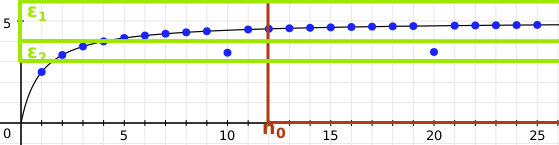
The sequence behaves in the same way as in the previous case, except for the tenth, twentieth, thirtieth (and so on) terms of the sequence (let's assume that these terms are always equal to the number 3.5 – they neither rise nor fall). These terms are somehow out of rhythm. I have drawn two neighbourhoods in the picture, epsilon one and epsilon two. As we can see, for ϵ2 (the larger epsilon neighbourhood) we can find an n0 such that all later terms are in the green strip. But when we reduce the value of epsilon to ϵ1, we can no longer find such an n0 – every tenth term will be outside this neighbourhood. This sequence would not have a limit at the point five (and it has no limit anywhere else either).
Examples of other limits
An example of a sequence that has no limit at all is an = sin n, shown in the following picture:
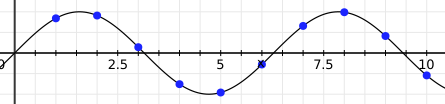 We can see that the sequence does not converge to any number: its terms keep falling and rising. We call such a sequence divergent.
So far we have shown convergent sequences that converged to the given limit from one side. But a sequence can also approach a limit from both sides, as this sequence shows
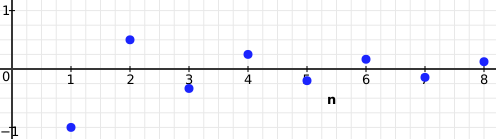 This sequence also converges to zero.
Infinite limit
So far we have talked about a finite limit, that is, the case where a sequence approaches some real number. But what about a sequence such as an = n? Which real number does the sequence approach? Take a look at the graph:
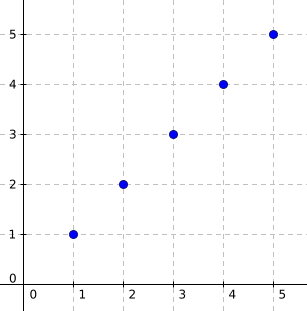
It clearly doesn't approach any real number, but grows without bound, grows to infinity. Such a sequence has the limit infinity, and we say that such a limit is infinite. The definition of an infinite limit is simple. What does it mean for a sequence to grow to infinity? It means that if we choose any real number A, however large, we can always find an index n0 such that all the terms of the sequence after this term are greater than the number A. In short, if we choose a bound A, then from some point in the sequence onwards all the terms are greater than this A. Written mathematically:
At the beginning we have “for all A”, that is, for all the bounds we might want to choose. Then we have the existential quantifier, which says that there must exist an index n0 such that if n is greater than this n0, then the value of the term an is greater than the bound we chose at the start, that is, A. There is a similar definition for the infinite limit minus infinity.
Methods for working out limits
We already know a few basic methods for working out the limit of a sequence. Variations of the sequence an = n, such as
have the limit plus infinity. On the other hand, sequences such as
have a limit of zero. Now we'll state some basic rules for working with sequences. Suppose that
Then the following rules also hold:
We could use the first rule in the following example:
And what about when we have an example like this?
Here there is a problem, because the expression in the numerator tends to infinity at infinity, and the expression in the denominator also tends to infinity. But if we have infinity in both the numerator and the denominator, we get what is called an indeterminate form. In short, we can't tell what this expression is equal to:
Our task will be to rearrange the expression so that this indeterminate form doesn't arise. If we manage to remove the variable n from the denominator or the numerator, we may get an expression with only one infinity in it.
First we rearrange the expression by dividing every term by the variable n, that is, by multiplying the top and bottom of the fraction by 1/n.
We can see that the denominator no longer contains the variable n, so the expression in the denominator no longer tends to infinity at infinity. Using the previous rules we can split the whole limit into several smaller ones by working out the limits of all the expressions separately, then adding the results and dividing.
We have now reached a situation where we can work out all the limits. Let's do so.
The limit of this sequence is the number 1.5.
Let's try another example:
Here we can either use the same method as before or try some logical reasoning. The function n2 will pull the sequence up far faster than the function n pulls it down. The function n2 is far stronger, so the whole expression will have the limit infinity. Let's work it out as well. Again we divide every term by n:
A few more words on why we divided by n and not, for example, by n2, which also appears in the expression. Our aim, as we know, is to get rid of a variable. However, we know that the value of the denominator must not be zero, as we would again get an indeterminate form. We multiply the top and bottom of the fraction by an expression chosen so that no zero appears in the denominator. In this case that meant using the expression with the highest power in the denominator.
So we can say that the limit is governed by the function that grows faster by orders of magnitude. But watch out for signs: even when working with infinity we must keep the sign:
