
Sine rule and cosine rule
The sine rule is a result that – unlike the ordinary trigonometric functions – works in any triangle. It gives us a relationship between the lengths of the sides and the angles. The cosine rule also works in any triangle, and a special case of it is Pythagoras’ theorem.
The sine rule
The sine rule tells us that in a given triangle (of any shape!), the ratio of each side length to the sine of the angle opposite it is constant. We write it like this:
where r is the radius of the circumcircle and a, b and c are the lengths of the sides of the triangle. We can also rewrite the equation above as:
The cosine rule
The cosine rule also works in any triangle, just like the sine rule. The cosine rule says:
Notice that if one of the angles is a right angle, that is, it is 90 degrees, then the last term disappears from one of the formulae and we get Pythagoras’ theorem. If α = 90°, then cos(α) = 0, so we get:
Motivation
Let ABC be a triangle with side c, where c = 9. The angles are α = 40°, β = 80°, γ = 60°. The question is: what are the lengths of the other two sides? Here the ordinary trigonometric functions are not enough, because they work in a right-angled triangle, and this is certainly not one. Here is the figure:
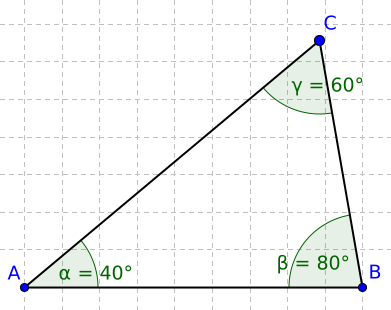
We will have to take a different route, and the sine rule is one of them. How do we use it? The sine rule tells us that:
We know all the angles and the length of side c. So we can work out side b from the equation
Here we need to make the length of side b the subject. We do the same to both sides of the equation: multiply by the sine of angle beta. We get:
We know, or can work out, everything on the right-hand side. So we substitute:
We work out the remaining side a in exactly the same way:
We make a the subject by multiplying the equation by the sine of angle alpha.
Let’s work out the result:
Proof of the sine rule
Why does the sine rule hold? Let’s look at an ordinary triangle ABC in which we also draw the perpendicular height to side c.
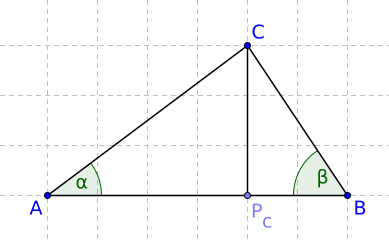
The question is: what is the length of CPc? The height splits triangle ABC into two right-angled triangles, and we can use them to express the length of the height. So let’s express the length of CPc using both triangles. The sine of angle alpha is equal to:
From this we make CPc the subject:
Now let’s express the length of CPc using the other triangle, with angle beta:
Again we make CPc the subject:
So now we have the length of the height expressed by two formulae:
which gives the equation
That is already close to what the sine rule tells us. We divide the whole equation by sine alpha times sine beta:
In the working above we proved part of the sine rule, but the proof for the other combinations of sides is identical.
Chapters: Trigonometric functions, The unit circle, Inverse trigonometric functions, Properties of sine, cosine, tangent and cotangent, Trigonometric formulae, Graphs of trigonometric functions, Sine rule and cosine rule
