
Division
Division is the opposite process to multiplication. Division is also a good source of humour because, as everybody knows, we cannot divide by zero, or our exercise book would burst into flames.
What division is
We can picture division as splitting one large whole into smaller pieces of equal size. Suppose a dad needs to saw a board 100 cm long into five equal pieces. How big will each piece be?
We can work it the other way round – if we add up the lengths of all five pieces, we must get 100 back. Which number does that? It is 20, because 20 + 20 + 20 + 20 + 20 = 100. Instead of addition we can use multiplication. We can ask which number gives a hundred when multiplied by five. Again 20, because 5 · 20 = 100.
We could show this graphically as splitting a line segment of length 100 into five equal parts:
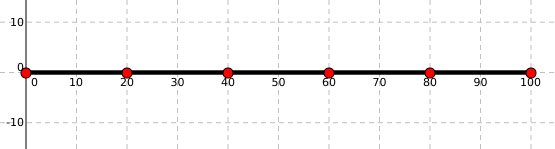
When we want to divide 100 by 5, we are finding out “how many times 5 goes into 100”. We write division either with a slash: 100 / 5 or with the division sign:
- a is called the dividend,
- b is called the divisor,
- c is called the quotient.
Defining division using multiplication
The simplest way to define the quotient is by using multiplication. As an example, take the quotient of these numbers: 35 / 7. What will the result be? We are looking for the number which, when multiplied by 7, gives 35. If we were dividing 48 / 8, we would be looking for the number which, multiplied by 8, gives 48.
So the result of 35 / 7 is 5, because 7 · 5 = 35. The result of 48 / 8 is 6, because 8 · 6 = 48.
If we divide a / b in general, then the result is the number c for which b · c = a.
Although we have shown all the examples with natural numbers, the definition using multiplication means that we can divide any other numbers too. For example, we can find the quotient −85.76 / 6.7 by finding the number x for which 6.7 · x = −85.76. This holds for x = −12.8.
We can divide zero by another number
We can divide zero by a number; this is a valid expression: 0 / 15. In effect we are saying that we want to split zero into 15 equal parts. You can imagine that you have no pie, and you want to split this pie that you do not have into 15 parts – how big will each part be? They will be zero, because you simply have no pie. Or imagine that you have £0 in your wallet and you want to share this £0 between three children. How much does each child get? Nothing at all, because you simply have nothing. So 0 / 15 = 0.
We can divide zero by another number, but we cannot divide another number by zero. This expression is not valid: 8 / 0.
But why can’t we divide by zero?
We cannot divide by zero because the eleventh commandment forbids it.
But there are also more convincing reasons. For now we will look at the case where the dividend is not zero – a division of the form a / 0, where a ≠ 0. Let’s go through two reasons:
- Let’s stay with the analogy of splitting a whole into smaller parts of equal size. We have 15 of the fiercest dragons. Now we want to share them among zero children. How many dragons does each child get?
Eh???
Yes, you are reading the question correctly, and yes, it makes no sense. We cannot ask how many dragons each child got when we had no child to give the dragons to. So dividing by zero does not make sense either, and that is why we say that the expression x / 0 is undefined.
- We introduced division using multiplication. When we try to divide by zero, 15 / 0, we are looking for a number x for which x · 0 = 15. But anything times zero is zero, so we will never find an x for which this equation makes sense.
And what about the quotient 0/0?
That is undefined, just like x / 0. The reasons:
This time we have zero of the fiercest dragons, which we want to share among zero children. That is again a nonsensical request.
By the definition of division, when we divide 0 / 0 we are looking for a number x for which x · 0 = 0. We would find a solution, or more precisely: any real number is a solution of this equation. Whether we substitute 4, 1 or π for x, the equation holds. Of course it is unacceptable for the result of a division to be an entire set of real numbers; that makes no sense.
We would have to pick one particular number from the whole set and say that this number is the result of 0 / 0. But which one? Should it equal one? Eight? Zero? Minus one? And why? Let’s try giving arguments for zero and for one:
- We know that if we have a fraction of the form x / x, then this fraction is equal to one. For example, 7 / 7 = 1 or 3 / 3 = 1. From this we could conclude that we should define 0 / 0 so that 0 / 0 = 1.
- Look at this sequence of perfectly valid fractions. In each of them we divide zero by a number that gets closer and closer to zero:
We see that however close to zero the number we divide by is, we still get zero as the result. From this we could conclude that 0 / 0 = 0.
Both of these are valid arguments for how we could define the quotient 0 / 0. But which of them is better? In the end, even if we chose one of them and declared it the only valid one, we would still end up contradicting other parts of maths.
That is why division by zero is best left undefined.
The final argument against dividing by zero
If the previous arguments were not enough for you, perhaps you will be convinced by the following photographic evidence of a case where someone really did try to divide by zero:

