
Addition and subtraction
Addition and subtraction are the most basic mathematical operations, and we need them in everyday life too. Although we can add many different structures, here we will deal only with adding integers.
Addition
The operation of addition is marked with the plus sign +. When we add, we add numbers together, so if we want to work out 2 + 3, then both the 2 and the 3 are the numbers being added (the terms). The result is the sum, so the 5 in the expression 2 + 3 = 5 is the sum.
We can add practically any numbers, whether natural numbers such as 1, 5 and 157, or negative numbers such as -4 and -74. We can also add rational numbers, that is, fractions, real numbers such as π, and finally even complex numbers. We can add other structures too – matrices or vectors.
Addition is usually explained with a pile of apples. If you have three apples in a basket and someone gives you another four apples, how many will you have? You will have 3 + 4 = 7.
How to add large numbers
If I gave you the task of adding 17,564 and 3,272, you probably could not give me the answer straight off in your head. So you use either a calculator or pencil and paper. I will not teach you how to key it into a calculator; let’s concentrate on the method on paper.
We write the numbers we want to add one under the other and line them up on the right – so that the same place values (tens, hundreds, …) are in the same column. Under both numbers we draw a horizontal line. It would look like this:
Now we add the digits that are under each other. If the sum of the digits is less than ten, we simply write that sum under the line. We work from the right-hand side, starting with the smallest place value. So first we add 4 + 2, which equals six. Six is less than ten, so we write the digit six under the line:
We carry on and add 6 + 7. That equals 13, which is more than ten. This time we write under the line only the digit in the units place, that is, we write a 3 (we take away the ten from the thirteen).
What happened to the 1 that we cut off, and what does it stand for? We are now working with the second column from the right, which stands for the tens. So we were really adding tens, that is, we were adding 60 + 70 = 130. We decided to keep the 30 and to set the 100 aside for later. For when? For the next step, the next column. In the next step we get to adding the digits that stand for hundreds, and we have one extra hundred that we got from adding the tens. So the simplest thing to do is to add that hundred in the next step.
So instead of adding 5 + 2 in the next step, we add 5 + 2 + 1, where the 1 stands for the hundred that we got from the addition in the previous step. The total is eight, which is less than ten. So we write an 8 under the line.
No extra thousand is carried into the next step, so we add just 7 + 3 = 10. This is not less than ten, so we write the last digit under the line and carry one. We write a zero under the line and keep one extra ten thousand for the next step.
In the last column there is a digit only in the first row. In the second row we imagine a zero, and we add 1 + 0, remembering to add the 1 carried from the last step: 1 + 0 + 1 = 2. We write a 2 under the line.
That is the end of the method, and we have the sum of the numbers 17564 + 3272.
Animation of column addition
In the boxes below you can enter two natural numbers and then just sit back and enjoy an animation of the whole method.
Addition on a number line
We can show addition on a number line. A number line is a line on which all the numbers are marked. It can look like this:

If we wanted to illustrate the addition of two numbers on this number line, for example 3+4, we would proceed like this: we would draw a line segment starting at the origin, that is, at zero, and ending at three. When adding, we point the line segment to the right of the point where we started. So like this:
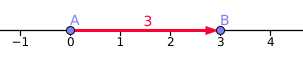
Now we mark off the four on the number line. This time, though, we start at three and draw a line segment of length four to the right from there. Like this:

The point where the second, green, line segment ended represents the final result: 3 + 4 = 7.
Subtraction
Subtraction is the inverse operation of addition. If you add a number b to some number a and then subtract b again, you get a back. We will show the method with the example 158,748 − 99,575. As with addition, we write the numbers one under the other:
We write the result under the line, just as in addition. We work from the right, starting with the smallest place values. So we deal with the units first. If the top digit is not smaller than the bottom digit, we write the difference top digit − bottom digit under the line. (Or the other way round – if the bottom digit is smaller than or equal to the top one, we can subtract without any worries.) In the units place the top digit is not smaller, so we write the difference 8 − 5 = 3.
We move one digit to the left, to the tens place. Here the top digit is smaller than the bottom digit. So we add ten to the top digit and then do the same calculation: top digit + 10 − bottom digit. The result is 4 + 10 − 7 = 14 − 7 = 7.
When subtracting the tens, we helped ourselves by including ten extra tens, so we have to remember that in the next step. Ten tens make one hundred, so in the next step we subtract one more hundred. That means we add the 1 from the previous step to the bottom 5.
In the hundreds place we therefore ask whether the 7 (top digit) is smaller than the 6 (bottom digit + 1). It is not, so we can do the standard difference, top minus bottom. Even so, we have to add the 1 to the bottom digit, so the result is 7 − (5 + 1) = 7 − 5 − 1 = 1.
Nothing is carried into the next step, because in this step we did not need to borrow from any higher place value. So in the thousands place we add nothing to anything. Nevertheless, the 8 in the top number is smaller than the 9 in the bottom number, so we have to add ten to the top digit. We get the difference 8 + 10 − 9 = 9.
We carry a 1 into the next step and add it to the bottom digit. Nine plus one is ten, and the top 5 is smaller than ten. We add ten to the top digit and work out the difference: 5 + 10 − (9 + 1) = 5.
Again we helped ourselves with a higher place value, so we carry a 1 into the next step. There the bottom row has no digit, so we assume a zero. When we add the 1, we get one. The top digit is not smaller than the bottom digit (now the top digit equals the bottom one), so we can simply subtract: 1 − 1 = 0.
And we have the result. We can drop the zero at the start and write: 158,748 − 99,575 = 59,173.
Subtraction on a number line
Like addition, subtraction can be shown on a number line. We only change the direction of the line segment when marking it off. We do not draw the line segment to the right of the current point, but to the left. So if we wanted to work out 2 − 5, we would proceed like this. First we mark the 2 on the number line in the positive direction, because 2 is positive. We are subtracting 5, so that one goes the opposite way.
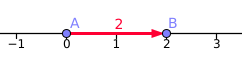
Now we add a second line segment to the number line, representing minus five. We start at the point where we finished, that is, at 2. This time, though, we draw the line segment backwards, to the left.

