
Multiplication
Multiplication is one of the basic operations of arithmetic, and we meet it all the time.
What is multiplication
We write multiplication either with a dot or with a cross. If we want to write three times seven, we can write 3 · 7 or 3 × 7. Sometimes people use the ordinary letter x instead of the cross symbol: 3 x 7.
Multiplying natural numbers, that is the numbers 1, 2, 3, …, can easily be turned into addition. Take 4 · 6 = ?, four times six. In everyday speech we could put it like this: “go to Oliver four times and give him six sweets each time”. How many sweets is that in total? The first time we give him six sweets, the second time six more, and so on for the third and fourth times. Altogether we gave him 6 + 6 + 6 + 6 = 24 sweets. So that we do not have to write out so many equal numbers to add up, multiplication was introduced: instead of 6 + 6 + 6 + 6 we can simply write 4 × 6.
Notice that it makes no difference whether we add four sixes or six fours. We always get the same result.
The result of a multiplication is called the product, so we say “the product of 4 and 6 is 24”. The numbers we multiply, here 4 and 6, are called factors.
Multiplication as a picture
We can show multiplication as the area of a rectangle. Let’s stay with 4 · 6. We draw a rectangle with one side of length 4 and the other of length 6. The rectangle looks like this:
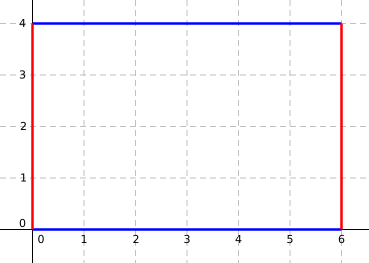
Now we work out the area of this rectangle, which means counting all the little squares inside it.
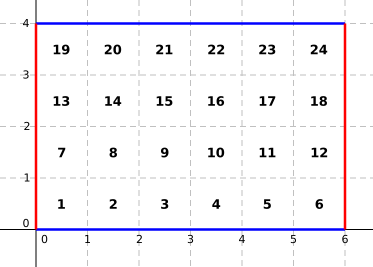
We can see that there are exactly 24 squares. Why? Because we stacked six squares four times, so the result is again the sum 6 + 6 + 6 + 6 = 24.
Multiplying by zero
If we multiply any number by zero, the result is zero again. The reason is simple. Sticking with the earlier examples, it is as if we said “don’t go to Oliver even once, but give him six sweets”. Oliver misses out this time: he is meant to get six sweets, but he is never given them.
We can show this in a picture too. A picture of the product 5 · 0 would look like this:
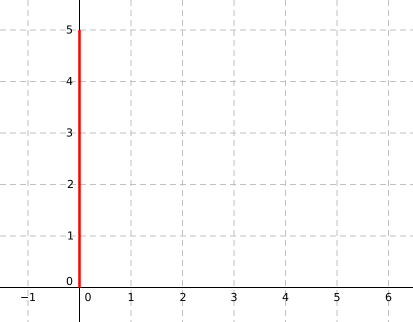
Because the second factor is zero, one side of the rectangle has length zero, so the rectangle turns into a line segment, which has no area.
Order of operations
Multiplication takes priority over addition and subtraction. This means that in 2 + 3 · 4 you first work out the product 3 · 4 = 12 and only then do the addition. After working out the product we have 2 + 12, which equals 14.
If you did the addition first, you would get a different result: 2 + 3 = 5 and then 5 · 4 = 20. That result is wrong.
The same goes for subtraction, so 10 − 8 · 2 + 7 is worked out as if it had brackets: 10 − (8 · 2) + 7. So 10 − 16 + 7 = 1.
Watch out for the trick questions that often turn up on social media. They look like 1 + 1 + 1 · 0 = ?. Many people see multiplication by zero and immediately write that the answer is zero, but that is wrong. Because multiplication comes first, the question is equivalent to 1 + 1 + (1 · 0) = ?.
Here we first work out the bracket: 1 + 1 + 0 = ? and now we add: 1 + 1 + 0 = 2. The correct answer is 2, not 0.
The really sneaky part is that a simple calculator will also give you zero. Why? Because on a simple calculator you do not enter the whole expression at once, you enter it step by step and the calculator works with an intermediate result. If you key 1 + 1 + 1 · 0 into such a calculator, it first works out 1 + 1 = 2, then 2 + 1 = 3, because it only remembers the intermediate result 2, and finally 3 · 0 = 0. So the calculator has really worked out (((1 + 1) + 1) · 0).
Some calculators can cope with the order of operations, and some let you enter the whole calculation in one go and then work it out correctly. If yours cannot, bear this in mind.
You can read more in a separate article on the order of operations.
Times tables
For further calculation it is handy to remember the whole set of times tables, that is, all the multiples of the numbers up to 10:
First the times tables from one to five:
And now from six to ten:
Chapters: Multiplication, Long multiplication, Multiplying negative numbers
