
Why we cannot divide by zero
Try typing 6:0 into a calculator. The calculator rebels and, instead of an answer, displays something like “Error” or “E”. This is not down to the whim of teachers or calculator makers. We will look at several reasons why you cannot divide by zero, and they all lead to the same conclusion.
Division is multiplication in reverse
To work out 12:3, we look for the number that gives 12 when multiplied by three. That number is 4, because
So 12:3 = 4. This is how division is defined, and we can check any quotient by multiplying.
Now let's use the same approach with zero. If 6:0 were some number x, then we would need
But anything times zero is zero, as we know from multiplying by zero. Whether we substitute one, a million or minus three for x, we always get zero and never six. There is simply no such x, so the quotient 6:0 has no result at all.
How many times does zero fit?
We can also think of division as repeated subtraction. The quotient 12:3 tells us how many times we subtract three from twelve before we reach zero:
Three fitted in four times, so 12:3 = 4.
With 6:0, however, we would be subtracting nothing but zeros from six. After the first subtraction we still have 6, after the tenth we still have 6, and after the millionth we still have 6, except that by then we have got bored. We never reach zero, and we could keep subtracting for ever. There is no number of subtractions that we could write down as the result.
What happens close to zero
We must not divide by zero, but we can divide by numbers very close to zero. Let's take one and divide it by smaller and smaller numbers:
The smaller the divisor, the larger the result. The divisor 0.000001 already gives a million, and the result grows beyond all bounds.
If we approach zero from the negative side, for example 1:(−0.001) = −1,000, the result gets smaller and smaller and falls towards minus infinity. The graph of the function
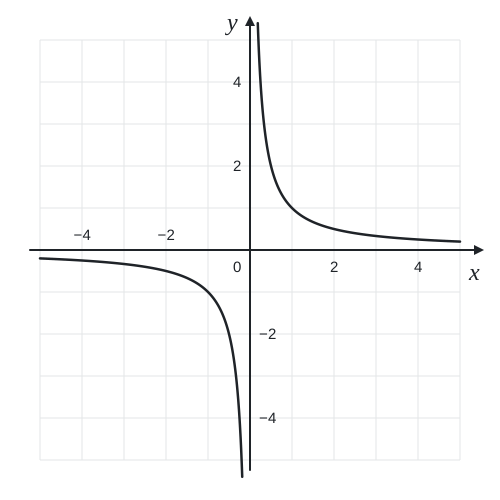
To the right of zero the curve shoots upwards, and to the left of zero it plunges downwards. From the right the result approaches infinity, from the left minus infinity, so each side pulls us in a different direction. This is why “infinity” does not work as the result of 1:0 either. If you want to know more, have a look at the article on the one-sided limit, where exactly this behaviour is written down.
Couldn't we simply say it is infinity?
Let's try it and see what breaks. Suppose 1:0 = ∞. The same reasoning would give 2:0 = ∞, because two divided by smaller and smaller numbers also grows beyond all bounds.
Now we check both quotients by multiplying, just as at the start. From 1:0 = ∞ it follows that ∞ · 0 = 1, and from 2:0 = ∞ it follows that ∞ · 0 = 2. The left-hand side is the same in both cases, so we would have
That is obviously false. So we cannot calculate with infinity as if it were an ordinary number.
Mathematicians, though, are not afraid of new numbers. The square root of minus one does not exist among the real numbers, so they introduced a new number i with the property i2 = −1. This gave rise to the complex numbers, in which addition, multiplication and working with brackets still function. Division by zero is different: whatever the new number looked like, if the usual rules of arithmetic held for it, we would always end up with something like 1 = 2, and arithmetic itself would fall apart.
And what about zero divided by zero?
Here the trouble is the opposite one. If 0:0 = x, we would need x · 0 = 0. But every number satisfies this equation: 5 · 0 = 0, 1 · 0 = 0 and (−7) · 0 = 0. The result would not be unique, and we would not know which number to choose, so the quotient 0:0 is not defined either. You can read more about it in the article on division.
Proof that 1 = 2
Division by zero can hide itself cleverly. Take two equal numbers a = b that are not zero, and rearrange:
We factorise the left-hand side using the formula a2 − b2 = (a + b)(a − b) and take out b from the right-hand side:
Since a = b, we can substitute b for a:
Every step looks innocent, and yet we have “proved” nonsense. Where did the mistake happen? Try to find it before you read on.
The mistake is hidden in the division by the expression a − b. Because a = b, we have a − b = 0, so we divided the whole equation by zero. That is why, when manipulating equations, you always check whether the expression you are dividing by could be zero. The last division, by b, is fine, because b is not zero.
