
Inflation
Inflation is the rise in prices. With inflation of 3%, something that costs £100 today will cost £103 in a year. So money in a drawer loses value even though the same amount is still lying there. The Bank of England would like to keep inflation at around 2% a year, but in 2022 prices in the United Kingdom rose by 9.1%.
How prices rise
Inflation is calculated much like compound interest. Every year prices go up by i per cent of what they cost last year, so each time we multiply by
With inflation of 3%, a purchase that costs £1,000 today will cost after a year
pounds, and after two years 1,030 · 1.03 = 1,060.9, that is £1,060.90. After ten years we multiply by 1.03 ten times in all, which is written more briefly as a power:
So after ten years the same purchase costs about £1,344. It would be easy to think “10 years times 3% is 30%”, but prices have gone up by 34%. Each year the 3% is worked out from a higher price than the year before.
What money will be worth
Let’s look at it from the other side. We have £100,000 in a drawer and want to know how much we could buy with it in ten years’ time, in today’s money. Over that time prices are multiplied by 1.0310, so we have to divide the amount by this number:
Our £100,000 will have the same purchasing power in ten years as £74,409 today. For any amount c, inflation of i per cent and n years, it looks like this:
There is a trap here too. It is tempting to subtract 10 times 3% and arrive at £70,000. But the money has lost only 25.6% of its value, because we divided rather than subtracted.
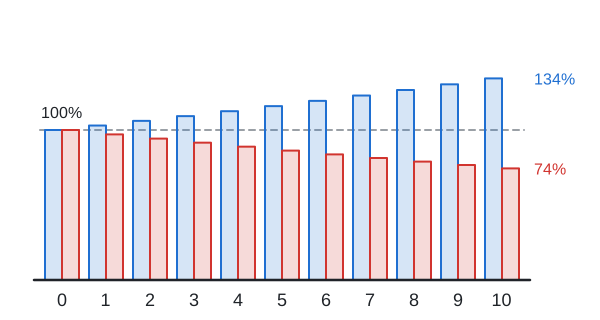
The blue bars show the price of a purchase that cost 100% in year zero. The red ones show how much we can buy with the same amount. The blue bars grow faster and faster, while the red ones fall more and more slowly, because each time we divide a purchasing power that is already smaller.
Real interest rate
In a savings account paying 4% interest a year, the money grows, but prices run away too. In a year the money is multiplied by 1.04 and prices by 1.03. We find out how much more we can buy by dividing one by the other:
So we can buy only about 0.97% more than today, not 4% more. This rate is called the real interest rate. Roughly speaking, it is the interest rate minus inflation, in our case 4% − 3% = 1%.
If inflation is higher than the interest rate, the money loses value in real terms even though the balance goes up. Take 2022 and an account paying 5% interest (the figure is just for the example). £100,000 would grow to £105,000 in a year, but a purchase that cost £100,000 would by then cost £109,100:
The purchasing power of the savings would fall by about 3.8%. On the bank statement, though, it looks like a gain.
The rule of 70
How long does it take for prices to double? Just divide 70 by the inflation rate in per cent:
With inflation of 2%, prices double in about 70:2 = 35 years, and with 7% in about 70:7 = 10 years. This is only an estimate: an exact calculation gives 35.0 and 10.2 years.
Calculator
The calculator works out what your money will be worth in a few years’ time in today’s prices.
See also
Chapters: Interest, Compound interest, Inflation, Monthly interest from an annual rate, How to work out mortgage interest
