
Why 0.999… equals 1
The number 0.999…, with infinitely many nines after the decimal point, is equal to one. Not approximately, not “almost”, but exactly. Most people don’t believe it at first, and arguments about this one number are among the most common arguments about maths on the internet. We will look at several proofs and finally find out why our intuition keeps whispering the opposite.
Like any recurring decimal, this one can be written with a bar over the digit that recurs:
Using thirds
We start from a fraction that gives nobody any trouble. If we divide one by three, we get a recurring decimal:
Now we multiply both sides of the equation by three. On the left we get
On the right we multiply each 3 separately. Since 3 · 3 = 9 and nothing is carried over to the next place, we get
The left-hand sides are equal, so the right-hand sides must be equal too: 1 = 0.999… Anyone who accepts that 0.333… is a third cannot reject this either.
Using multiplication by ten
We have met this method before in the article on rational numbers, where the same method converts a recurring decimal to a fraction. We call our number a:
We multiply by ten. The decimal point moves one place to the right, and after it there are still infinitely many nines:
From this we subtract a, and all the nines after the decimal point cancel each other out:
All that remains is to divide by nine:
What is the difference?
If 0.999… and 1 were different, their difference would be some positive number. Let us try to track it down. First we take only a finite number of nines:
Each extra nine makes the difference ten times smaller. The top of the picture shows a number line from zero to one, with a blue point at 0.9 and a red segment showing what is still missing to reach one. Each further line makes this segment ten times bigger, and so the blue points lie in turn at 0.9, 0.99 and 0.999:
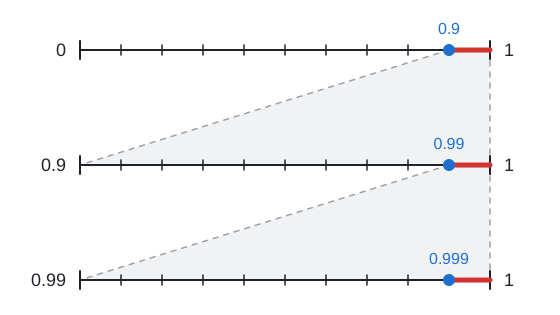
Choose any small positive number you like, say one billionth: with enough nines the difference will be smaller still. But in 0.999… all the nines are there at once, infinitely many of them, so the difference must be smaller than any positive number. Yet no positive number is smaller than all positive numbers, because it would have to be smaller than its own half. So the difference can only be zero.
A common objection is that the difference is 0.000…01, that is, infinitely many zeros with a 1 at the end. But an infinite string of zeros has no end, so there is nowhere to write that 1.
Nothing fits between them
Between any two different real numbers we can always find another number, for example their average. Between 0.5 and 0.6 lies 0.55, and between 0.5 and 0.55 lies 0.525. This holds for every pair of different numbers, however close together: their average always fits between them.
Which number would lie between 0.999… and 1? It would have to be greater than 0.999… and at the same time less than one, so it would begin with a zero and a decimal point. At least one of its digits after the decimal point would then have to be greater than nine, and there is no such digit. Nothing fits between the two numbers, so they are the same.
As an infinite sum
A decimal expansion is really a sum: 0.999… means nine tenths plus nine hundredths plus nine thousandths and so on:
Each term is a tenth of the previous one, so we are adding up the terms of a geometric sequence with first term
Substituting:
To be precise, the sum of an infinite series is the limit of the sums of its first terms, that is, of the sequence 0.9; 0.99; 0.999; … This approaches one, and the notation 0.999… means exactly this limit. The earlier proofs rest on this too.
Why we don’t want to believe it
Our intuition confuses “lots of nines” with “infinitely many nines”. The number 0.999 with three nines really is less than one, and so is a number with a million nines. Printed out, it would fill a few hundred pages, and it would still be missing something to reach one. But
We also often picture 0.999… as a process: nines keep being added and the number creeps towards one. But the number does not move anywhere. All its nines are there from the start, and its value does not change.
The second stumbling block is the idea that one number should have two different representations. But we know this from fractions as well:
And just as one half can be written as different fractions, there is another decimal representation of 0.5:
Every number with a terminating decimal expansion, except zero, has two representations, for example 0.25 = 0.24999… or 7 = 6.999… These are not two numbers but one number in two disguises.
