
Modulus–argument form of a complex number
It is not always convenient to have a complex number in Cartesian form, which is why we also introduce the modulus–argument form of a complex number.
How can we describe a point in the plane?
We know that in the geometric representation a complex number z = x + yi is a point on the Argand diagram. This point has coordinates (x, y). Is there another way to define the point z, apart from listing its coordinates (x, y)?
We can work out the angle between the line joining z to the origin and the x-axis (more precisely, its positive half). That tells us which direction from the origin the point z lies in. To find out exactly where it lies, we also need to know its distance from the origin. With these two pieces of information we can define the point z on the Argand diagram exactly.
Modulus–argument form
The following figure summarises what we need to know to write a complex number in modulus–argument form:
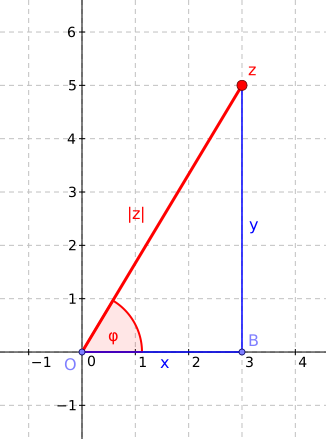
As you can see, we need the length of the line from the point z to the origin, which is equal to the modulus of z – we already know how to work that out. We also need the angle φ. The modulus–argument form of a complex number then looks like this:
How do we find the angle φ? We use the trigonometric functions. Here we have a right-angled triangle and we know the length of the hypotenuse, which is the modulus of z. The modulus–argument form contains both sine and cosine, so we have to find the angle φ using both functions. From the properties of the trigonometric functions we have:
From these formulae we can work out the angle φ itself. We have to find the angle, because the modulus–argument form is written with the sine and cosine included.
Example
Convert the complex number from Cartesian form into modulus–argument form:
Now we have:
At this point we can either use a calculator and work out the inverse sine and inverse cosine, or we can use the table of exact values of the trigonometric functions. Both values we got are exact values, so this time we will not need a calculator.
If
Multiplication and division
Of course, we can also multiply and divide complex numbers in modulus–argument form. Using the addition formulae, we can derive formulae for the product and quotient of two complex numbers. Take two complex numbers z1 and z2:
The formulae themselves look like this:
Chapters: Complex numbers, Graphical representation of complex numbers, Modulus–argument form of a complex number
