
Inverse trigonometric functions
For the basic trigonometric functions to be really useful, we also need to define their inverse functions. These are the inverse sine, inverse cosine, inverse tangent and inverse cotangent, written for short as arcsin, arccos, arctan and arccot.
Motivation
Let’s start with an example. Work out the size of angle alpha:
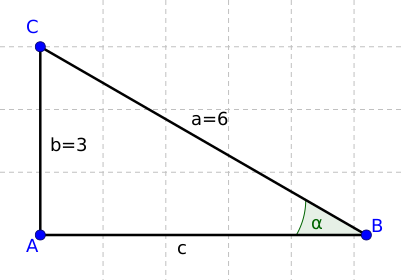
We know the lengths of two sides of the triangle, b = 3 and a = 6. We have to work out angle alpha – side a is the hypotenuse and side b is the side opposite angle alpha. The sine function works with the opposite side; more precisely, the sine of angle alpha is equal to the length of the opposite side divided by the length of the hypotenuse. So let’s try substituting into the formula:
Now we know that the sine of angle alpha is one half. The question is how to get the angle from this number. For that we need the inverse function of the sine. The sine function takes an angle as input and gives us a ratio of two sides. But now we need a function into which we put the ratio and an angle comes out.
This is exactly what the inverse trigonometric functions do. Before we define properly what they are, let’s finish the example by asking Google, which tells us that arcsin of one half is 30 degrees. If you want to work out the same example on a calculator, the inverse sine is usually written there as sin−1, as it is at GCSE.
An inverse function to the sine?
First, look at the graph of the sine function:
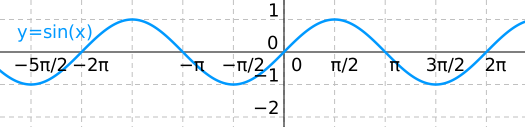
Now let’s recap some facts about functions. A function f has an inverse function if it is one-to-one. What does this mean? If we take two different elements x1 and x2 from the domain, then their images f(x1) and f(x2) must be different. This must be true for all possible pairs. You can easily see it from the graph – if we can draw a line parallel to the x-axis that meets the graph of f more than once, then the function is not one-to-one.
For the sine function we can clearly find such a line. For example, the x-axis itself meets the graph of the sine function more than once – infinitely many times, in fact. So the sine function is not one-to-one and has no inverse function.
An inverse function to a restriction of the sine function
From the previous section we know that the sine function has no inverse function. But from the first section we know that there is a function arcsin that behaves exactly the way we want. How did we manage that? We took just a part of the sine function that is one-to-one, so we can define an inverse function to this restriction of the function.
We restrict the sine function by making its domain smaller. Which subset of the original domain (the real numbers) should we choose? There are several possible choices, but the best one is the interval
This interval is shown in the following picture:
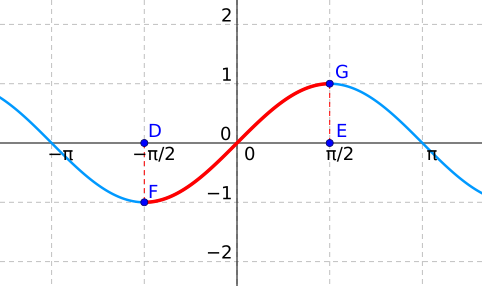
On this domain we can already define an inverse function, because on this interval the sine function is one-to-one. The inverse function is a reflection of the original function in the line y = x, so we can already draw the graph of the inverse of our restriction of sin(x). Look at the picture:
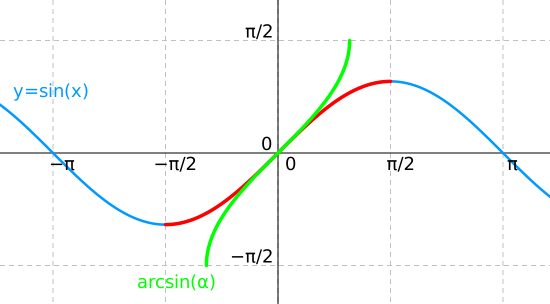
The original sine is drawn in blue. The part of the function whose inverse we are looking for is highlighted in red. The inverse function is shown in green, and we write it as arcsin (or sometimes just asin).
Domain and range of arcsin
These two functions are a nice way to show how the domain and the range swap places. Look at the following picture, which has the same graphs in the same colours, just a bit bigger and with some lines and points added:
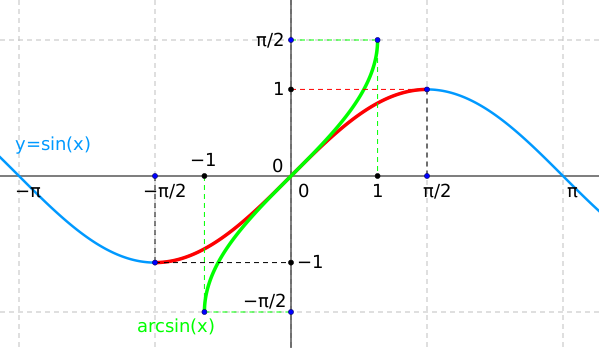
Notice that the domain of the restricted sine function (the red line) was the interval
By the domain we mean all the x for which the function is defined. We defined it only on this interval, so that we get a one-to-one function. On the graph we look for these x on the x-axis.
Now look at the range of the arcsin function (the green line). The range is all the y that the function can give us as output, so we look for them on the y-axis. The range of arcsin is again the interval
This is a general property of an inverse function, so it should not surprise anyone. It works the same way the other way round, for the range of the restricted sine function and the domain of arcsin. The range of the sine function is the interval from minus one to one. The sine can give us only these values: no angle has a sine greater than one or less than minus one. And because the sine of an angle cannot be greater than one, it makes sense that the inverse function cannot take an input greater than one either. That is why the domain of arcsin is the interval [−1, 1].
Inverse cosine
Now briefly about the inverse function of the cosine. For the same reason as for the sine, there is no inverse function here, because the function is not one-to-one. But we can choose a subset of the domain and get a one-to-one function.
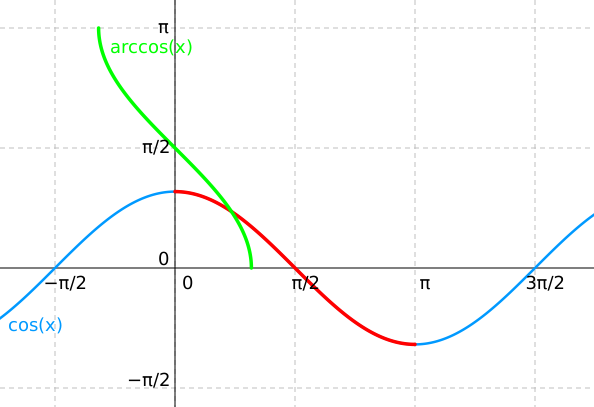
The graph of the cosine function is shown in blue, and the red part is the restriction of this function to the domain [0, π]. The green line is the graph of the function arccos(x), the inverse of our restriction of the cosine function.
Inverse tangent
The graph of the tangent function looks like this:
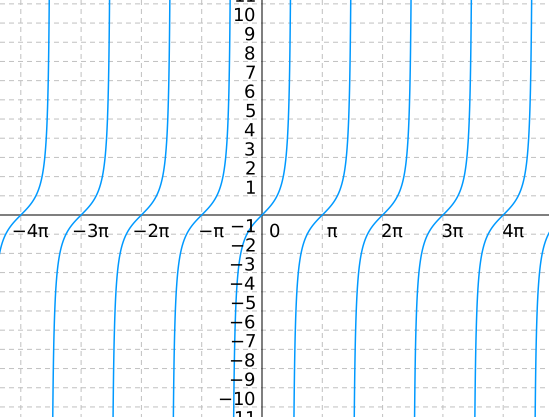
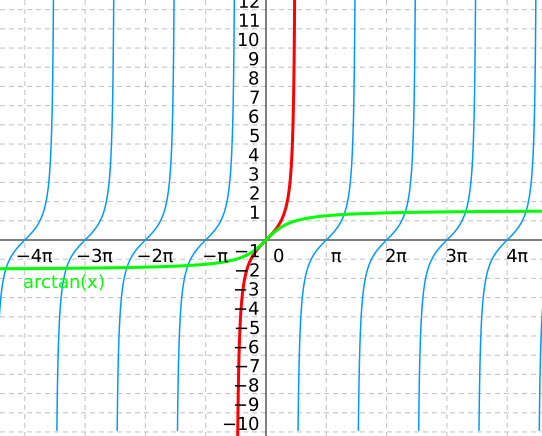
The graph has a different shape from the previous functions, but it is still not one-to-one. Again, though, we can restrict the function and choose a part that is one-to-one. We choose the open interval
The inverse function then has the following shape:
Inverse cotangent
Everything is the same as in the previous sections. The graph of the cotangent function:
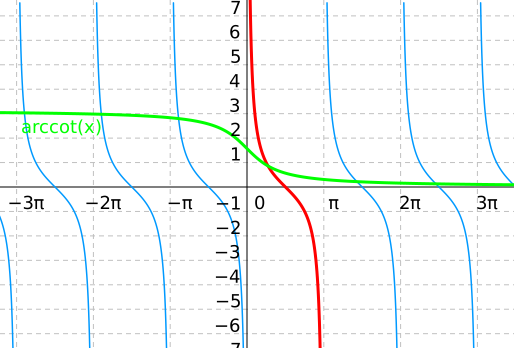
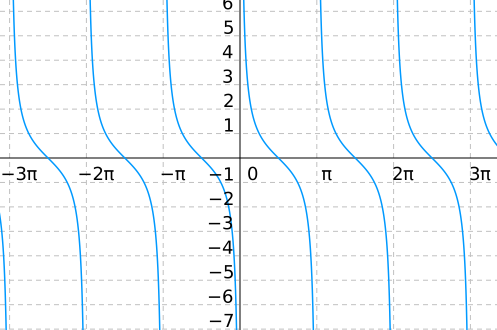 The domain of the restriction of the cotangent function will be the open interval (0, π).
Chapters: Trigonometric functions, The unit circle, Inverse trigonometric functions, Properties of sine, cosine, tangent and cotangent, Trigonometric formulae, Graphs of trigonometric functions, Sine rule and cosine rule
