
Right-angled triangle
A right-angled triangle has one interior angle that is a right angle, that is, an angle of 90 degrees. This triangle has several interesting properties, which this article covers.
Basic description
The right-angled triangle was already partly described in the main article on triangles. A right-angled triangle has one interior angle of 90 degrees. The other two interior angles must both be less than 90 degrees, because otherwise the interior angles would not add up to 180 degrees. In fact, the other two angles add up to exactly 90 degrees.
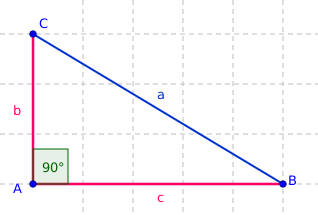
A right-angled triangle of course has three sides. Two of them (the red sides) are called the legs – these are the shorter sides, the ones adjacent to the right angle. The third side is called the hypotenuse (the blue side) – this is the longest side. The hypotenuse is always opposite the vertex with the right angle.
Pythagoras’ theorem
Probably the most famous theorem in maths, Pythagoras’ theorem, holds precisely in right-angled triangles. It is about the lengths of the sides of the triangle. The theorem says that “the area of the square on the hypotenuse of a right-angled triangle is equal to the sum of the areas of the squares on the other two sides”. Written mathematically for our triangle, where the hypotenuse is side a:
Pythagoras’ theorem in a picture, this time in the usual notation with hypotenuse c:
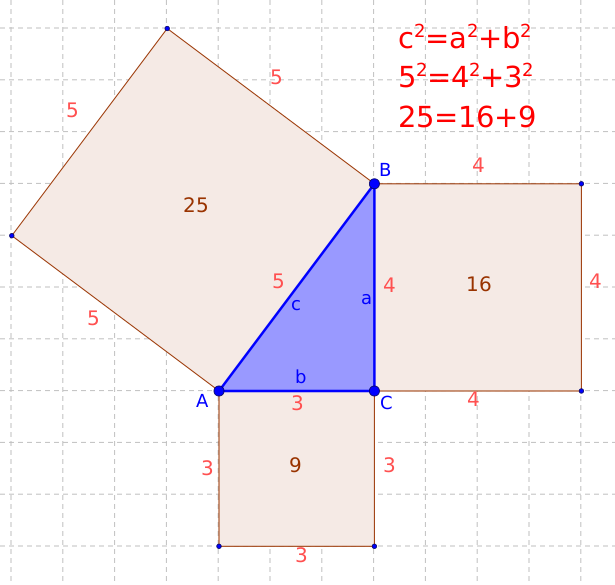 The theorem has its own separate article.
Area of a right-angled triangle
In a right-angled triangle it is very easy to work out the area, because the altitudes coincide with the shorter sides. Imagine the right-angled triangle from the first figure. How would we work out its area without knowing any altitudes? We can complete the triangle to form a rectangle. The sides of the rectangle are formed by the two shorter sides of the triangle, and we add the other two sides so that we really do get a rectangle:
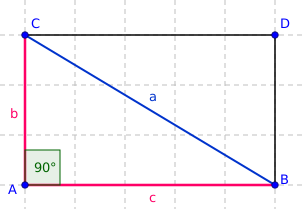 We already know how to find the area of a rectangle: it is the product of the lengths of two adjacent sides, here the product of the red sides AC and AB. That gives the area of the rectangle. However, the hypotenuse BC is a diagonal of the rectangle, and it cuts the rectangle in half, so if we divide the area of the rectangle by two, we get the area of the right-angled triangle. The formula therefore looks like this:
where T is the area of the triangle and b and c are the lengths of the shorter sides.
The trigonometric functions sine and cosine
In a right-angled triangle the basic trigonometric functions and the relationships between them apply. Trigonometric functions such as sine, cosine, tangent and cotangent express the ratio between the lengths of the sides of a right-angled triangle. Let’s take the first triangle once more, this time with the angles highlighted.
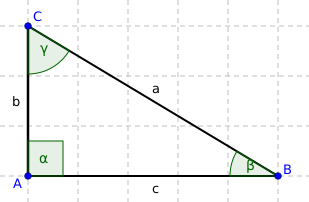
If we want the ratio of the lengths of two sides, we take both lengths and divide them in the order given. For example, the ratio of the side lengths b:c (read “b to c”) is found by dividing 3/5 (side b has length 3 and side c has length 5).
The sine function then works with the ratio of two sides and one angle. In our figure, if we take the ratio of the sides b:a, we get the value of the sine function applied to the angle β. Cosine works in a similar way, but for the ratio c:a and the same angle β. So:
Sine and cosine only work with the angles in a right-angled triangle that are less than 90 degrees. Here those are the angles β and γ. In this range sine and cosine always give a number in the interval (0, 1), so you can remember the rule that you always divide the shorter side by the longer side – so that you get a number in the interval (0, 1).
Both functions also work with one of the shorter sides and the hypotenuse, never with the two shorter sides together. Because you always divide the shorter side by the longer one, the hypotenuse is always in the denominator of the fraction. If you look at the formulas above, the denominator is always a, which is the hypotenuse of the triangle.
The last rule is that sine works with the opposite side, while cosine works with the adjacent side. What does that mean? If we have the angle β, then the adjacent side is the shorter side that starts at point B, which is side c. The opposite side is the other shorter side, side b. That is why the formula for sine has side b and the formula for cosine has side c.
In summary: sine gives the ratio of the opposite side to the hypotenuse, and cosine gives the ratio of the adjacent side to the hypotenuse. How can we use that? If you know the angles of the triangle and the length of the hypotenuse or of one of the shorter sides, you can work out the lengths of the remaining sides. Example:
For the previous triangle we have:
What is the length of side a? We know that:
We know the value of the sine and we know the length of side b, and we are looking for the length of side a. We rearrange to make a the subject using equivalent steps:
(First we multiplied the equation by a and then we divided the equation by the sine.) On the right-hand side we now have only known values, so we substitute. We work out the value of the sine on a calculator.
Side a has length 5.83. When you work out a sine on a calculator, be careful to have it in degree mode. A common problem is that you end up working in radians, which is a different unit of angle. The conversion between them is:
where deg is your value in degrees.
The trigonometric functions tangent and cotangent
These two functions can also be used easily in a right-angled triangle. Again, we always work with angles less than 90 degrees. Unlike sine and cosine, however, these functions do not use the hypotenuse of the triangle, only the two shorter sides. The tangent of an angle is the ratio of the opposite side to the adjacent side, and the cotangent is the ratio of the adjacent side to the opposite side.
For the previous triangle we therefore have:
Let’s try to work out the length of side AC (side b) in the previous triangle, using the angle β. We know its size from the previous example. We know that:
We rearrange to make side b the subject:
(We simply multiplied the equation by c and swapped the sides.) Now we know everything we need to work out the length of side b. We substitute:
We can already see from the figure that we got the correct answer. Again, be careful: the angle in the tangent in this formula is in degrees, while your calculator may need the angle in radians.
To illustrate, we can work out the same side using the cotangent:
We substitute the values:
Again we got the correct result.
Chapters: Triangle, Altitude of a triangle, Median of a triangle, Circles in a triangle, Right-angled triangle, Constructing a triangle, Congruent triangles, Similar triangles, Area of a triangle, Pythagoras’ theorem
