
Trigonometric functions
In this article I will look at the trigonometric functions. The word trigonometry comes from Greek: trigon means triangle and metron means measure. There are four basic trigonometric functions – sine, cosine, tangent and cotangent.
Basic terms for a triangle
Trigonometric functions work with the angles in a triangle, so in this section we recap the terms connected with triangles.
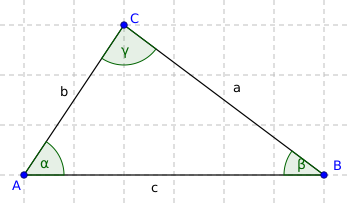 The picture shows a triangle with vertices A, B and C, so it is triangle ABC. It has three sides: AB, BC and AC. Notice that the sides are also named with small letters. There is a rule for this – the side opposite vertex A is side a, the side opposite vertex B is side b, and the side opposite vertex C is side c. Each side is named after the vertex it is opposite, that is, the vertex that is not an end of that side.
Every triangle has three interior angles, which we usually label with the Greek letters alpha α, beta β and gamma γ. The three interior angles always add up to 180 degrees. The angle at vertex A is usually alpha, the angle at B is beta and the angle at C is gamma.
We can use trigonometric functions in any triangle, but we often work only with a right-angled triangle. This is a triangle with one right angle, that is, an angle of 90 degrees. For example, it looks like this:
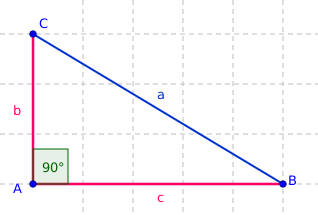
The sides of a right-angled triangle have special names. The longest side is opposite the right angle and is called the hypotenuse (the blue side in the picture). The two shorter sides (the red sides) are the sides adjacent to the right angle. This is the triangle we will be most interested in.
Naming the shorter sides of a triangle
Let’s move on to the first trigonometric function, the sine. All the trigonometric functions describe a relationship between an angle in a triangle and the ratio of the lengths of two sides. The angle is usually not the right angle but one of the other two. The input to a trigonometric function is the size of an angle. The output is the ratio of two sides. The functions differ in which sides they use.
The sine function works with the opposite side and the hypotenuse. The following picture shows which side is adjacent and which is opposite for a given angle.
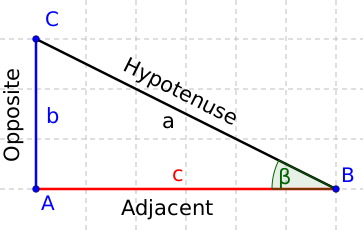
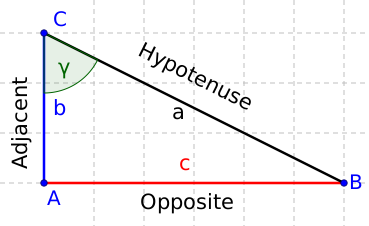
In the picture we are working with angle beta, the angle at vertex B. The black side is the hypotenuse, which never changes. The side c, highlighted in red, is the adjacent side, because it is next to angle beta. The side b, highlighted in blue, is the opposite side, because it is across from angle beta. The important thing is that these names always refer to a particular angle. If we look at the picture from the point of view of angle gamma, we get this:
The sine function
The sine of angle alpha is equal to the length of the opposite side divided by the length of the hypotenuse. What does this mean? If we work out (on a calculator, for example) the sine of angle alpha, we get the value of the fraction
Let’s try it on this triangle and angle beta:
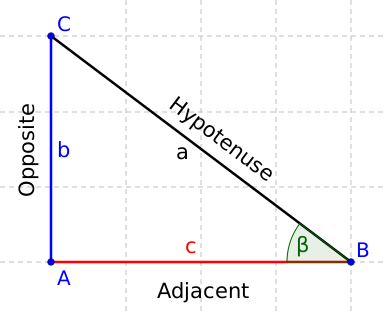 It is a nice triangle, with side lengths a = 5, b = 3 and c = 4. The side opposite angle beta is side b, and the hypotenuse is side a. We work out the fraction b/a, that is 3/5, which is 0.6. So the sine of angle beta is 0.6. Angle beta is 36° 52′, and if you enter this angle into a calculator and work out the sine, you get exactly 0.6 (after a little rounding).
What is it good for
It is useful when you know one angle and the length of one side and need to work out the remaining sides.
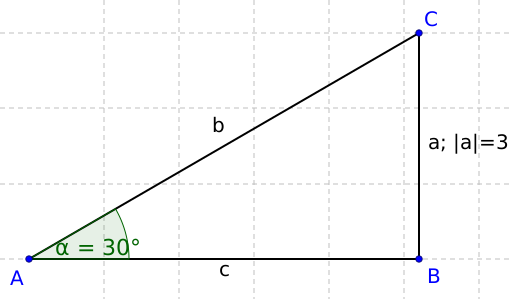
First we write down what we know. We know angle alpha. We know that the sine of this angle is equal to the opposite side (which is side a) divided by the hypotenuse (side b). Written mathematically:
We know the sine of the angle, or at least we can work it out, and we know the length of side a. The only thing we do not know is the length of side b. So we will try to get this unknown on its own. First we multiply the equation by the length of side b. We get
and now we just divide the equation by sin(α), which gives the form we want with the length of side b on the left-hand side:
We know the length of side a: it is three. The sine of thirty degrees is equal to one half. Substituting:
Side b has length six.
The cosine function
Cosine is very similar to the sine function. The terminology for cosine is the same as in the previous section, so let’s go straight to the definition:
The cosine of angle alpha is equal to the length of the adjacent side divided by the length of the hypotenuse. So if we work out the cosine of angle alpha on a calculator, we get the value of the fraction
The following picture shows the difference between sine and cosine:
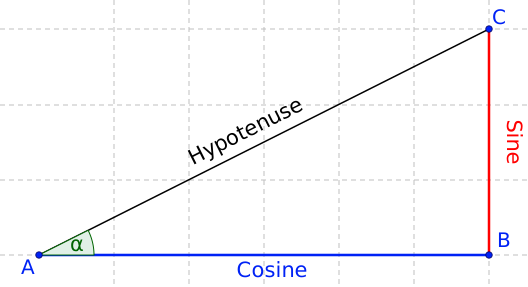 Both functions use the hypotenuse of the triangle, which stays black. The sine uses the opposite side, which – with respect to angle alpha – is the red side BC. The cosine uses the adjacent side, which is the blue side AB.
Let’s go back to the example from the previous section. We had to work out the length of the hypotenuse when we knew the length of side a. Now let’s work out the length of side c if we know angle alpha and the length of the hypotenuse that we have just found in the previous example: b = 6.
What do we know? Angle alpha is 30 degrees, side b has length six, and the cosine gives us the ratio of the adjacent side to the hypotenuse. The adjacent side is side c, the side whose length we want to find. We write:
We need to get c on its own. We do this by multiplying the equation by the length of side b, which leaves just the length of side c on the right-hand side:
We just swap the sides:
On the right-hand side we have expressions that we either know or can work out. The cosine of thirty degrees is approximately 0.866. Substituting into the equation:
This is the length of side c. As we will see later, the cosine of thirty degrees is one of the exact values, which is equal to
so we can make the previous length exact:
Tangent and cotangent
There are two more trigonometric functions, the tangent and the cotangent. The main difference from the previous functions is that tangent and cotangent use only the two shorter sides and do not use the hypotenuse.
The tangent of angle alpha is equal to the length of the opposite side divided by the length of the adjacent side. We write the tangent as tan.
The cotangent of angle alpha is equal to the length of the adjacent side divided by the length of the opposite side. We write the cotangent as cot.
The terminology is the same as in the previous sections, and so is the way we work with the functions. Let’s go back to the previous example and try to work out the length of side c knowing only the size of angle alpha and the length of side a, which is a = 3.
The tangent is the ratio of the opposite side to the adjacent side, so written mathematically it looks like this:
We need to work out the length of side c, so we have to get c on its own in this equation. We multiply by c and divide by tan(α), just as in the previous examples.
We substitute into the right-hand side, where the tangent of thirty degrees is approximately 0.5773.
There is an exact value for the tangent of thirty degrees:
so we can do the previous calculation exactly:
Exact values
For some nice angles, sine, cosine, tangent and cotangent have nice exact values. Here is a summary of the basic ones:
Links
Related topics on this site:
Chapters: Trigonometric functions, The unit circle, Inverse trigonometric functions, Properties of sine, cosine, tangent and cotangent, Trigonometric formulae, Graphs of trigonometric functions, Sine rule and cosine rule
