
Calculating VAT
VAT, value added tax, is hidden in the price of almost everything we buy. The shop collects it from us when we pay and passes it on to the government. In the UK there are three rates: the standard rate of 20%, the reduced rate of 5% and the zero rate of 0%. The zero rate applies to most food, children’s clothes and books. The reduced rate applies to home energy, such as gas and electricity bills, and to children’s car seats. Most other goods and services, such as adult clothing, electronics, car repairs and meals in restaurants, are charged at 20%.
What matters is what VAT is calculated from: always from the price excluding tax. Otherwise it is an ordinary calculation with percentages.
Price including VAT
We have spotted a bike for £500 excluding VAT. How much will we pay for it in the shop? We add 20% of the price to the price excluding VAT. We start by working out the tax itself:
We add the tax to the price excluding VAT:
The bike costs us £600, of which £100 goes to the government.
It can also be done in one go. The price excluding VAT is 100%, we add 20%, and we pay 100% + 20% = 120% of the price excluding VAT. And 120% of any number is easy to find: we just multiply it by 1.2:
In general,
and for the reduced rate we multiply by 1.05 instead of 1.2.
Price excluding VAT
Now let’s turn this round. The price tag says £600 including VAT, and we want to find out how much of that is the price before tax. It is very tempting to simply subtract 20%, that is, to take 80% of the price. Let’s try it:
We get £480, but we know the bike cost £500 excluding VAT. Caught out.
The mistake is that the 20% is calculated from the price excluding tax, not from the price including tax. The price including VAT is higher, so 20% of it comes to more than the tax we added to the price:
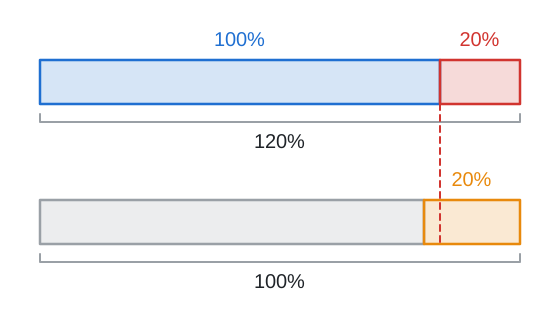
The top bar shows the price excluding VAT (in blue) and the tax that was added (in red). The bottom bar is the same length and represents the price including VAT, but this time we treat it as the whole, that is, 100%. The 20% of it, shown in orange, is a longer piece than the red tax, so we subtracted too much.
The correct method is the reverse of the one for the price including VAT. The price including VAT is 120% of the price excluding VAT, so instead of multiplying we divide by 1.2:
In general:
We find how much tax is hidden in the price by subtracting:
Notice one more thing: £100 is only about 16.67% of the price including VAT. The tax rate is 20%, but the tax makes up a smaller share of the price you pay.
Example with the reduced rate
Our electricity bill came to £84. Home energy is charged VAT at the reduced rate of 5%. How much was the bill excluding VAT, and how much of it is tax?
The £84 we paid is 105% of the price excluding VAT, so we divide it by 1.05:
Excluding VAT, the bill was £80. The tax is the difference between the two prices:
Of our bill, £4 goes to the government. We can check it: 5% of 80 is 0.05 · 80 = 4. It works.
Calculator
You can also have the price excluding VAT worked out here. Fill in the price including VAT and the rate, that is, 20, 5 or 0.
See also
Chapters: Working with percentages, Per mille, Calculating VAT, A discount on a discount
