
The discriminant
The discriminant is a polynomial that lets us work out the solutions of a general quadratic equation, or decide whether the equation has any solutions and how many.
The formula and basic relationships
First, a reminder of the form of a quadratic equation:
where a, b and c are real numbers. We call the discriminant D and work it out like this:
Example: take the quadratic equation 3x2 + 5x − 7 = 0. Here a = 3, b = 5, c = −7. We work out the discriminant like this:
So the result is 109. What does this number tell us? If the discriminant is…
- positive, the equation has two different real roots,
- zero, the equation has two equal real roots,
- negative, the equation has no solution in the real numbers. It does, however, have solutions in the complex numbers.
How to find the roots of a quadratic equation
We can use the discriminant to find the roots of a quadratic equation directly. The quadratic formula is
where D is the discriminant. Written out in full, with the discriminant expanded, it looks like this:
Let’s use this formula to find the roots of the quadratic equation x2 + 7x + 12 = 0. First we work out the discriminant:
The discriminant is positive, so the equation has two different real roots. We work out the first root by adding the square root of the discriminant; for the second we subtract it:
The first root is −3. We find the second root by subtracting the square root:
Now we have both roots of the equation, x1 = −3 and x2 = −4.
To master this method you must be able to pick out the values of a, b and c correctly. How to do this was described in the first article on quadratic equations.
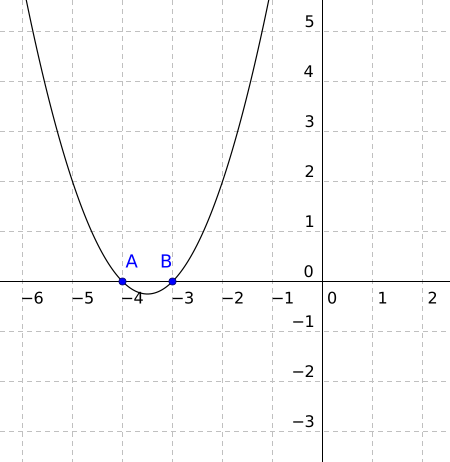
And what does this solution mean graphically? If we draw the graph of the function on the left-hand side of the equation, we find that the graph of this quadratic function crosses the x-axis at two points: x1 = −3 and x2 = −4.
A zero discriminant
If the discriminant is zero, the equation has a solution, but only one – or rather two, but equal. Example: solve the equation x2 − 10x + 25 = 0. We work out the discriminant:
We find the root in the same way as in the previous section, using the formula. But because the discriminant is zero, the plus-or-minus square root of D drops out of the formula, since we would be adding or subtracting zero.
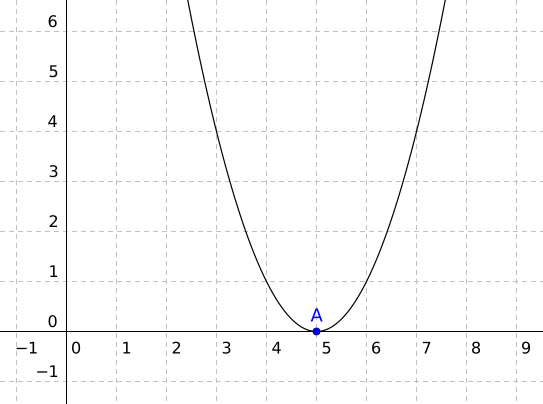
We got one repeated root, x = 5. What does this mean graphically? The graph of the function touches the x-axis at exactly one point, its turning point.
A negative discriminant
If the discriminant is negative, the quadratic equation has no solution in the real numbers. We can solve the equation in the complex numbers, but that is the subject of the next article. As an example, let’s try to solve this quadratic equation: x2 + x + 1 = 0. The discriminant is:
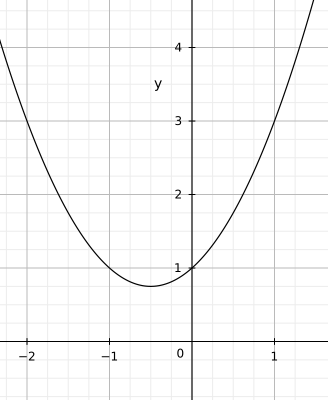
So the quadratic equation has no solution in the real numbers. You can try it: the expression x2 + x + 1 is positive for every real number. For example, substituting x = 1 gives 1 + 1 + 1 = 3. For x = −1 we get 1 − 1 + 1 = 1. For x = 0 we get 0 + 0 + 1 = 1. And similarly for other numbers. You can also look at the graph of the function y = x2 + x + 1, which never crosses the x-axis.
Sum and product of roots
We already know how to find the solutions of a quadratic equation. But how are they related to each other? Let’s try adding the two solutions x1 and x2:
If we add the roots of the quadratic equation ax2 + bx + c = 0, we get −b/a. What happens if we multiply them?
So if we multiply the roots, we get c/a. These two results are known as Vieta’s formulas. Once more, together:
Notice that the denominator of the fraction is always a. A special case is a quadratic equation with a = 1. Then we can write the sum and product of roots like this:
We can use this to find the solutions of quadratic equations. Instead of working out the discriminant the long way, we can see whether we can find numbers x1 and x2 for which the relationships above hold. Example: find the solutions of the equation x2 + 8x + 15 = 0. Here a = 1, so we can use the simpler version. We are looking for numbers x1 and x2 such that
If we restrict ourselves to integers, there are four ways to get a product of 15:
Now we need the numbers on the left to add up to −8. Only one pair does that: −3 and −5. These numbers are therefore the solutions of the quadratic equation. We can check them by substituting into the equation; we must get zero:
It works. If you know the roots, you can also write the equation in a more readable form. If x1 and x2 are the roots of the equation ax2 + bx + c = 0 and a = 1, you can rewrite the equation as
So we can rewrite the previous equation as:
Chapters: Quadratic equations, The discriminant, Quadratic equations with a parameter, Quadratic equations with complex solutions
