
Quadratic equations
A quadratic equation is an equation with one unknown that is raised to the power 2. If the equation contains the unknown raised to a higher power than 2, it is no longer a quadratic equation.
Describing a quadratic equation
A quadratic equation can always be written in this form:
The values a, b and c are real numbers and a is not zero. The parts of the equation have their own names:
- ax2 is called the quadratic term,
- bx is called the linear term,
- c is called the constant term.
Every quadratic equation can be rearranged into the form ax2 + bx + c = 0 by doing the same to both sides or by other manipulations. An example of a quadratic equation is
A harder question is whether this is also a quadratic equation:
There is no x2 in sight and the right-hand side is not zero. The right-hand side is easy to deal with: we subtract 7 from both sides, which gives
Still no x2. Let’s expand the brackets:
Now there is an x2. After collecting like terms we finally get the form ax2 + bx + c = 0:
What about the next example? Is it a quadratic equation, and can it be rearranged into that form?
The answer is that it cannot. If we multiply the whole equation by x to get rid of the variable in the denominator, we get
Now there is an x3, which cannot appear in a quadratic equation.
There are special types of quadratic equations, depending on the values of the coefficients a, b and c.
Finding the coefficients
For the later sections it is absolutely vital that you can pick out the coefficients a, b and c. Let’s start with a simple example. Find the coefficients of 3x2 + 4x + 7 = 0. This one is easy: a = 3, b = 4 and c = 7.
What about 3x2 − x + 2 = 0? The values of a and c are clear, a = 3 and c = 2, but what about b? It would be a mistake to say b = 1. Imagine there is a 1 in front of the x, like this: 3x2 − 1x + 2 = 0. Now it is easier to see that b = −1.
Another interesting example: x2 − 3 = 0. Again the coefficient b can cause trouble; the others are clear: a = 1 and c = −3. What is b? There is no linear term at all in this equation, which is the same as writing x2 + 0x − 3 = 0. So b = 0.
A trickier example:
This equation has two traps. There is no constant term, so c = 0. The quadratic term is clear, so a = 5. But what about that wretched b? We can rearrange the equation a little by taking out the common factor x from the two terms:
The coefficient b is again whatever is “in front of” the variable x, so the whole bracket is the coefficient: b = (3 + π). A similar equation:
The first two coefficients are clear: a = −1 and b = 4. What is the constant term? It is all the remaining terms that do not contain x, so
And what are the values for this equation? (x + 1)(x + 2) = −2x. First we must rearrange it into the form ax2 + bx + c = 0. Expanding the brackets gives
and finally we add 2x to both sides to get zero on the right-hand side:
Now the values are clear: a = 1, b = 5 and c = 2.
Quadratic equations with no x term
If b = 0, the equation has no x term and is solved much like a linear equation. Such an equation has the form
Because b = 0, the whole linear term bx drops out of the equation, since 0x = 0. We solve the equation by first subtracting the constant term, that is, subtracting c from both sides. This gives:
Next we divide both sides by a. We get
And finally we take the square root of both sides. For this to work, the fraction on the right-hand side must not be negative, because you cannot take the square root of a negative number. The result is:
Notice that we get two solutions, one positive and one negative. This is easier to see in an example. Let’s solve the equation
Following the method, we first subtract the constant term c. Watch out: here c is negative, so we are subtracting a negative number, which means adding a positive one. We add +8 to both sides (the aim is to get the 8 onto the right-hand side). This gives:
Next we divide both sides by a, which is 2. This gives:
Now we take the square root.
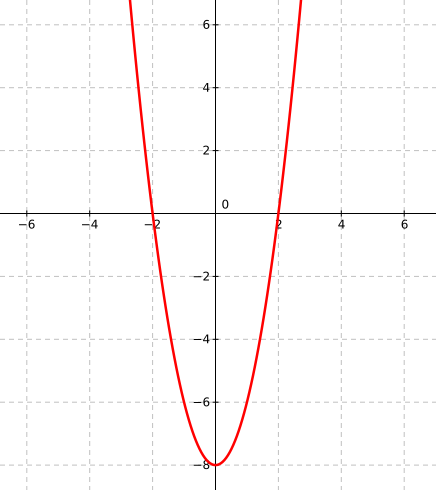
Why is minus 2 a solution as well? Because minus 2 times minus 2 is 4. We can also look at the solution graphically: the graph of the function 2x2 − 8 crosses the x-axis exactly at the points x1 = −2 and x2 = 2.
Solve the equation
We add 5 to both sides:
Divide by 80:
Cancel the fraction:
Take the square root:
Quadratic equations with no constant term
Another special case arises when the constant term c is zero. The equation then has the form
This type of equation is solved by taking out the common factor x:
The result is now fairly clear. Again there are two roots, but one of them is always zero. The whole left-hand side is a product of two expressions: x and the bracket (ax + b). When is this product zero? When at least one of the two expressions is zero. So the left-hand side is zero in two cases:
We already have the first solution: it is zero. We get the other by solving the linear equation ax + b = 0. From the article on linear equations we know that this equation has exactly one solution:
So we can now write down the solution of the whole quadratic equation ax2 + bx = 0:
Example:
Take out x:
The first solution is x = 0. We find the second by solving the linear equation 6x + 3 = 0:
Write down the result:
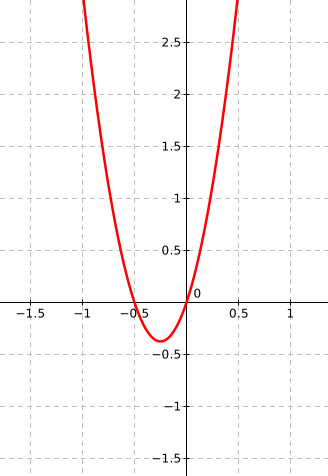
Again we can look at the graph of the function, which crosses the x-axis exactly at these points:
Other ways of solving
These were the basic techniques for special types of quadratic equations. A general quadratic equation is solved using the discriminant. Other types of equations include the quadratic equation with a parameter.
Calculator
Enter the coefficients a, b and c of the general equation ax2 + bx + c = 0, and the calculator will work out the discriminant and the roots. You can also find it on its own as the quadratic equation calculator.
Chapters: Quadratic equations, The discriminant, Quadratic equations with a parameter, Quadratic equations with complex solutions
