
Quadratic functions
A quadratic function is a function that can be written in the form f(x) = ax2 + bx + c, where a, b, c are real numbers and a ≠ 0. Just as a linear function is always described by a straight line, a quadratic function is always described by a parabola.
An example of a quadratic function
An example of a simple quadratic function is f(x) = x2 + 3x − 7. The graph of this function looks like this:
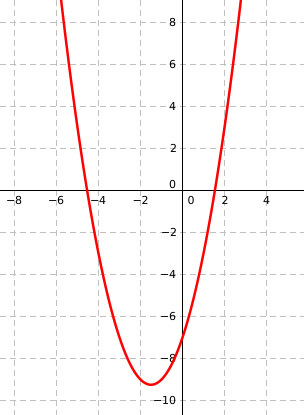
We could write a quadratic function in general form as ax2 + bx + c. The term ax2 is called the quadratic term, and every quadratic function must have it. The next term, bx, is called the linear term and it doesn’t have to appear in a quadratic function – it can be zero. For example, the function f(x) = 5x2 + 7 is still a quadratic function. The last term, c, is called the constant term and it isn’t compulsory either. For the function f(x) = x2 + 3x − 7 we would therefore have
Why is a equal to one? Because writing x2 really means 1 · x2, so a = 1.
Properties of a quadratic function
Let’s start with the domain. The domain of a quadratic function is ℝ, the set of real numbers. The range depends on the particular function, but it always goes off to (plus or minus) infinity on one side. A quadratic function is always increasing on one side of its turning point and decreasing on the other. If the linear term is zero (b = 0), the quadratic function is even. A quadratic function is never one-to-one.
Bounded above or below
A quadratic function is always bounded either above or below. It depends only on the parameter a. If the parameter a is positive, the graph “opens upwards”, it looks like the letter “U”, and so the graph is bounded below. An example is the function f(x) = 2x2 with this graph:
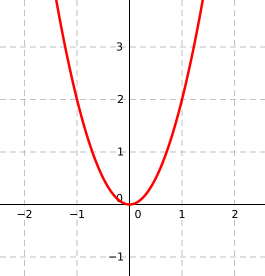
We can see that all the function values (all the red points) are above the number −1, so the function is bounded below. If we had the function f(x) = −2x2:
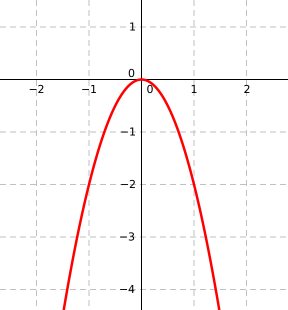
then all the function values would be below the number 1, so the function would be bounded above.
Convexity and concavity
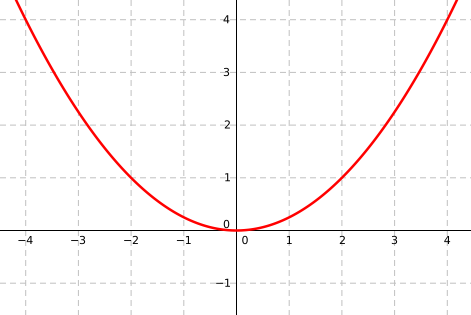
Convexity and concavity again depend on the parameter a. A quadratic function is convex if it has the shape of the letter “U” and concave if it has the shape of an upside-down “U”. So if a > 0 the graph is convex, and if a < 0 the graph is concave.
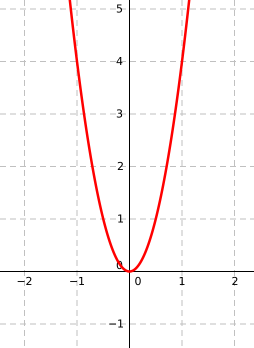
The parameter a also affects whether the graph is narrow or wide. The closer its value is to zero, the wider the graph, and vice versa.
Intercepts with the x-axis and y-axis
If we want to work out where a function meets the x-axis or y-axis, we just set up a simple equation and solve it. We only need to realise that we can write the function as y = ax2 + bx + c, which means we find the y-coordinate at x = 2 by substituting 2 for every x.
For example, for the function y = x2 − 4x + 3 at x = 2 we get the y-coordinate 22 − 4 · 2 + 3 = −1. So the graph certainly passes through the point (2, −1). If we want to work out the x-intercepts, we are interested in the x-value when y = 0. A point on the x-axis always has y-coordinate 0 – look at the following graph and it will be clear.
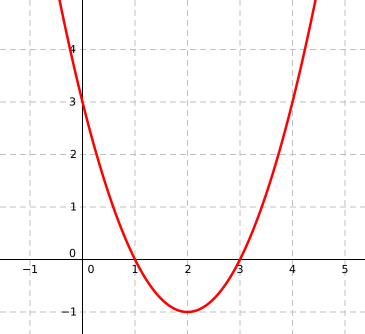
So in y = x2 − 4x + 3 we just substitute zero for y and solve the equation. The resulting roots are the x-coordinates of the intercepts.
This is a quadratic equation, which we can solve by standard methods. For example, we can factorise it as (x − 1) · (x − 3), from which we find that the roots are x1 = 1 and x2 = 3.
To get the y-intercept we proceed in the same way. We take y = x2 − 4x + 3 and this time substitute zero for x. We are really asking what the value of the function is at x = 0:
So the x-intercepts are (1, 0) and (3, 0), and the y-intercept is (0, 3).
How to find the coordinates of the turning point
For a quadratic function it is also very important to find its turning point (the vertex). So that you don’t have to remember a rather complicated formula, we’ll show you another way, which uses the method of completing the square. The turning point of a quadratic function is the point where the function has a minimum or maximum. The function f(x) = x2 − 4x + 3, whose graph looks like this:
has its turning point at (2, −1).
The standard way to write a quadratic function is f(x) = ax2 + bx + c. For a = 1, we convert this function into the completed-square form g(x) = (x + m)2 + n, where (−m, n) is the turning point of the quadratic function. For our function we want to get (x − 2)2 − 1. How do we get this form?
First we write down just the bracket: (x + m), and for m we substitute half the value of the parameter b of the quadratic function. The parameter b is equal to minus four, half of it is minus two, so we get this expression: (x − 2)2.
Now comes the second step: we have to adjust for the extra terms. If you expanded this bracket, you wouldn’t get the right result – we wouldn’t get the original function. From the bracket we still have to subtract the square of m and add the parameter c of the original function.
So specifically, we subtract (−2)2 from the bracket and add three (the parameter c):
After simplifying we get
which is the final result. Because the function is in the form (x + m)2 + n, where m = −2, n = −1, we know that the turning point has coordinates (−m, n), that is, (2, −1).
We should still check that we worked it out correctly. All we did was convert the quadratic function x2 − 4x + 3 into the form (x − 2)2 − 1. This new form should describe the same function, so if we expand the bracket, we should get the original form of the function. Let’s try expanding (x − 2)2 − 1.
We can see that we got the same function, so our working is correct.
