
Exponential functions
An exponential function is a function that has the variable in the index (the power).
Definition
An exponential function f has the form
The symbol a is any number, not some more complicated expression; it is called the base. The expression x is called the index (or exponent). The base can be, for example, the integer 3, the rational number
Why do we put conditions on the base a? If a were equal to 1, we would get a constant function, because “1 to the power of anything” is always 1. We have 12 = 1, 19 = 1, 1666 = 1. And since we don’t count a constant function as an exponential function, a must be different from 1, so a ≠ 1.
And why must a>0? Because a power with a real index is defined only for a positive base. For example, if we chose x to be a half and worked out
If we meet the conditions above, the exponential function f(x) = ax has the real numbers as its domain.
Quadratic vs exponential functions
It is easy to confuse an exponential function with a quadratic function. A quadratic function has the variable as the base and a number as the index, whereas an exponential function has a number as the base and the variable in the index. So quadratic functions are, for example: x2, x2 + 4 or x2 − x + 1. Exponential functions are: 2x, 4x or πx.
Important exponential functions
An important exponential function is the “natural exponential function”. It is the function whose base is the constant e, that is, Euler’s number. Euler’s number is an irrational number, that is, a number with an infinite non-recurring decimal expansion, and it cannot be written down exactly. Its approximate value is e = 2.718 281,828… This function is often written as exp.
Another important exponential function is the “base 10 exponential function”, whose base is equal to ten: a = 10.
The shape of the function depending on a
The function has two basic shapes, depending on the value of the base. We distinguish two intervals: (0, 1) and (1, ∞). If a is in the first interval, that is, less than 1, the function is decreasing. If it is in the second interval, the function is increasing. This makes sense, of course. Take
On the other hand, if a>1, multiplying gives a larger number. For the exponential function f(x) = 3x we get, for the values 2, 3 and 4, the results f(2) = 32 = 3 · 3 = 9. For 3: f(3) = 33 = 3 · 3 · 3 = 27. Then f(4) = 81. The function is increasing. Notice that even if the base were any other number greater than 1, the function would still be increasing.
That is why we also have to distinguish two types of graph, depending on the value of the base a.
Graphs of exponential functions
From the previous section we know that the graph must have two basic shapes, depending on the value of the base a. First we show the graph for values of a in the interval (0, 1).
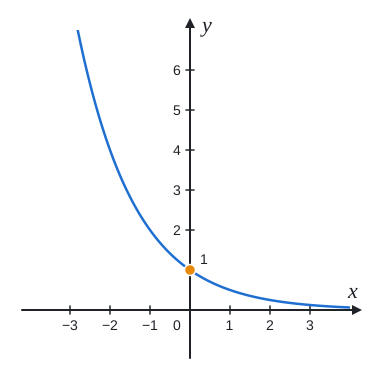
We can see that the function is decreasing and passes through the point (0, 1). This is no accident – from the properties of powers we know that anything to the power zero is 1. So
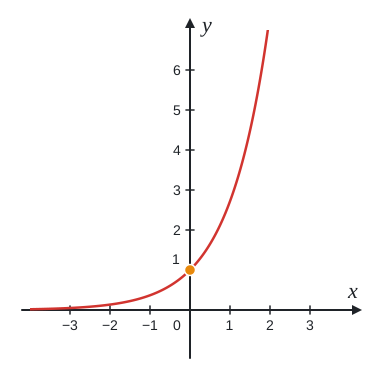
Properties of exponential functions
- The domain is the set of all real numbers
- The range is the interval (0, ∞)
- It is bounded below, ax>0. It is not bounded above.
- It has no maximum or minimum.
Whether the function is increasing or decreasing depends on the value of a. If a is in the interval (0, 1), the function is decreasing. If it is in the interval (1, ∞), it is increasing.
Exponential growth
The phrase “exponential growth” is used quite often in everyday speech. Usually people mean that something is rising incredibly fast. A classic case is the splitting of bacteria. Imagine a harmful bacterium that multiplies by splitting in two each time. We can describe this way of multiplying by the exponential function f(x) = 2x. The value of the function gives us the number of bacteria after x rounds of splitting.
Example: at the start (zero splits, x = 0) we have one bacterium, so 20 = 1. After the first round of splitting we have 21 = 2, that is, two bacteria. That fits: one bacterium splits into two. Now both of these bacteria split, so we have 22 = 4 bacteria. Again each one splits, so after the third round we already have 23 = 8 bacteria. And so on.
This multiplying, though it may not look like it, is incredibly fast. How many bacteria do we have after the tenth round? 210 = 1024. That is quite a number. After twenty rounds we have 220 = 1,048,576. After thirty rounds we are already past a billion.
This rate is much greater than for an ordinary quadratic function. If we compare the rate of the exponential function f(x) = 2x with the quadratic function g(x) = x2, the exponential function clearly wins. We already know the value of f at x = 20, while the value of the quadratic function g at x = 20 is: g(20) = 202 = 400. That is many times smaller than 1,048,576.
