
Thales’ circle
Thales’ theorem, which you may know as “the angle in a semicircle is a right angle”, says that every triangle whose circumcentre lies on one of its sides is right-angled.
Description of Thales’ circle
Thales of Miletus discovered an interesting property of triangles a very long time ago. Let’s draw a triangle and its circumcircle so that the centre of the circle bisects the hypotenuse (the longest side) of the triangle. Take a look at the diagram below:
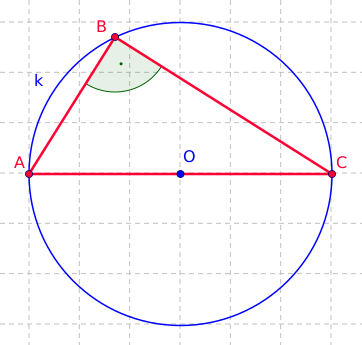
In the diagram we have a circle k with centre O. This circle is the circumcircle of triangle ABC, which means it passes through all the vertices of the triangle. The important feature is that the hypotenuse passes through the centre of the circle, through the point O.
Then the interior angle ABC is always 90°, a right angle.
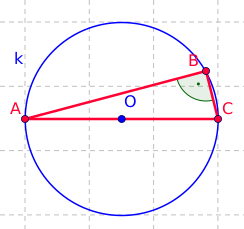
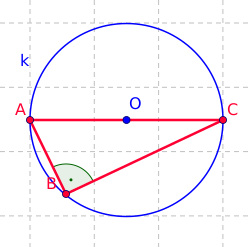
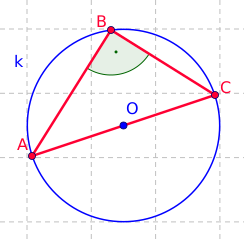
Wherever we move the vertex B along the circle, we always get a right angle at that vertex. Here are a few more examples:
Proof
Let’s work out why a triangle in Thales’ circle is always right-angled. Let’s adapt the first diagram slightly:
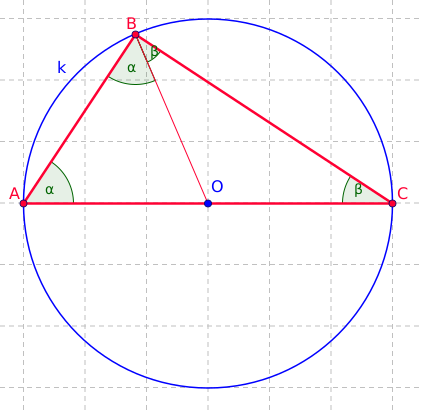
Triangles OCB and AOB are isosceles, because each has two sides of equal length. In triangle OCB these are the sides OC and OB, because their length is equal to the radius of the circle. In the other triangle they are the sides OA and OB.
So angle BCO and angle OBC are equal, shown in the diagram by the letter β. The same is true in the other triangle, where the equal angles are marked α.
We also know that the angles in a triangle always add up to 180°. Now we write the sum of the angles in triangle ABC using α and β. We must have
One α is there for angle CAB, the other α for angle ABO. The same goes for β. We simplify the equation a little:
Divide the equation by two:
And the proof is complete. The sum of the angles α + β is 90, and the sum of the angles α and β gives the interior angle ABC we were investigating.
Links and sources
Chapters: Circle, Thales’ circle
