
Area of a triangle
There are two main ways to find the area of a triangle. Either we complete the triangle to a parallelogram and work out the area of that parallelogram, or we use Heron’s formula.
Completing a parallelogram
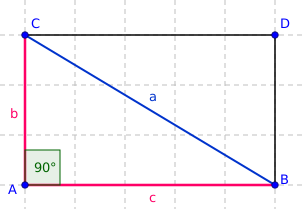
First let’s look at how we worked out the area of a triangle when it was a right-angled triangle. We completed the triangle to a rectangle, worked out the area of that rectangle and divided the result by two. The following diagram shows this:
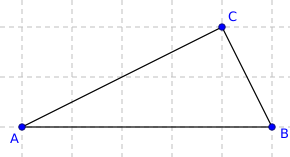
However, a triangle that is not right-angled cannot be completed to a rectangle so easily. But we can complete it to a parallelogram. So let’s take the following triangle ABC:
We complete this triangle to a parallelogram by drawing a line segment from the point C that is parallel to the line segment AB and the same length. Then we draw a line segment from the point A that is parallel to BC and the same length. We get this parallelogram:
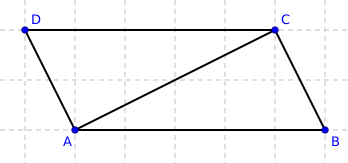
The question is how to work out the area of this parallelogram. We cannot multiply two adjacent sides as we did for a rectangle. However, we can easily turn this parallelogram into a rectangle with the same area as the parallelogram. The following triangles, highlighted in red, have the same area:
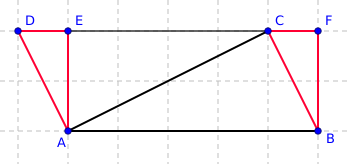
If we move triangle AED to the place of triangle BFC, we get a rectangle with the same area:
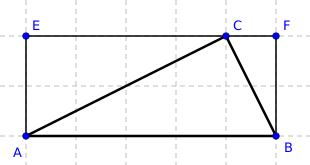
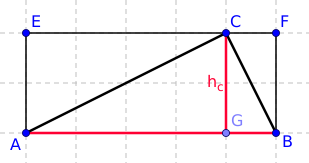
This is now a rectangle, so its area equals the product of the lengths of two adjacent sides. But what is the length of side AE or BF? If you look carefully at the original triangle ABC, highlighted in bold, you will see that the length of side AE is exactly the length of the perpendicular height of the triangle from the vertex C. So what can we say about the area S of this rectangle? It is equal to:
where hc is the height from the vertex C. The area T of the triangle is then half of this area:
The final formula
We can of course generalise the formula from the previous section to any of the three sides:
Here ha, hb and hc are the heights to the sides a, b and c.
Heron’s formula
If you do not know the length of any height in the triangle but you do know the lengths of all the sides, you can work out the area using Heron’s formula. It says that:
where
Calculator: work out the area of a triangle
Chapters: Triangle, Altitude of a triangle, Median of a triangle, Circles in a triangle, Right-angled triangle, Constructing a triangle, Congruent triangles, Similar triangles, Area of a triangle, Pythagoras’ theorem
