
Similar triangles
Similar triangles have the same shape but can be a different size. One is an enlarged or reduced copy of the other, like a picture enlarged on a photocopier. We can happily rotate or flip the copy, and it makes no difference to similarity.
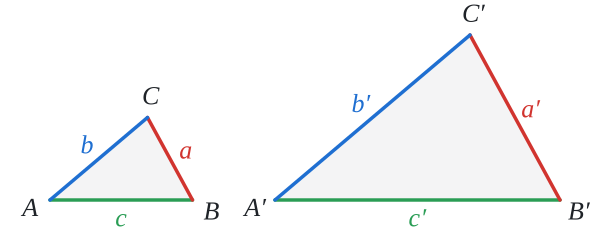
In similar triangles, corresponding angles are equal in size and corresponding sides are in the same ratio. In the figure, side a' is twice as long as side a, side b' is twice as long as b and c' is twice as long as c. We call this number the scale factor and write it as k. Every side is k times as long:
In the figure, k = 2. If k were less than one, say
As with congruence, the order of the vertices tells you what corresponds to what: vertex A corresponds to vertex A', B to B' and C to C'. Congruent triangles are really a special case of similar ones, with scale factor k = 1: the copy is neither larger nor smaller.
Conditions for similarity
You can tell whether two triangles are similar without checking all the angles and all the sides. The conditions for similarity are like those for congruence, except that instead of sides of equal length we look for equal ratios of sides.
AA (angle, angle): If two triangles have two pairs of equal angles, they are similar. We can save ourselves the trouble of measuring the third angle. The angles in a triangle always add up to 180°, so the third angles must come out equal as well.

SSS (side, side, side): If all three ratios of corresponding sides are equal for two triangles, they are similar:
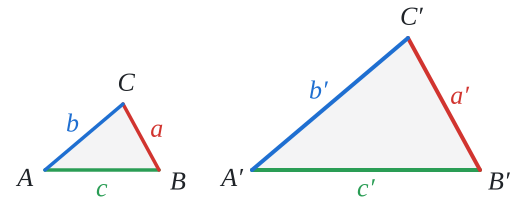
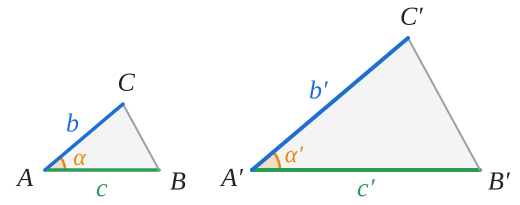
SAS (side, angle, side): It is enough for two corresponding sides to be in the same ratio and for the angle between them to be equal.
Example: how tall is the tree
A tall tree is growing in the garden and we want to know exactly how tall it is. We do not fancy climbing into the treetop with a tape measure. So we push a vertical pole 2 metres tall into the ground. The pole casts a shadow 1.5 metres long, and at the same moment the tree casts a shadow 12 metres long.
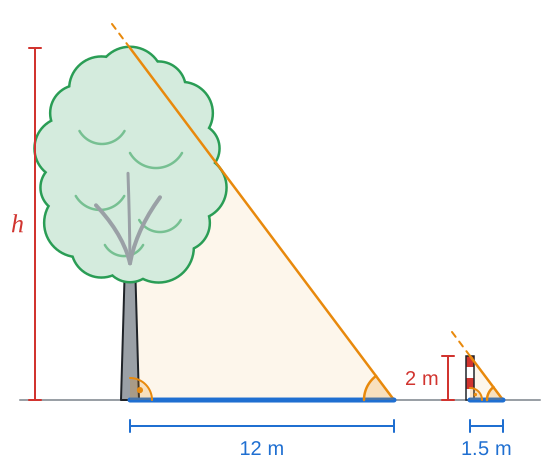
The tree, its shadow and a sunbeam form a triangle. A second triangle is formed by the pole, its shadow and a sunbeam. The pole and the tree both stand at right angles to the ground, so both triangles have a right angle at the base. The sun’s rays hit the ground at the same angle at the same moment, so the angle at the end of the shadow is equal in both triangles too. We have two pairs of equal angles, so by the AA condition the triangles are similar.
We read the scale factor from the shadows: the tree’s shadow is k times as long as the pole’s shadow:
Let’s divide:
So the tree is eight times as tall as the pole. The height of the tree is
Let’s multiply:
The tree is 16 metres tall. We check by comparing the ratio of height to shadow, which must be the same in both triangles. For the pole it is
Careful with area
It is tempting to conclude that if the sides are k times as long, the area will be k times as large. Wrong. The area grows k2 times.
Imagine a triangle with all its sides twice as long. If we join the midpoints of its sides, it splits into four triangles, and each of them is an exact copy of the original:
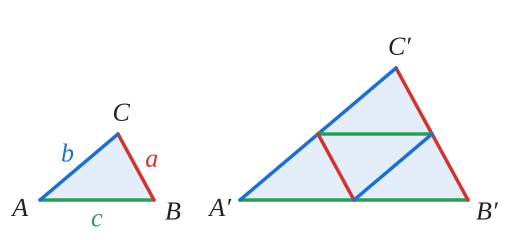
With scale factor k = 2 the area is therefore four times as large, not twice. In general, the area of triangle A'B'C' is
where T is the area of the original triangle. With k = 3 the area is nine times as large. It is like a photo: if you enlarge it to double the width and double the height, it uses four times as much paper.
See also
Chapters: Triangle, Altitude of a triangle, Median of a triangle, Circles in a triangle, Right-angled triangle, Constructing a triangle, Congruent triangles, Similar triangles, Area of a triangle, Pythagoras’ theorem
