
Converting road gradient to an angle
You have probably seen a road sign warning of a steep climb (or a steep descent). Such a sign tells you that there is a pretty steep hill ahead. But the sign gives the steepness as a percentage, while we usually measure angles in degrees. So what does a percentage gradient mean?

To explain what that 12% tells us, let’s look at the following picture:
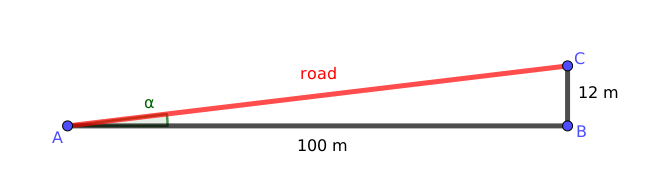
Imagine our car is at point A, where the sign for a 12% gradient is placed. Now we drive on up the hill along the red road until we have travelled one hundred metres horizontally. Our destination is point C. The horizontal distance is the distance between points A and B. In reality the car travels a slightly longer distance, because it is going uphill, so the distance AC is a little longer than AB. But when we reach point C, we have risen by 12 metres, shown by the line segment BC. And that is what the sign tells us: a 12% gradient means that if the hill continued for one hundred metres horizontally, we would rise by 12 metres. If the gradient were 14%, we would rise by 14 metres in one hundred metres.
How to work out the angle in degrees
How do we now find the size of angle α at vertex A? In other words, what angle does the rising road make with level ground? We use trigonometric functions, specifically the tangent. We know that the tangent of an angle in a right-angled triangle equals the ratio of the opposite side to the adjacent side. The side opposite angle α is BC and the adjacent side is AB. So we can write that the tangent of angle alpha is:
But we don’t actually want the tangent of the angle, we want the size of the angle α itself. For that we need the inverse trigonometric function arctan, which can find the size of an angle when we know the ratio of the sides (it is also written tan−1, which is the button on a calculator). So we can write that
We need to put this into a calculator, or we can use good old Google, which works out that
The road makes an angle of approximately 6.84° with the ground.
Calculator
A gradient can be given in three ways: as a percentage, as on a road sign; as an angle in degrees; or as a ratio 1 : n, where n is the horizontal distance over which the road rises by one metre. The ratio is used, for example, for ramps and roofs. Enter what you know, and the calculator will work out the other two values.
Chapters: Angle, How to construct an angle bisector, Copying an angle, Radian measure of angles, Directed angle, Sum of angles in a polygon, Converting road gradient to an angle
