
Triangle
A triangle is a geometric shape made up of three vertices joined by three line segments.
Description
Take a look at the following figure:
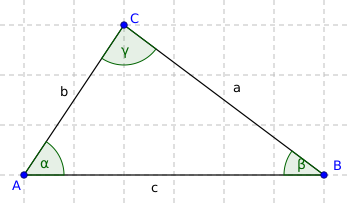 The figure shows a triangle with vertices A, B and C, so it is triangle ABC. It has three sides: AB, BC and AC. Notice that the sides are also labelled with lowercase letters. There is a rule behind this labelling – the side opposite vertex A is side a, the side opposite vertex B is side b and the side opposite vertex C is side c. Each side is named after the vertex opposite it, that is, the vertex that is not an endpoint of that side.
Every triangle has three interior angles, which we usually label with the Greek letters alpha α, beta β and gamma γ. The three interior angles always add up to 180 degrees.
A triangle has no diagonals, but it does have medians and altitudes.
The triangle inequality
The triangle inequality is an important relationship that holds in every triangle. The sum of the lengths of any two sides is always greater than the length of the third side. Written out:
What would happen if this inequality did not hold? That is, if one side were longer than the other two put together? There would be no triangle, because the two shorter sides would be too short and would not “reach” each other.
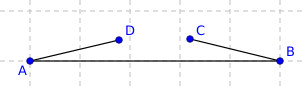
If equality held, that is, if two of the sides together were exactly as long as the third side, then when you tried to draw the triangle all three points would lie on one straight line:

The triangle inequality is also used in the definitions of other concepts, often ones to do with distance, where the principle is most natural. In the real world, for example, the direct route (as the crow flies) from London to Manchester is certainly shorter than going from London to Leeds and then from Leeds to Manchester.
Types of triangle
We distinguish several types of triangle, usually according to the lengths of their sides and their angles.
- An equilateral triangle has all three sides the same length. All of its interior angles are also 60 degrees.
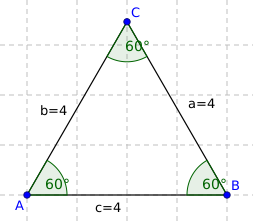
- An isosceles triangle has two sides of the same length, and the third side has a different length. The two equal sides are called the legs, and the third side is called the base. The angles that the equal sides make with the base are always equal.
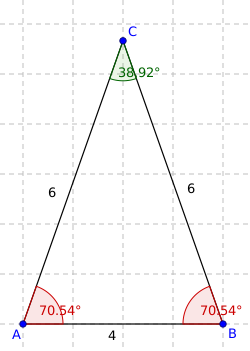
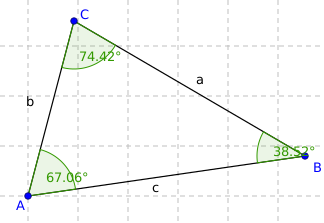
- An acute-angled triangle has every interior angle acute, that is, less than 90 degrees.
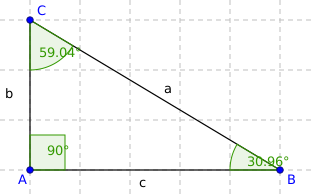
- A right-angled triangle has exactly one right angle, that is, an angle of 90 degrees. A triangle cannot have two right angles, because the interior angles add up to 180 – the third angle would then have to be zero, which is impossible. In a right-angled triangle the famous Pythagoras’ theorem holds. For more information, read the separate article on the right-angled triangle.
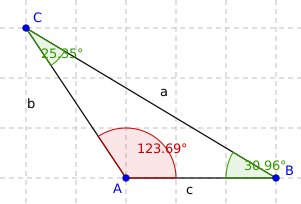
- An obtuse-angled triangle has exactly one obtuse angle, that is, one greater than 90 degrees. Again, a triangle cannot have two angles greater than 90 degrees, so the other two angles must be acute, that is, less than 90 degrees.
Chapters: Triangle, Altitude of a triangle, Median of a triangle, Circles in a triangle, Right-angled triangle, Constructing a triangle, Congruent triangles, Similar triangles, Area of a triangle, Pythagoras’ theorem
