
Quadratic inequalities
We can write a quadratic inequality in the general form ax2 + bx + c > 0 or ax2 + bx + c < 0, where a, b, c are any real numbers and a ≠ 0. Instead of “greater than” and “less than” we can, of course, use “greater than or equal to” and “less than or equal to”.
Positive coefficient a
An inequality like this is solved in a similar way to an ordinary quadratic equation: first we work out the discriminant and then use the result to decide how to continue. If the discriminant is positive, the related equation has two real roots. A root of the equation is a point on the x-axis where the graph of the function ax2 + bx + c crosses the x-axis. These two points of intersection split the x-axis into three intervals.
Let's try to solve the inequality 2x2 − 7x + 3 < 0. We draw the graph of the function 2x2 − 7x + 3, which looks like this:
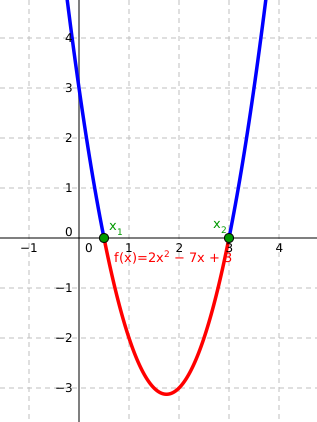
We can see that the graph crosses the x-axis at two points:
We would then work out the roots like this:
These two roots split the graph of the function 2x2 − 7x + 3 into three intervals.
- (3, ∞): in this interval the values are positive again, the remaining blue part of the graph.
Notice that we use round brackets in the intervals, which denote an open interval. This means that neither 3 nor
Now we have all the information we need to find the solution of the inequality 2x2 − 7x + 3 < 0. We ask: when are the values of the function 2x2 − 7x + 3 less than zero? They are less than zero in the interval
We can also try to solve these inequalities:
-
2x2 − 7x + 3 ≤ 0: this inequality differs from the previous one in having ≤ instead of just <. The result will be the same as before, except that instead of an open interval we use a closed interval. The solution is therefore the interval
-
2x2 − 7x +3 > 0: the solution is the “blue parts” of the graph of the function. We have to take the union of the resulting intervals, because the function is positive both in the interval
-
2x2 − 7x +3 ≥ 0: again we have only changed > to ≥. The solution is therefore the same set, except that we include the elements
Negative coefficient a
What would happen if we changed the previous inequality to −x2 + x + 2 < 0? The main change is in the coefficient a, which is now a = −1. In the last inequality we had 2x2, so the coefficient of x2 was positive, whereas here it is negative. It is best to look at the graph:
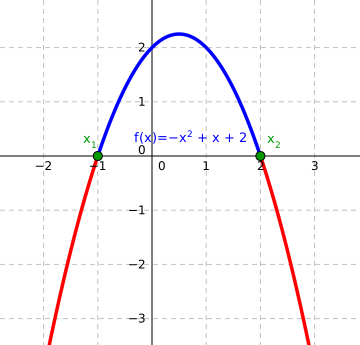
We can see that the graph has changed mainly in that it is no longer shaped like the letter “U” but like a hill. The method has not changed, though. Again there are three intervals:
- (−∞, −1): the values are negative.
- (−1, 2): the values are positive.
- (2, ∞): the values are negative.
The solution of the inequality −x2 + x + 2 < 0 is therefore the union of the intervals (−∞, −1) ∪ (2, ∞).
But I don't want to keep sketching graphs!
You don't have to! All the previous solutions relied on drawing a graph and reading off from it the points where it meets the x-axis, and then whether the values in each interval are positive or negative. But there is another way.
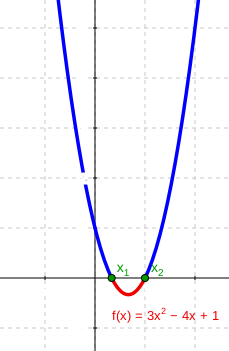
Suppose we have the quadratic inequality 3x2 − 4x + 1 < 0. We can simply solve the quadratic equation 3x2 − 4x + 1 = 0 in the usual ways. First we work out the discriminant:
Next we work out the roots of the quadratic equation:
We know that the graph crosses the x-axis at
We do this by substituting a number from the interval into the function f(x) = 3x2 − 4x + 1. If the result is positive, the function is positive on the whole interval. The same goes for negative values.
-
We choose any number from the interval
-
We choose a number from the interval
The number
-
In the last interval the values will be the same as in the first – positive. The signs always alternate: positive – negative – positive, or negative – positive – negative. But we can just as well work it out. We choose a number from the interval (1,∞), for example 10:
That is a positive number, so all the values in this interval are positive.
It remains to finish solving the inequality. It was 3x2 − 4x + 1 < 0. From the information above we know that the function 3x2 − 4x + 1 has negative values in the interval
Zero discriminant
When solving a quadratic equation we may find that the discriminant is zero. This happens when the graph of the function touches the x-axis at one point. We will show it on the inequality 3x2 + 6x + 3 ≥ 0. The discriminant is equal to zero:
The graph would look like this:
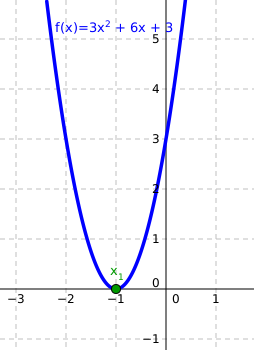
As you can see, the graph touches the x-axis at a single point x1 = −1 and the rest of the graph is above the x-axis, with positive values. This means that the solution of the inequality 3x2 + 6x + 3 ≥ 0 is the whole set of real numbers, because whatever real number we substitute for x, the value will always be greater than or equal to zero.
Negative discriminant
If the discriminant is negative, the graph never crosses the x-axis. How does this show up in our inequalities? The graph is either entirely above the x-axis or entirely below it. If we changed the previous inequality like this: 3x2 + 6x + 4 > 0 (we changed the sign from ≥ to > and changed the number three to four), the discriminant would be:
and the graph would look like this:
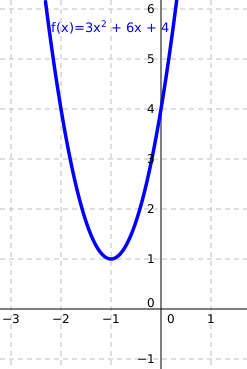
The whole graph lies above the x-axis, so whatever real number we substitute for x, the value will always be positive. The solution of the inequality is again the set of real numbers.
