
Exponential and logarithmic inequalities
An exponential inequality is an exponential equation with an inequality sign in place of the equals sign. Like this one:
The method starts just like it does for an equation. We write eight as a power of two:
For the equation 2x = 23 we would now compare the exponents and get x = 3. Why are we allowed to? The function 2x is increasing: the bigger the exponent, the bigger the power. So it never takes the same value twice, and two powers of two are equal only when their exponents are equal. The same idea helps with the inequality too, we just also have to decide which way the sign points. Two to the power of something is greater than two cubed exactly when that something is greater than three:
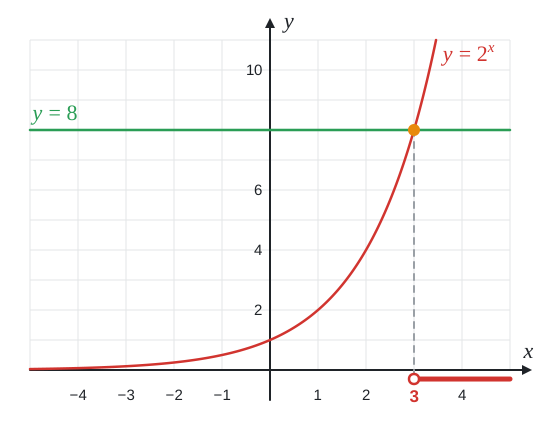
The solution is the interval (3, ∞). It checks out: 24 = 16 is more than eight, but 22 = 4 is not. In the picture, it is the part of the x-axis above which the red graph is higher than the green line.
An inequality with a base smaller than one turns out differently, for example
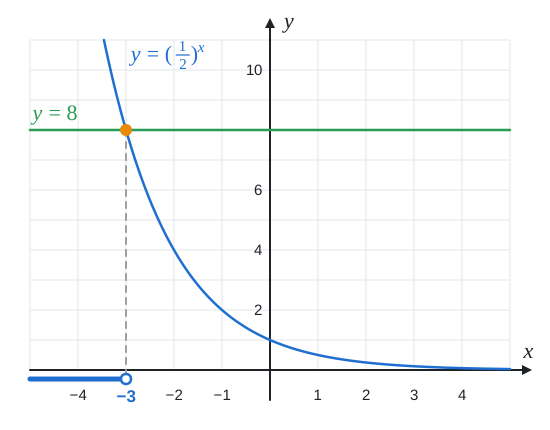
It rises above the line y = 8 only to the left of −3, so the inequality
- base greater than one: the function is increasing and the inequality sign stays,
- base between zero and one: the function is decreasing and the sign flips.
A base smaller than one
Let’s tackle the inequality
We have to write nine as a power of one third. One third to the power of minus one gives three, and to the power of minus two gives nine:
The bases match, but the base
The solution is the interval (−∞, −2]. Let’s check with x = −3:
The most common mistake in these questions is: forgetting to flip the sign. Anyone who writes x ≥ −2 would have to accept, say, zero as a solution. But
If you don’t like working with fractions in the base, you can rewrite
When the bases can’t be made the same
In the inequality 3x < 5 we can’t write five as a power of three with a whole-number exponent. We deal with it just as we did for equations: we take logarithms of both sides, this time to base three. That logarithm is increasing, so the sign doesn’t change: log3 3x < log3 5, so x < log3 5. We can happily leave the answer like that. The approximate size of the number is revealed by the inequality 3 < 5 < 9, so log3 5 lies between log3 3 = 1 and log3 9 = 2.
Logarithmic inequalities
Logarithmic inequalities follow the same rule about the base, and there is one more restriction, which we know from logarithmic equations: the argument of a logarithm must be positive. Let’s try it on the inequality
First the restriction: x − 1>0, so x>1. Then we write three as a logarithm to base two, because 23 = 8:
The base two is greater than one, the logarithm is increasing and the sign stays:
Finally, we combine the result with the restriction. We need x>1 and at the same time x<9, so the solution is the interval (1, 9). To check, we take x = 5: log2 4 = 2, which really is less than three.
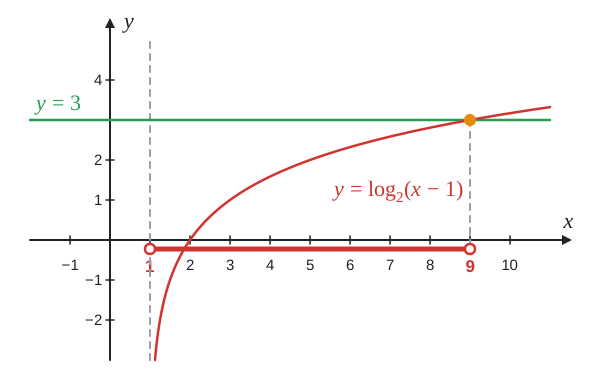
The picture shows the solution: the red graph is below the green line for every x from one to nine. To the left of one there is no graph at all, because the logarithm does not exist there. That is the restriction x>1.
The mistake here is a different one from the exponential inequalities. Anyone who forgets the restriction will write the answer x<9. But that includes zero as well, and log2(0 − 1) = log2(−1) does not exist. With an equation, a forgotten restriction would be exposed by the check, but with an inequality infinitely many numbers come out and we can’t substitute them all. That is why we always write the restriction down right at the start.
The last example brings both traps together:
The restriction is x>0. We write two as a logarithm to base one half, because
The base is smaller than one, so the sign flips for a second time:
With the restriction x>0 we get the solution
