
What is an equation
An equation is one of the basic ideas in maths and one of the tools that makes the whole subject work.
Introductory example
An equation has a left-hand side, then an equals sign, then a right-hand side. A trivial equation might look like this:
On the left-hand side there is the variable x, then the equals sign, and on the right-hand side the number 2. This equation is simple and tells us that the value of the variable x is equal to two. The variable x usually stands for something we are looking for. It could be, for example, the number of buttons on a shirt or an employee's salary.
However, an equation in this form is more likely to be something we are looking for than something given in a question. In practice we usually have a more complicated equation. For example, we are told how much five employees earn in total, and our task is to find out how much one employee earns (assuming they all earn the same).
For example, we know that five teachers earn £150,000 a year in total. How much does one teacher earn? We build the equation like this: let x be the salary of one teacher. That gives us the equation
This equation is a mathematical way of writing “five teachers earn a total of 150,000”. Our goal is to find the salary of one teacher, that is, to find the value of x = ?. Let's jump ahead a little and use equivalent steps and divide the equation by five. If five teachers earn 150,000, then one teacher earns a fifth of that. We get
and after dividing
Definition of an equation
To define an equation we need to know what a function is. If we know functions, we can think of an equation as a statement that two functions are equal:
This is the general way of writing an equation in one variable. On the left-hand side we have the function f and on the right-hand side the function g. Our task is to find the solutions (also called roots) of the equation, which are the values of x for which the functions f and g have the same value.
So we want to find particular values of x, let's call one of them x1, for which
Let's use the equation 2x = −4x + 6 as an example. Then f(x) = 2x and g(x) = −4x + 6. We are looking for the values of x for which the function f has the same value as the function g. Solving the equation with equivalent steps, we get:
The solution of the equation is x = 1. For this value both functions should give the same result. If we put 1 into the function f, we get
At x = 1 the function f has the value two. What about the function g? Let's put 1 into it:
We can see that we got two again. So one is a solution of the equation. It is also the only solution of the equation over the real numbers. If we put in a different value, the two functions give different results. For example, for 5 we would get:
Graphical meaning
The solutions of an equation have a nice, obvious graphical meaning. If you draw the graphs of the functions on the left-hand and right-hand sides of the equation, the graphs cross exactly where the equation has its solutions.
Let's go back to the equation 2x = −4x + 6. The function on the left-hand side is f(x) = 2x and the function on the right-hand side is g(x) = −4x + 6. We know that the solution of this equation is x = 1. So the two functions should cross at x = 1. Here is a picture of the graphs of both functions:

You can see that the lines cross at one point, and this point has coordinates (1, 2). The first coordinate is the value of x, the solution of the equation. The second is the value of y, that is, the value both functions give when you put in 1.
So the solutions of the equation are all the points where the functions on the left-hand and right-hand sides cross. We often rearrange equations so that the right-hand side is zero, that is, the constant function g(x) = 0. Then we ask where the function on the left-hand side crosses the x-axis. We can rearrange the equation 2x = −4x + 6 so that the right-hand side is zero like this:
If we draw the graph of the function on the left-hand side…

… we find that the graph crosses the x-axis at 1. We can see that even though we rearranged the equation so that the right-hand side is zero, we get the same result – one again.
Number of solutions of an equation
From the graphical interpretation of equations we can work out how many different solutions an equation can have. That lets us answer questions such as: does every equation have a solution? Can an equation have more than one solution? Can an equation have infinitely many solutions?
No solution
Let's take them in order. Is there an equation that has no solution? We reduce this to a question about graphs: are there two function graphs that never cross? Of course there are. If we stay with linear equations, whose graphs are straight lines, we only need to take parallel lines. For example:
Just by common sense we can see that x + 1 can never be equal to x + 2. If we draw the graph, we get:

We can see that the functions are parallel lines, so they never cross. So the equation we built from them has no solution. We can rearrange the equation like this:
We can see that the equation really has no solution.
We can think up many more equations with no solution, for example x2 = x − 1. The graphs of the two functions never cross:

More than one solution
Can an equation have more than one solution? (But still fewer than infinitely many.) Again we reduce this to a question about graphs: are there two function graphs that cross a finite number of times, with more than one crossing point?
Certainly there are. In the previous section our last example was an equation with a quadratic and a linear function. We can change that graph by moving the line so that it crosses the graph of the quadratic function at exactly two points. We only need to take the function y = x instead of y = x − 1.

We can see that the graphs cross at two points. We could solve the equation like this:
Infinitely many solutions
Are there equations with infinitely many solutions? That is, are there two graphs that cross at infinitely many points? Yes, there are. We just need a periodic function and a suitably placed line. A typical periodic function is the sine. The range of the sine is the interval [−1, 1], and the sine repeats periodically within it.
So we only need to set sin(x) = a, where a lies in the range. A specific example could look like this: sin(x) = 0.5. The graphs of the functions:
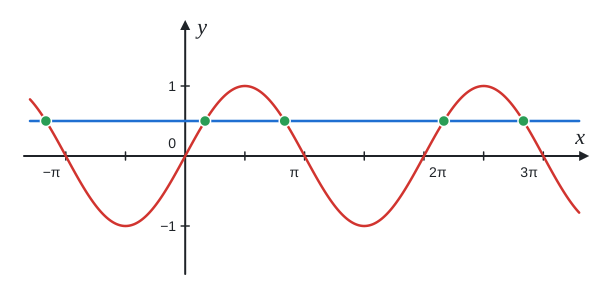
You can see that in the picture the line crosses the sine at several points. The sine keeps oscillating both to the right and to the left, so on both sides the line crosses the sine infinitely many times.
The same functions in an equation
Can it happen that we can put in any value of x from the domain of the functions and the equation will be true? That happens only when the two functions are the same, or when we can turn one function into the other. For example:
At first glance we have different functions on each side, but if we expand the brackets on the right-hand side, we get the same functions:
Such an equation has a solution set equal to the domain of the functions, so the solution set is the set of real numbers. We can rearrange such an equation into the form 0 = 0.
