
Inequalities in product and quotient form
The product of several numbers is positive when none of them is zero and the number of negative factors is even. A negative times a negative is a positive, so the negative factors cancel out in pairs. If one is left over – that is, if the number of negative factors is odd – the whole product is negative. This simple idea is behind the solution of every inequality that has a product or a quotient on one side and zero on the other.
If you have read the article on quadratic inequalities, you can already solve (x − 1)(x + 3) > 0: you find the roots 1 and −3 and look at where the expression is positive. Now you will see that the same method works for any number of factors, not just two.
The critical values method
We will start with this inequality:
We will not expand the brackets, because we would get a cubic polynomial, which is much harder to work with. The factorised form is, on the contrary, the best thing that could have happened to us.
First we find the critical values, that is, the numbers at which one of the factors is equal to zero. We set each bracket equal to zero separately:
The critical values split the number line into four intervals: (−∞, −2), (−2, 1), (1, 3) and (3, ∞). Inside each of them no bracket passes through zero, so none of them changes sign. It is therefore enough to pick one number from each interval and work out the sign of each bracket.
- From the interval (−∞, −2) let’s try x = −3. All three brackets are negative: (−1) · (−4) · (−6). Three negative factors is an odd number, so the product is negative.
- From the interval (−2, 1) we substitute zero: 2 · (−1) · (−3). Two negative factors, so the product is positive.
- From the interval (1, 3) a two will do: 4 · 1 · (−1). One negative factor, so the product is negative.
- From the interval (3, ∞) we try ten: all the brackets are positive, and so is the product.
A sign table shows this clearly. Each row is one bracket, the whole product is at the bottom, and the intervals where it is positive are in red:
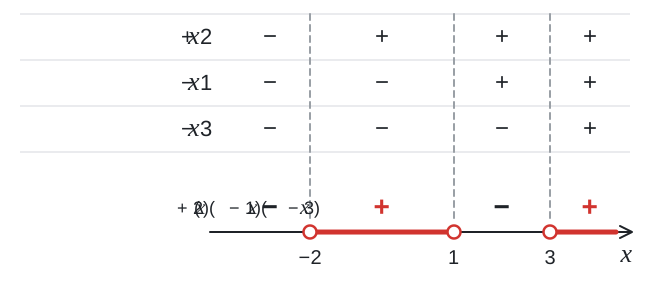
We are looking for where the product is greater than zero. The critical values themselves are not part of the solution, because the product is zero there and zero is not greater than zero. The solution is
Check: for x = 4 we get 6 · 3 · 1 = 18, which is indeed a positive number.
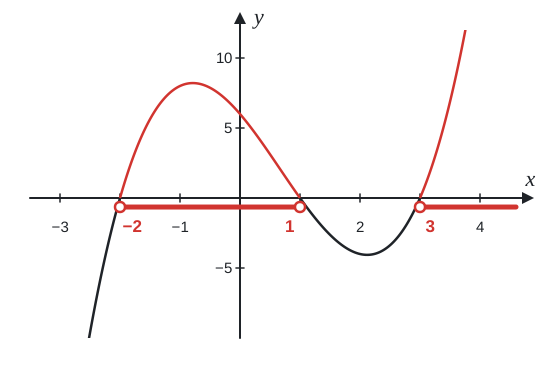
The same result can be seen on the graph of the function y = (x + 2)(x − 1)(x − 3). The graph crosses the x-axis exactly at the critical values, and between two neighbouring ones it lies either entirely above the axis or entirely below it. Where it is above the axis, the product is positive, and those parts are red:
The signs do not have to alternate
In the previous example the signs alternated regularly: minus, plus, minus, plus. This tempts you to find the sign in just one interval and then simply flip it in each of the others. Better not to. Look at the inequality
The critical values are 1 and −2, so there are three intervals. We try one number in each:
- x = −3: (−4)2 · (−1) = 16 · (−1) = −16, negative,
- x = 0: (−1)2 · 2 = 2, positive,
- x = 2: 12 · 4 = 4, positive.
The sign did not change when we passed through one. This is because of the square: (x − 1)2 is a square, and a square is always positive or zero, whatever is inside it. A factor with an even power therefore never reverses the sign of the product. If we had simply alternated the signs, we would have got a minus in the last interval and missed a good part of the solution.
So the expression is positive on (−2, 1) and on (1, ∞). But the inequality says “greater than or equal to”, so we also include the points where the expression is zero. These are both critical values, −2 and 1. The number one therefore belongs to the solution thanks to the equality, and the two intervals merge into one:
Be careful with a strict inequality: for (x − 1)2(x + 2) > 0 the number one would not belong to the solution and we would get (−2, 1) ∪ (1, ∞), that is, an interval with a hole in it.
Quotient form
A fraction is treated in exactly the same way, because a quotient has the same sign as the corresponding product: it is positive if the numerator and the denominator have the same sign. Let’s solve the inequality
We find the critical values in both the numerator and the denominator: x = −2 and x = 4. We substitute one number from each interval:
- x = −3:
- x = 0:
- x = 5:
We are looking for negative values or zero. The fraction is negative on the interval (−2, 4). It is zero when the numerator is zero, that is, for x = −2, and that value belongs to the solution. But four never belongs to it, whatever inequality sign is in the question. For x = 4 the denominator would be zero, and you cannot divide by zero. So the critical values of the denominator are always excluded.
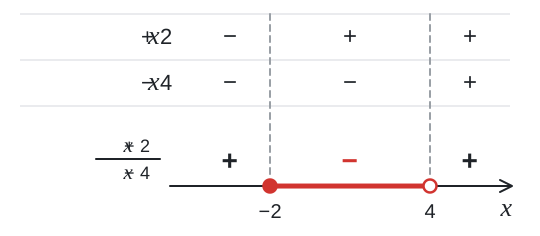
In the figure you can tell by the circles. A filled circle at −2 means that the number belongs to the solution, an open circle at four means that it does not. The result is
Do not multiply by the denominator
The critical values method only works when there is zero on one side of the inequality. Let’s take the inequality
It is very tempting to multiply it by the denominator x + 1, get 2x − 1 ≥ x + 1 and from that x ≥ 2. But we do not know whether x + 1 is positive or negative, and multiplying by a negative number would reverse the inequality sign. So that was not an equivalent step, and part of the solution has vanished. You can read more about this in the article on linear inequalities.
The correct way is to move everything to one side:
We write one as a fraction with the same denominator:
And subtract the fractions:
The critical values are 2 and −1. For x = −2 we get
Let’s check that multiplying by the denominator really did take something away from us by substituting x = −2 into the original inequality:
