
Linear inequalities
Linear inequalities are solved using steps similar to those you use for an ordinary linear equation. A linear inequality usually has this form: ax + b>0 (or with less than, greater than or equal to, or less than or equal to). All that is left is to rearrange the inequality into the following form, and the answer is there: x>−b/a. We assume, of course, that a>0. For negative a the inequality sign would turn round when you divide, and you would get x<−b/a.
An ordinary linear inequality
A linear inequality can be solved using equivalent steps for inequalities.
-
A simple example might look like this:
First we move all the terms without the unknown to the right-hand side. So we add the number −9 to the inequality, which gives us:
Next we divide the whole inequality by three:
That is the solution of the whole inequality. It holds for all x > −2.
We could also solve the inequality graphically. If we have the inequality 3x + 9 > 3, we draw the graphs of two functions – the left-hand and right-hand sides of the inequality. We get the functions f(x) = 3x + 9 and g(x) = 3. Their graphs look like this:
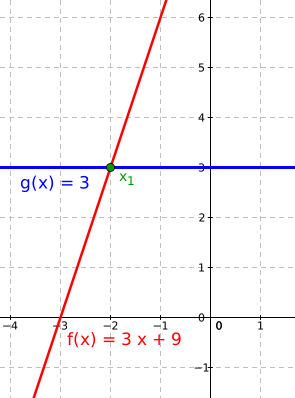
We can see that the graphs meet at one point x1, whose x-coordinate is exactly −2. We can also see that for all x > x1, that is, for all x in the interval (−2, ∞), the red function 3x + 9 is “above” the blue function 3 (here “above” means “has a greater y-coordinate”). This agrees with the result we worked out a moment ago.
-
Sometimes, when there are a lot of minus signs, it helps to multiply the whole inequality by minus one. In that case, as well as changing the values in the inequality, you must also reverse the inequality sign – turn greater than into less than and vice versa:
This applies, of course, whenever you multiply the whole inequality by any negative number. So here is one more quick example:
In the first step we add −2x to the inequality as usual, which moves all the terms with the variable to the left-hand side. At the same time we subtract 8, which moves the constants to the right-hand side. Then we just multiply the whole inequality by
To illustrate, have a look at the graphical solution of the inequality, where we plot the two functions f(x) = −3x + 8 and g(x) = 2x − 7.
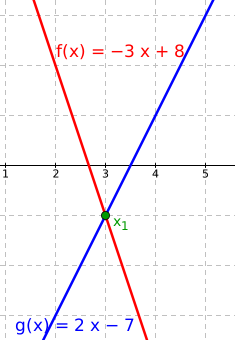
We can see that the red graph of −3x + 8 lies below the blue graph of 2x − 7 whenever x > 3.
The variable in the denominator
A linear inequality that contains fractions with the variable in the denominator is solved in a slightly more complicated way. An example is the inequality:
We cannot multiply the inequality by the unknown in the denominator, because we do not know its sign. If the value of the variable were negative, we would have to reverse the inequality sign. So we cannot simply multiply the inequality by the variable in the denominator. It would not be an equivalent step for inequalities.
We start by rearranging the inequality so that we get a single fraction on the left-hand side and zero on the right-hand side. First we add −4 to both sides, which gives:
Now we have to write the expression on the left-hand side as a single fraction. We multiply the number −1 by the fraction
Now we face the question: when is a fraction positive? A fraction is positive if the numerator and denominator are both positive, or if they are both negative. If one is positive and the other negative, the fraction is negative. For example, the fraction
So we have to solve two sets of inequalities. We start by finding when the numerator and denominator are both positive:
-
For the numerator and denominator to be both positive, both of these inequalities must hold at the same time:
For the first inequality we just move 2 to the other side and multiply by −1:
That is the solution of the first inequality. There is nothing more to solve in the second inequality, x > 0. Now we have to take the intersection of these solutions, because we are interested in the cases where both hold at once, that is, where the numerator is positive and the denominator is positive at the same time. We can write the first solution as the interval (−∞,2) and the second as the interval (0,∞). Now we take the intersection of these intervals:
That is one part of the solution of the inequality. If you substitute numbers from this interval, the inequality holds. For example, if we substitute x = 1, which is a number from the interval (0, 2), we get the inequality
-
When the numerator and denominator are both to be negative, we solve the inequalities:
Again we quickly solve the inequality 2 − x < 0:
The second solution is simply x < 0. We write them as intervals: (2,∞) and (−∞, 0), and take the intersection:
We got the empty set. What does that mean? It means that the fraction
Now we just take the union of the two results and get the final solution set S:
The inequality
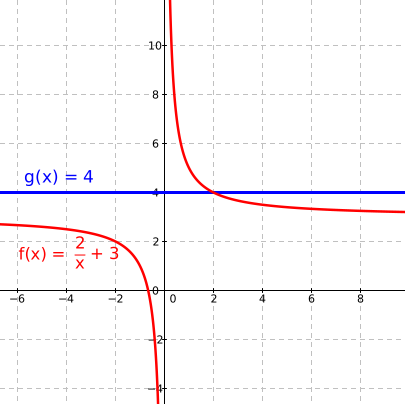
We can see that the red graph of
Linear inequalities with a modulus
Inequalities that contain a modulus (absolute value) are a bit more fun. You have to work out separately when the expression inside the modulus is positive, so the sign does not change, and when it is negative, so the sign does change – in effect there are two inequalities in one. Here is a simple example:
First we have to find the critical value. This is the number that makes the whole expression inside the modulus equal to zero, and it is used to find the intervals where the sign changes and where it does not. So first we solve the equation
We can see that the result is x = −5. This splits the values of x into two intervals. In one, the function x + 5 takes positive values and in the other negative ones. So on the interval (−∞, −5) we get negative numbers and on the interval [−5, ∞) positive (or, strictly, non-negative) ones. To show this, the first line uses a number from the first interval and the second line a number from the second:
What does this tell us? If we substitute a value of x greater than minus five, the modulus does not change the result, because x + 5 will be a positive number. On the other hand, if x is less than minus five, then x + 5 is negative and the modulus turns it into a positive number. That is why we have to treat these two cases separately in the inequality.
First we work out the result when x is taken from the interval [−5, ∞). Here the sign does not change, because we simply remove the modulus.
We almost have the first solution. We still have to take the intersection with the interval we are choosing x from. We are working in the interval [−5, ∞), so the solution of this linear inequality cannot be, for example, x = −15, because it does not lie in our interval. So we take the intersection:
That is the first result. Now we have to work out the result when we take x from the interval (−∞, −5). In this interval the modulus changes the sign. If we want to remove the modulus from the inequality, we have to change the sign ourselves, that is, multiply the expression inside the modulus by −1. So we rewrite it like this:
We add 5 to both sides:
And multiply by −1:
This gives the result:
But as before, we are choosing x from the interval (−∞, −5), so we still have to take the intersection of this interval with our result:
Now we have both results, and we just take their union:
To check, we can look at the graphs of these functions:
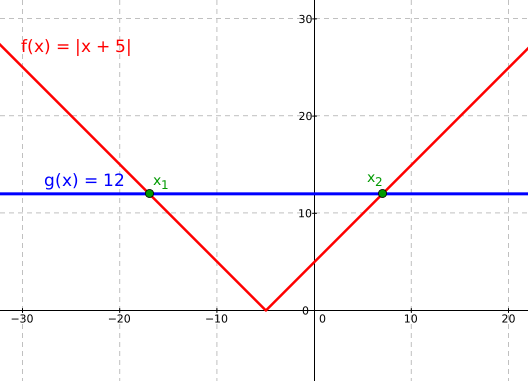
A few more words on when to use a closed and when an open interval. If we have a strict inequality, such as x>0, we use an open interval, because x cannot equal zero. If the inequality is not strict, x ≥ 0, we use a closed interval, because x can equal zero. For example, if you substitute x = 7, which only “just” misses being a solution of the inequality we have just solved, you get:
The inequality does not hold, because 12 is not less than 12.
