
Equations with square roots
An equation with the unknown hidden under a root is called an irrational equation. The name does not mean that the equation is unreasonable, only that it contains roots, which often turn out to be irrational numbers. Take this one:
We get rid of the root by squaring the whole equation. Squaring and the square root cancel each other out, because
To be safe, we check the result: we substitute it separately into the left-hand side of the original equation (LHS) and into the right-hand side (RHS), and compare the two.
We got LHS = RHS, so it works. This substitution looks like excessive fussiness, but with irrational equations it is as much a part of the working as the squaring itself; without it you do not have an answer. The whole method fits into four steps: get the root on its own, square the equation, solve whatever comes out, and finally check.
Why the check is compulsory
Squaring is not an equivalent step. Equal numbers have equal squares, but it does not work the other way round: 3 ≠ − 3, and yet 32 = (−3)2 = 9. Squaring can therefore produce an equation with more solutions than the original had. Let’s look at the equation
We square both sides and move everything to one side:
We have got a quadratic equation. It factorises as (x − 2)(x + 1) = 0, so the solutions are x = 2 and x = −1. Now comes the check, first with two:
Both sides are equal, LHS = RHS, so two is a solution. And what about minus one?
On the left we got one, on the right minus one, so LHS ≠ RHS. Minus one is not a solution, even though the working has honestly served it up to us. The equation has just one solution, x = 2.
Where did the false solution come from? A picture shows it best. The left-hand side of the equation is the function
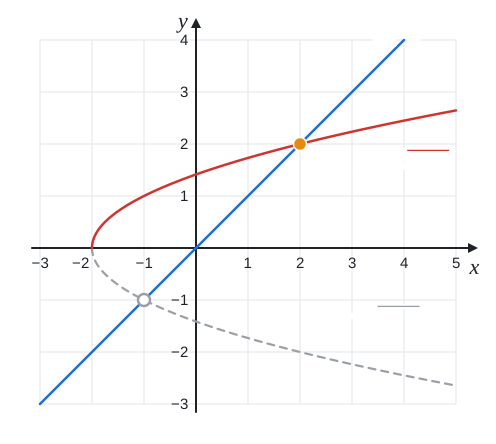
The dashed grey curve is the function
The picture reveals something else: both square roots, the red one and the grey one, start only at x = −2. There cannot be a negative number under the root, so the equation makes sense only for x ≥ − 2. The false minus one falls inside this range, so the condition does not catch it. Only the check brings it to light.
Get the root on its own first
Let’s move on to another equation:
It is very tempting to square the left-hand side straight away, three included. But the square of a sum is not worked out term by term, (a + b)2 = a2 + 2ab + b2, so we would get
and the root would still be lurking in the equation, just in an uglier form. That is why we get the root on its own on one side first, and only then square:
We squared the right-hand side with the same formula, (x − 3)2 = x2 − 6x + 9. The quadratic equation factorises as (x − 6)(x − 2) = 0, with solutions x = 6 and x = 2. We start the check with six:
LHS = RHS holds, so six fits. Now two:
Four is not two, LHS ≠ RHS. There’s the catch. The only solution is x = 6.
Why did two fail the check? After getting the root on its own we had
Sometimes the check lets nothing through. The equation
Two roots
As soon as two roots meet in one equation, a single squaring is usually not enough. The method stays the same, though: get a root on its own, square, and if a root is left, repeat the whole cycle. Let’s try this equation
We cannot get both roots on their own at once, so at least we move
On the right we again squared a binomial, so the middle term
We squared twice, so the check is doubly useful here:
LHS = RHS, it works, so the equation has the solution x = 4.
