Trigonometric equations
Trigonometric equations are equations that contain a trigonometric function – that is, sine, cosine, tangent or cotangent.
Basic trigonometric equation
Take the equation sin x = 0. For which values of x is it true? When is sine equal to zero? Let’s start by looking at the graph:
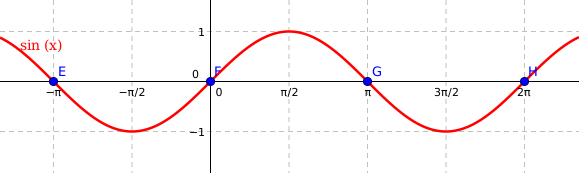
We can see that sin x equals zero quite often – for example at −π, 0, π, 2π and many other values. Sine is a periodic function, so the solutions of the equation are spaced at regular intervals – in this case intervals of length π. We can therefore write the set of all solutions as a set, which we will call R, defined like this:
These are all the K-multiples of pi, where K is an integer. This describes the set of all solutions of the equation sin x = 0.
Remember that the range of sine and cosine is the interval [−1, 1]. So the equation sin x = 2 has no solution, because we cannot find an x for which sin x is greater than one. Of course, the equation 3 · sin x = 2 does have a solution, because we can divide both sides by three and the right-hand side is then less than one. We would be solving sin x = 2/3.
Solving a simple example
We solve simple trigonometric equations by reading the value off the graph or the unit circle, finding the period and adding it to the result. Example: solve the equation
We have the graph of sine above, so let’s look at where the curve takes the value
Now we need to find the period so that we know how to build the set of all solutions. Sine has period 2π – look at the graph and you will see that the function starts repeating after every 2π.
So if one solution of the equation is 1/6π, then any number 1/6π + 2Kπ, where K is an integer, must also be a solution, because sine has the same value there. The 2K just means that we only want even integers: whatever integer you put in for K, multiplying it by two gives an even number. It works in exactly the same way for the second solution, 5/6π. At the points 5/6π, 5/6π + 14π and 5/6π − 82π the function sin x has the same value, so every 5/6π + 2Kπ is a solution.
We write the final set R as the union of the two previous results:
We can show the solutions graphically as the intersections of the graph of sin x (red) and the graph of
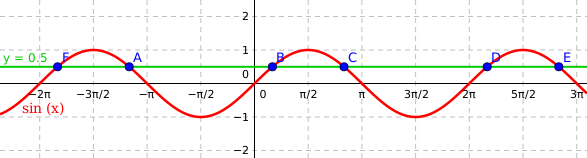
For example, if we put K = 0, we get the solutions:
So x1 = 1/6π and x2 = 5/6π. In the figure these correspond to points B and C, because their x-coordinates are exactly 1/6π and 5/6π. If we put K = 1, we get points D and E.
Substitution
If a function contains a more complicated expression, we can use substitution – replacing it with something simpler. For example, to solve sin 2x = 1, we substitute a = 2x and carry on with the equation sin a = 1, just as we did in the previous section. Usually we take the argument of the function, here 2x, and write a different unknown in its place. We can name it anything we like; here we chose a. We could just as well substitute q = 2x or orange = 2x and then write sin orange = 1.
Substitution simplifies the expression we are working with. We will deal with the fact that a is really 2x later.
So now we are solving sin a = 1, where a is the unknown. We are looking for where sine equals one. It turns out that sine equals one at π/2 + 2Kπ. The solutions of sin a = 1 are therefore the values in the set
Finally, we have to remember our substitution – we have to reverse it. We know that the solutions of sin a = 1 are the elements of the set R above. But we want the solutions of a different equation, sin 2x = 1, and we know that a = 2x.
Let’s take one particular solution from R, for example K = 1, which gives a = π/2 + 2π. At this point the equation sin a = 1 is satisfied. Since a = 2x, it is also true that 2x = π/2 + 2π (we have just written 2x in place of a).
But we are not interested in 2x, we want x, so we divide the whole equation by two. This gives x = π/4 + π. That is one particular solution of sin 2x = 1.
To get all the solutions, we have to do this to every element of R. We set up the equation like this:
and make x the subject, which means dividing the whole equation by two:
That is the final solution. We write it as a new set, R':
Again we can check the solution graphically. The red curve is the graph of sin 2x and the green one is y = 1.
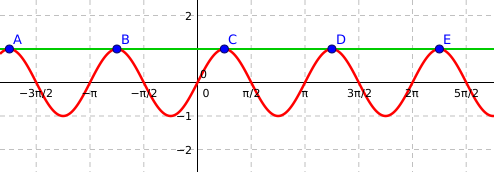
If we put K = 0, we get x = π/4, which is point C. If we put K = 2, we get x = π/4 + 2π, which is point E.
Formulae
When solving trigonometric equations you often use various formulae that you should know. Some are basic, others more complicated. The trigonometric formulae have moved to their own page, so have a look there.
Examples
-
Solve the equation sin(3x − π/2) = 0.
We use a simple substitution a = 3x − π/2 and solve sin a = 0. We already know that sine is zero for a = Kπ. Now we substitute back and solve the equation:
First we move π/2 to the right-hand side, that is, we add π/2 to both sides:
Now we divide both sides by three:
The solution is therefore the set R1, defined like this:
Here is the graph again:
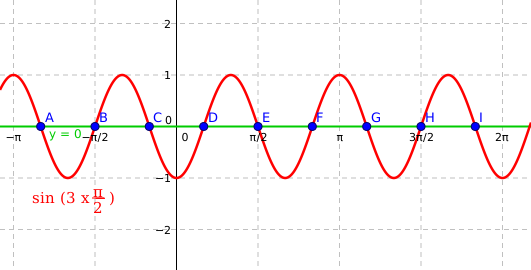
For K = 1 we get x = π/3 + π/6 = π/2, which is point E.
-
Solve the equation cos2x − sin x = 1.
First we use a formula to replace cos2 x with 1 − sin2 x. Substituting back into the equation gives:
Now we take out the common factor sin x:
The left-hand side is now a product and the right-hand side is zero, so we solve the equations sin x = 0 and sin(x) + 1 = 0 separately: the whole left-hand side is zero if at least one factor is zero.
We have already solved sin x = 0 several times; the solutions are all x of the form Kπ, where K is an integer.
We rearrange the second equation, sin(x) + 1 = 0, to sin(x) = −1. Sine is equal to minus one at 3/2π + 2Kπ.
We get all the elements of the final set R2 by taking the union.
Graph:
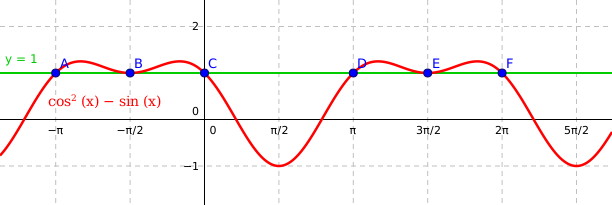
We can see that points A, C, D and F have an x-coordinate that is a multiple of π, so they are described by the right-hand set in the union. If we put K = 0 in the left-hand set, we get x = 3π/2, which is point E, and if we put K = −1, we get x = 3π/2 − 2π = −π/2, which is point B.
-
Solve the equation cos2 x − sin2x + cos x = 0.
In the first step we use the formula sin2x = 1 − cos2x to replace the squared sine:
In the next step we collect like terms:
And finally we substitute a = cos x.
We solve this as an ordinary quadratic equation. The solutions are:
Now we substitute back and solve the pair of equations cos x = −1 and
-
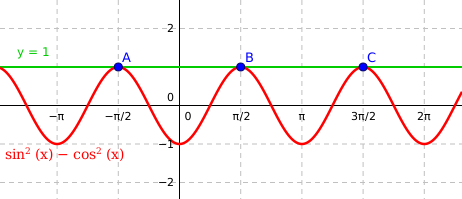
Solve the equation sin2x − cos2x = 1.
First we use the standard formula to write cosine in terms of sine. We get:
We divide by two and subtract one:
Now we use the formula a2 − b2 = (a − b)(a + b):
A product of two expressions is zero if at least one of the expressions is zero. We already know when sin x = 1 and sin x = −1. The solution of the trigonometric equation is:
Graph: