
Trigonometric inequalities
A trigonometric inequality looks like a trigonometric equation, except that instead of the equals sign it has <, >, ≤ or ≥. Take, for example, this one:
We are looking for all the x for which sine is greater than one half. Part of the work is already done. We solved the equation
On the unit circle
The easiest way to see it is on the unit circle. The sine of an angle is the y-coordinate of the point on the circle, so the inequality
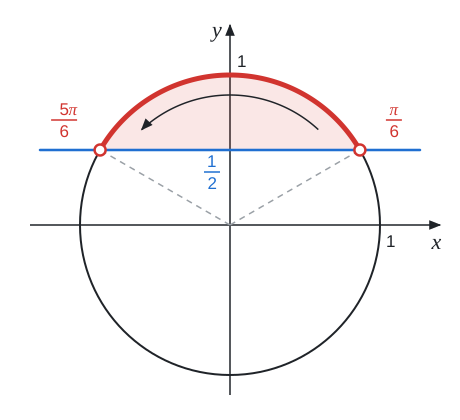
The blue line meets the circle at two points, which correspond to the angles
The end points do not belong to the solution, which is why they are open circles in the figure. There sine is exactly
But sine is a periodic function with period 2π: after every full turn everything repeats. So we add 2kπ to both ends and get the result
where k ∈ ℤ. For k = 0 this is the arc from the figure; for k = 1 it is the same arc shifted by one turn, that is, the interval
Let’s check, just to be safe. Try
An interval through zero
Now for cosine:
Cosine is the x-coordinate of the point on the circle, so we are looking for the points to the right of the vertical line that crosses the horizontal axis at
And here there is a strong temptation to write
A trap. The left end of an interval must be smaller than the right end, but
The fix is simple. Instead of
The angle
where k ∈ ℤ. This is also easy to see on the graph of cosine:
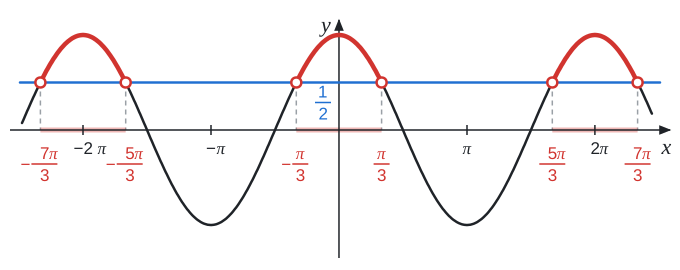
The red section around zero corresponds exactly to the interval for k = 0. The section on the right, which starts at
Tangent
One last example:
Tangent is equal to one for
There are two mistakes people commonly make here. The first is in the period. Tangent does not repeat every 2π like sine, but already every π. Anyone who adds 2kπ out of habit loses half of the solutions, for example
The second lies in wait at the right-hand end. The left end
The correct result is therefore
where k ∈ ℤ. To check, we substitute
