
Surface area of a cylinder
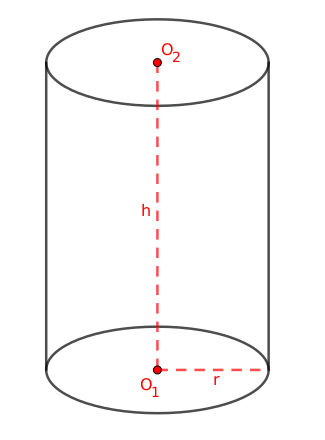
The surface area of a cylinder tells us the total area of the surfaces that enclose the cylinder. Be careful not to confuse it with the volume of a cylinder, which tells us “how many litres of water we can pour into the cylinder”. Here is what a cylinder looks like:
Formula
If you only need the formula, the surface area of a cylinder whose base has radius r and whose height is h is
Calculator: work out the surface area of a cylinder
How did we get this formula?
Every cylinder has two bases: the two circles at the top and bottom. A cylinder also has a curved surface, which is the surface “between” the bases. To work out the surface area of a cylinder, we need to find the area of both bases and the area of the curved surface, then add these values up. Each base is a circle, so we use the formula for the area of a circle
where r is the radius of the base. In the diagram it is the horizontal dashed line segment. For example, if r = 6, the area of a base is
Next we need the area of the curved surface. Notice that the curved surface is a “rolled-up” rectangle. One side of the rectangle has length equal to the height h of the cylinder – in the diagram it is the vertical dashed line segment. The other side, once we “unroll” it, is as long as the circumference of the circle that forms the base. So first we work out the circumference of the base, using the formula for the circumference of a circle
Substituting gives:
The circumference of the base is 12π. We find the area of the rectangle, which we call
If the height of the cylinder were, say, h = 10, we would get
We get the total surface area of the cylinder, which we call A, by adding up all the results (and remembering that the cylinder has two bases):
Substituting:
If you don’t like a result with the constant π, you can substitute the approximate value 3.14 for π and get an approximate result
Chapters: Area of a square, Area of a rectangle, Area of a circle, Sector of a circle, Area of a trapezium, Area of a parallelogram, Area of a rhombus, Area of a regular polygon, Surface area of a sphere, Surface area of a cube, Surface area of a cuboid, Surface area of a cylinder, Surface area of a cone, Surface area of a pyramid
