
Euclid’s theorems
The ancient Greek mathematician Euclid of Alexandria set out two theorems about triangles, specifically about the altitude and the shorter sides (the legs).
Euclid’s altitude theorem
This theorem works only in a right-angled triangle. Let’s look at the basic set-up:
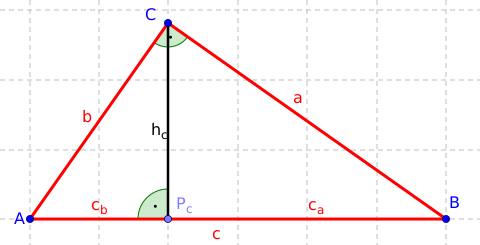
Here we have triangle ABC, where side c is the hypotenuse and the segment hc is the altitude (perpendicular height) to side c. The point Pc splits side c into two segments: we label the segment APc as cb and the segment BPc as ca.
Euclid’s altitude theorem then says that
where hc stands for the length of the segment hc, and so on. In other words: if we built a square with side length hc and a rectangle with side lengths ca and cb, these two shapes would have the same area. Have a look at the following picture, in which exactly such a square and rectangle are highlighted:
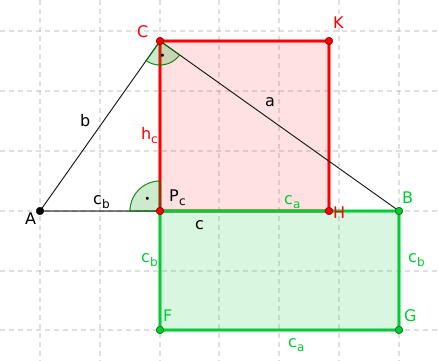
Euclid’s altitude theorem says that these shapes have the same area. The red square has side length hc, the green rectangle has one side of length ca and the other of length cb.
You can read a proof of the altitude theorem on Wikipedia.
Euclid’s leg theorem
This second theorem of Euclid also holds in a right-angled triangle. We stay with the first picture of the triangle:
The second theorem states that
If we build a square with side length a, this square has the same area as a rectangle with side lengths c and ca. Once again, you can look at the square and the rectangle:
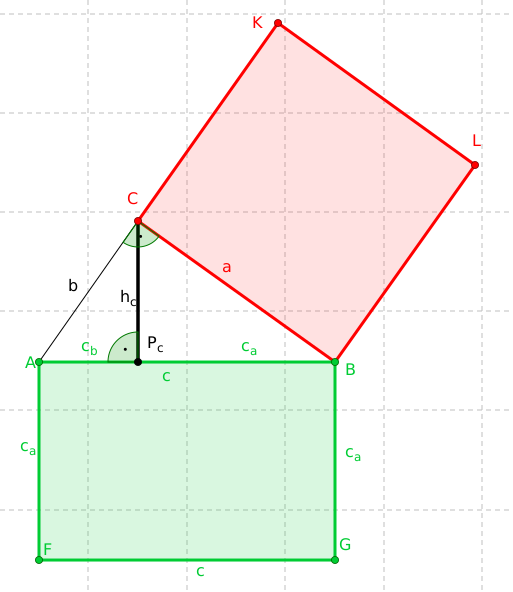
You can find the proof on Wikipedia again.
Chapters: Conic sections, Ellipse, Hyperbola, Parabola, Euclid’s theorems
