
Hyperbola
A hyperbola is a conic section. For every point on a hyperbola, the modulus (absolute value) of the difference of its distances from two fixed points is always the same. Incidentally, the word is a close cousin of “hyperbole”, which means exaggeration.
What a hyperbola looks like
That definition sounds a bit frightening, so first have a look at a picture of a hyperbola:

Notice that, unlike the other conic sections such as the ellipse or the parabola, a hyperbola is made of two curves. What does the definition mean? We have two foci, F1 and F2. For every point X on the hyperbola, the difference |XF1|−|XF2| must have the same absolute value.
In the picture we have two points, X1 and X2. For X1 the difference is |X1F1|−|X1F2| = 1 − 3 = −2, and its absolute value is 2. We should get the same value for X2. Let’s try: |X2F1|−|X2F2| = 3 − 5 = −2, with absolute value 2 (you can work out that the length of X2F2 is five using, for example, Pythagoras’ theorem).
If we apply this to all points of the hyperbola, we always get the result 2.
Description of a hyperbola
Have a look at an extended version of the previous picture:

- The points F1 and F2 are called the foci.
- The point S is called the centre of the hyperbola, and it lies at the midpoint of the line segment F1F2.
- The line F1F2 is called the transverse axis of the hyperbola. The perpendicular to this axis at S is called the conjugate axis.
- The points where the hyperbola meets the transverse axis are called the vertices of the hyperbola; in the picture they are A and B.
- Each of the segments AS and BS is called a semi-transverse axis. We write its length as a.
- We write the length of the semi-conjugate axis as b.
- The distance from a focus to the centre is called the linear eccentricity, written e. (Plain “eccentricity” means the ratio of this length to the semi-transverse axis.) The following relationship holds:
To make it clearer where the length of the semi-conjugate axis b comes from, have a look at one more picture:

This is the same hyperbola, but now with the asymptotes added: the two crossed purple lines a1, a2 passing through the centre S. The semi-transverse axis a is unchanged, still the segment AS. Now we mark a point D on an asymptote so that the distance |SD| equals the linear eccentricity e. The length of the segment AD is then the length of the semi-conjugate axis. As the picture shows, this is a right-angled triangle, so we can use Pythagoras’ theorem, which gives
The circle used here has its centre at S and simply shows that the length |F1S| (the linear eccentricity) is the same as |SD|.
The equation of a hyperbola
For a hyperbola we distinguish two different cases, depending on whether the transverse axis is parallel to the x-axis or the y-axis. Let the hyperbola have centre S with coordinates (m, n).
- The transverse axis is parallel to the x-axis:
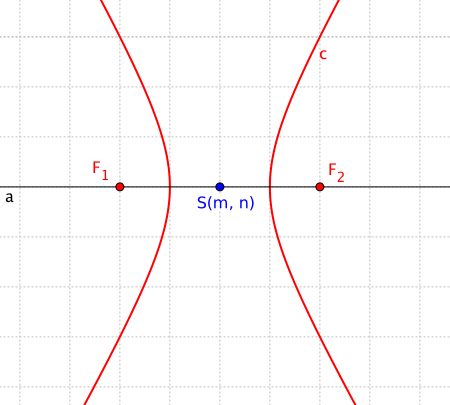
Equation:
- The transverse axis is parallel to the y-axis:
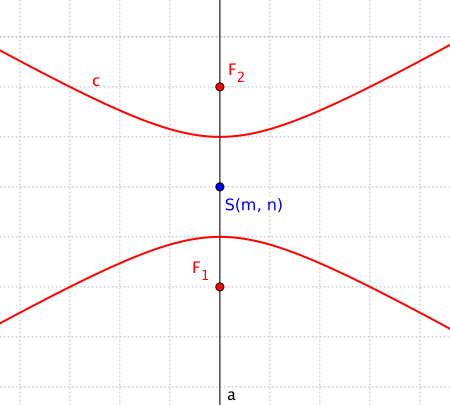
Equation:
Chapters: Conic sections, Ellipse, Hyperbola, Parabola, Euclid’s theorems
