
Quadratic equations with a parameter
A quadratic equation with a parameter differs from an ordinary quadratic equation in that it contains an extra letter, the parameter, often written p or m. Our task is then to find out what solutions the quadratic equation has, depending on this parameter p.
A first example
Here is a quadratic equation with a parameter p.
What different solutions does the equation have, depending on the parameter p? There are three cases: the equation has no solution in the real numbers, the equation has two equal solutions, and the equation has two different solutions. We tell these cases apart using the discriminant.
The parameter behaves like a constant, so for the equation above a = 1, b = 2p and c = 9. Now we work out the discriminant in the usual way:
So the discriminant is D = 4p2 − 36. Now we must find out when this discriminant is positive, negative and zero.
Let’s start with the simplest case, when the discriminant is zero. So we need to solve the equation 4p2 − 36 = 0. For which values of p is this true? This is a quadratic equation with no linear term and it is easy to solve:
If the parameter p is equal to plus or minus 3, the quadratic equation has one repeated solution.
Now we find when the discriminant is positive. This means solving the quadratic inequality
We already know the roots of the function f(p) = 4p2 − 36, because we worked them out in the previous step. From them we build two intervals, an “inner” one and an “outer” one.
In one of these intervals the function f(p) is positive and in the other it is negative. We find out which by substituting a point from one of the intervals into the function. The easiest choice is to substitute 0 from the interval I2. We have f(0) = 0 − 36 = −36. So in the interval I2 the function is negative and in the interval I1 it is positive.
From this we conclude that in the interval I1 the equation has two different solutions and in the interval I2 it has no real solution. You can look at the graph of the function f(p) = 4p2 − 36. At the points plus and minus 3 it is zero, in the interval I2 it is negative and in the interval I1 it is positive.
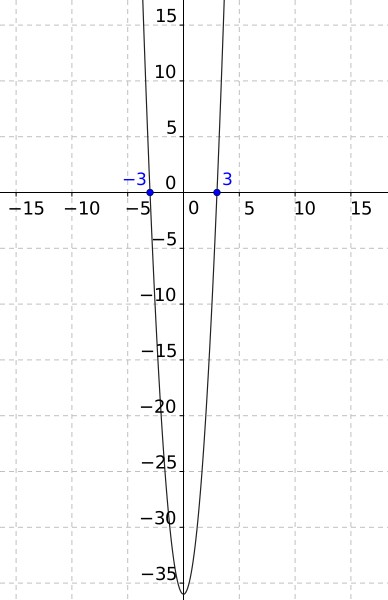
Finding the roots of the equation
Now we still have to find the solutions of the equation in the cases where it has any. We start with the case where the equation has one repeated root, that is, when the discriminant is zero. That happens when the parameter is plus or minus the square root of 9.
Case one, p = 3. The equation then has the form:
We work out the discriminant of this equation. It should come out as zero:
We find the root using the formula:
Case two, p = −3. The equation has the form:
We work out the discriminant:
We find the root:
In the last step we just need to find the solutions of the equation when the parameter belongs to the set (−∞,−3) ∪ (3, ∞). We already have the discriminant, so we find the roots using the formula.
At the end we cancelled the fraction by 2. These are therefore the roots of the quadratic equation when the parameter belongs to the set (−∞,−3) ∪ (3, ∞). If the parameter belongs to the interval (−3, 3), the equation has no real solution.
Chapters: Quadratic equations, The discriminant, Quadratic equations with a parameter, Quadratic equations with complex solutions
