
Fictitious forces
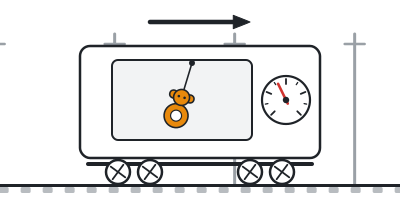
Ella is on a train to York, and she has hung a toy monkey on a string from a hook by the window. While the train is standing still, the monkey hangs straight down. As soon as the train sets off, the monkey swings backwards, against the direction of travel, and stays hanging at an angle for as long as the train is accelerating. Who gave it a push? Nobody. The monkey simply didn’t set off at once with the carriage.
When the frame of reference accelerates
Let’s look at it first from the platform. The train accelerates forwards, and by the law of inertia the monkey would prefer to stay where it is. But the hook drags it along, the string tilts and starts to pull the monkey forwards. Everything fits together: the monkey accelerates because a non-zero resultant force acts on it.
Ella, inside the carriage, sees the situation differently. The monkey is at rest relative to her, but hanging at an angle. The weight acts on it downwards and the tension in the string acts upwards and forwards at an angle. These two do not add up to zero, because the string pulls a little forwards and nothing stops it. According to Newton’s laws the monkey should set off forwards, and yet it hangs at rest. In the frame of reference attached to the accelerating train, neither the law of inertia nor Newton’s second law holds.
Such a frame is called a non-inertial frame of reference. It includes any frame that accelerates relative to an inertial frame, for example relative to the Earth, which we take to be inertial: a train or bus that is pulling away or braking, a lift as it starts moving, a car on a bend, a playground roundabout.
The fictitious force
But Ella knows how to cope. She will simply calculate as if one more force acted on every body in the carriage, pointing against the acceleration of the train:
where m is the mass of the body and
What the fictitious force describes, we know first-hand. When a train pulls away, we feel “pressed” into the seat, and when it brakes, we feel “thrown” forwards into the seat belt. But it is a really peculiar kind of force.
A force that nothing exerts
All the forces we have worked with so far were one body acting on another: the string pulls the monkey, the Earth attracts the monkey. Nothing exerts the fictitious force. Try to find who is pushing the monkey backwards. You won’t find anyone. That is why the fictitious force has no reaction either. By Newton’s third law the reaction would have to act on the source of the force, and there is no source.
The fictitious force is a tool for an observer who is riding along in an accelerating frame. An observer on the platform can do without it and doesn’t draw it in the diagram. That is why it is called fictitious; you will also come across the names inertial force and pseudo-force. But this doesn’t mean you feel nothing. The seat really does push you in the back when you pull away, but that is the real force of the seat, which sets you moving together with the train.
The monkey from outside and from inside
Let’s work out the angle at which the monkey swings when the train pulls away with an acceleration of 0.8 m/s2. We will do it twice, once from the platform and once from the carriage.
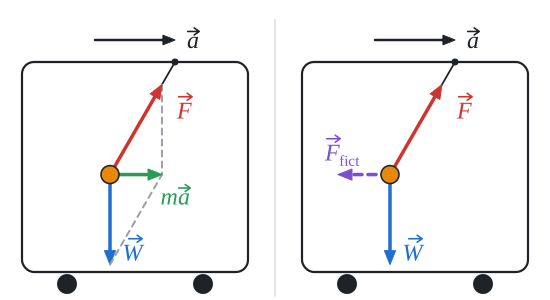
From the platform. The weight
From the carriage. The monkey hangs at rest, so the resultant is zero. Besides the weight and the string, a fictitious force of magnitude m · a now acts on it, backwards. The vertical component of the tension in the string balances the weight, and the horizontal one balances the fictitious force:
We have got exactly the same equations, only each time interpreted differently. The product m · a was the resultant from outside, and the fictitious force from inside. We divide the second equation by the first. The mass and the tension in the string cancel, and the ratio of the sine to the cosine is the tangent:
We substitute:
The angle whose tangent is 0.082 can be found on a calculator with the tan−1 button: α ≈ 4.7°. The monkey swings out by less than five degrees; the figure exaggerates the angle so that it is easy to read. The mass doesn’t matter: a heavy rucksack would swing out on its hook in exactly the same way. It also works the other way round: if you measure the angle, you find the acceleration of the train. A monkey on a string is quite a decent accelerometer.
A lift from inside
In a lift that is starting to move up with an acceleration a, the fictitious force points down, like the weight. To the passenger inside, it seems that the Earth suddenly attracts more strongly, as if the acceleration due to gravity had grown from g to g + a. A bag in your hand seems heavier and the floor has to push harder. When the lift then slows down at the top, the acceleration points down, the fictitious force points up and it takes a bit off the apparent weight (the force with which the passenger presses on the floor).
If the lift broke loose and fell with an acceleration g, the fictitious force m · g upwards would cancel the weight exactly and the passenger would float inside. From outside it is the same event, it just looks different: the passenger is falling together with the lift and the floor does not push on them.
Centrifugal force
A roundabout turns, so every point on it has a centripetal acceleration ω2 · r towards the centre. The fictitious force points the opposite way, that is outwards from the axis, and it is called the centrifugal force:
For a body that turns with the roundabout, it is as large as the centripetal force, only pointing the opposite way, and it exists only in a frame that is rotating. This is exactly what we mean by centrifugal force in everyday speech: what presses a passenger against the door on a bend. Inside the car it is a reasonable description. But from the pavement nobody sees any outward force. All you see is the door pushing the passenger towards the centre of the bend and making them turn with the car.
Thomas has a mass of 30 kg and is sitting on a playground roundabout, 1.5 m from the axis. He is holding the handle, and his dad sets the roundabout spinning at one revolution in 4 s. Thomas’s speed is
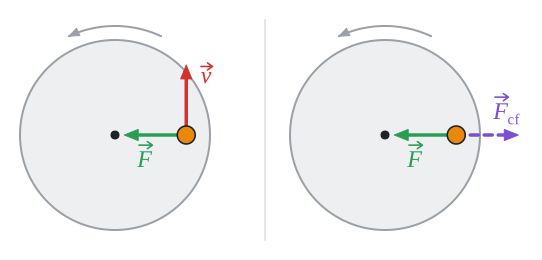
From the bench, Thomas is going round in a circle, and so the handle must pull him towards the centre with a centripetal force. Its magnitude Fc is the magnitude of the green force of the handle (we ignore friction with the seat):
From the roundabout, Thomas is sitting at rest. The centrifugal force pulls him outwards, by the same formula again 111 N, and the handle holds him inwards with an equally large force. The forces are in balance. But the centrifugal force is not the reaction to the force of the handle: both act on Thomas. The reaction is Thomas’s pull on the handle. Both descriptions agree on what Thomas really feels: in his hands he has to hold about 111 N, as if he were lifting an 11 kg bag. We left out the vertical forces, the weight and the normal force, because they cancel.
What if Thomas lets go? As soon as the handle stops pulling, no horizontal force acts and the seat does not hold him, because we are ignoring friction with the seat. By the law of inertia Thomas carries on in a straight line, along the tangent to the circle. This is exactly how a stone behaves when its string snaps. From the roundabout it looks different: Thomas moves away from the axis and at the same time lags behind the rotation. This turning, seen from inside, is brought about by yet another fictitious force, the Coriolis force, which in a rotating frame acts on bodies that are moving within it.
Which description to use when
Both descriptions are correct and arrive at the same results. From outside, from an inertial frame, we draw only the real forces and their resultant is
Trouble arises when the two descriptions get mixed. For example, someone draws a car on a bend from the point of view of the road and adds an outward centrifugal force to the friction. The forces then cancel, the resultant comes out as zero, and by the law of inertia the car would go in a straight line, not in a circle. The centrifugal force doesn’t belong in a diagram drawn from outside. It belongs only to someone sitting inside and turning with everyone else.
With this article, the series of explanatory articles on kinematics and dynamics ends. Next come Worked examples in kinematics and after them examples in dynamics.
